
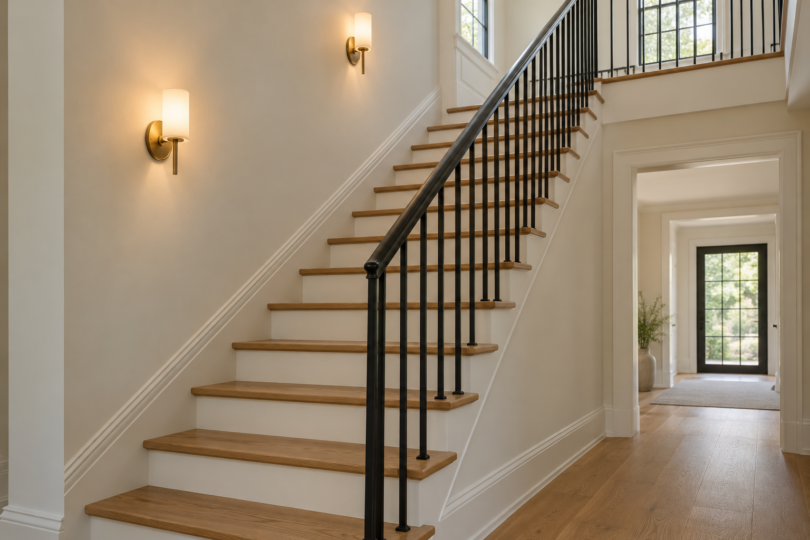

The best wall sconces for a staircase combine useful light with a shape that leaves enough room to pass comfortably. Start with the wall projection, the shade and the wiring plan, then choose the finish. A beautiful fitting can still be a poor choice if its bulb shines into your eyes as you climb.
Our shortlist covers three different needs: a traditional replaceable-bulb sconce, a shallower opal-glass design and an integrated LED cylinder for an exposed location. These recommendations compare manufacturer specifications and installation documents; they do not represent hands-on lighting or installation tests.
Best staircase wall sconces at a glance
| Pick | Best fit | Light source | Main limitation |
|---|---|---|---|
| Westinghouse Sylvestre 6126400 | Brass finish and a replaceable bulb | One E26 bulb, 60W maximum | Projects 6.25 inches from the wall; indoor use |
| Kichler Swiss Passport 6520NI | Opal glass with less projection | One E26 bulb, 75W maximum | Current depth is 4.5 inches; glass-up installation |
| WAC Tube WS-W2605-BK | Modern directional light, including wet locations | 16W integrated LED, 3000K | No screw-in bulb; confirm driver and dimmer compatibility |
Each model is a hardwired single fixture. A pair requires two units unless a seller explicitly identifies a two-pack. Have a qualified electrician check the junction boxes, supply, switching and required stair illumination before ordering.
1. Westinghouse Sylvestre 6126400: best for a classic brass look
The Sylvestre pairs a champagne-brass arm and backplate with frosted glass. It is the most traditional choice here and a sensible starting point for a staircase with enough wall clearance. The shade softens the appearance of the bulb, while the replaceable lamp lets you choose a suitable color temperature and output.
Westinghouse specifies one medium-base E26 bulb, rated at no more than 60 watts, sold separately. The fixture measures 8.25 inches high and 4.75 inches wide, with a 6.25-inch extension. Its 4.75-inch backplate also matters when replacing a larger fitting that may have left a visible outline on the wall.
The manufacturer permits upward or downward installation and identifies this as an indoor, damp-location fixture with ETL/CETL listing. Damp suitability does not make it an outdoor rain-exposed fitting. Choose the permitted orientation after considering sightlines from both ends of the staircase.
- Choose it for: a brass finish, frosted glass and the flexibility to replace the bulb.
- Check before buying: the 6.25-inch projection and the exact bulb dimensions. For dimming, the electrician should verify a compatible dimmable bulb and control; the socket alone does not establish compatibility.
- What to order: model 6126400, one fixture with mounting hardware and instructions, plus a suitable bulb. Other Sylvestre products include chandeliers and multi-light fittings.
View Westinghouse Sylvestre 6126400 specifications and product information.
2. Kichler Swiss Passport 6520NI: best for a shallower opal-glass design
The Swiss Passport places a curved satin-etched opal-glass shade close to its brushed-nickel backplate. Its restrained shape suits a staircase where a projecting arm would look bulky. It is the shallowest of these three choices, but that comparison does not establish clearance or accessibility compliance for your staircase.
Kichler’s current product page lists 6 inches wide, 8 inches high and 4.5 inches deep. Some older sheets and retailer pages show a 4-inch extension. Plan using the current 4.5-inch figure and have your supplier confirm the dimensions of the fixture being supplied before the electrician fixes its position.
Model 6520NI takes one E26 bulb up to 75 watts; budget for the bulb separately. Kichler marks it dimmable and damp-rated, with the glass installed upward. The actual dimming result still depends on the lamp and dimmer combination. Keep this indoor fixture out of direct weather exposure.
- Choose it for: an understated nickel finish and an opal shade without a long arm.
- Check before buying: current dimensions, glass-up orientation, lamp fit and access for bulb changes. Do not assume an older retailer drawing is the correct installation reference.
- What to order: one 6520NI fixture in brushed nickel. Confirm the exact finish and supply timing with the dealer; the manufacturer’s buying-options panel may require cookies to load.
View Kichler Swiss Passport 6520NI and its Where to Buy options.
3. WAC Tube WS-W2605-BK: best for a modern wet-location option
The black Tube uses a single integrated LED behind a cylindrical housing. Consider it for a modern staircase or an exterior stair wall where a wet-location fixture is required. Its directional light has a different purpose from the broader glow of an opal shade, so check that the overall lighting plan still illuminates the steps and landings.
The WS-W2605 is the single-light, 16-watt version, with 3000K light and a 90 CRI rating. WAC’s current specification gives a 120–277V input range and lists ETL/cETL wet-location and IP65 ratings. The drawing shows a 5-inch-high body and approximately 6 inches of total projection. The similarly named WS-W2604 is a larger double-light model.
WAC lists electronic low-voltage, 0–10V and TRIAC dimming on its current specification. Older documentation gives different dimming ranges, so do not buy a dimmer from the model name alone. Have the electrician verify the supplied driver revision, installation sheet and compatible control. The LED module is integrated; there is no E26 socket for a replacement bulb.
- Choose it for: a black cylinder and documented wet-location suitability.
- Check before buying: light direction, wall projection and the exact dimmer requirements. An IP rating does not replace correct mounting and weather sealing.
- What to order: WS-W2605-BK, black, single light, one fixture. The linked listing is not the double-light version or a pair.

WAC Tube WS-W2605-BK Single-Light Wall Fixture
As an Amazon Associate we earn from qualifying purchases.
Check WAC’s current Tube specifications and installation documents before choosing a control or installation location.
How to choose sconces for your staircase
Measure the usable space. Check the fixture’s total projection, not just its width. Consider people carrying laundry or furniture, the handrail and the narrowest part of the flight. Let the electrician or designer confirm the applicable clearance requirements; a fixture’s compact appearance is not proof that it meets them.
Plan illumination from both directions. Look at the stairs from the bottom and the top. A visible bulb or concentrated beam may create glare at one viewpoint. Sconces can work alongside overhead or other fixed lighting, but decorative pools of light should not leave tread edges and landings difficult to see. There is no single mounting height or spacing that works for every staircase.
Match the bulb, fixture and dimmer. For the Westinghouse and Kichler, use the specified base and stay within the actual wattage limit. An LED bulb’s “60W equivalent” describes approximate light output, not its electrical consumption. Check the bulb’s physical fit and any enclosed-fixture restrictions. With the integrated WAC model, follow the exact driver and dimmer documentation instead of buying a screw-in lamp.
Match the location rating. Dry, damp and wet locations are different installation conditions. The two opal/frosted-glass choices here are indoor damp-rated fixtures; the WAC is the wet-location option. Do not infer an IP rating for a product that does not state one.
Budget for installation and maintenance. These fittings need appropriate hardwired electrical boxes and supply connections. Use a qualified electrician who follows the supplied instructions and local code, with power safely isolated before work. Do not bypass grounding, protective devices or required sealing. Battery stick-on lights and solar deck lights may add convenience, but should not be treated as a substitute for required permanent stair lighting.
Frequently asked questions
Which wall sconce is the best starting point for an indoor staircase?
The Westinghouse Sylvestre 6126400 is a good starting point if you want a brass finish, frosted glass and a replaceable bulb, provided its 6.25-inch projection fits the space. Choose the Kichler Swiss Passport 6520NI when its shallower 4.5-inch profile and nickel finish better suit the layout.
How high and how far apart should staircase sconces be?
There is no universal height or spacing. The stair pitch, landings, fixture beam, ceiling height and required clearances all affect the layout. Have the electrician or lighting designer check glare from both directions and adequate illumination of the steps before fixing the positions.
Can I dim these wall sconces?
Kichler identifies the 6520NI as dimmable, subject to a compatible bulb and dimmer. For the Westinghouse, confirm a suitable dimmable lamp and control. WAC lists several dimming methods for the Tube, but the electrician should match the control to the driver and documentation supplied with the fixture.
Can indoor damp-rated sconces be used on outdoor stairs?
Do not assume so. The Westinghouse and Kichler choices here are indoor fixtures. For a rain-exposed stair wall, consider a fixture explicitly rated for wet locations, such as the WAC Tube, and follow its installation and sealing requirements.
Do these sconces include bulbs or come as a pair?
The Westinghouse 6126400 and Kichler 6520NI each use one separately purchased E26 bulb. The WAC WS-W2605-BK has an integrated LED module. The exact configurations discussed here are single fixtures, so order two units if you need a pair and the seller has not explicitly specified a two-pack.


