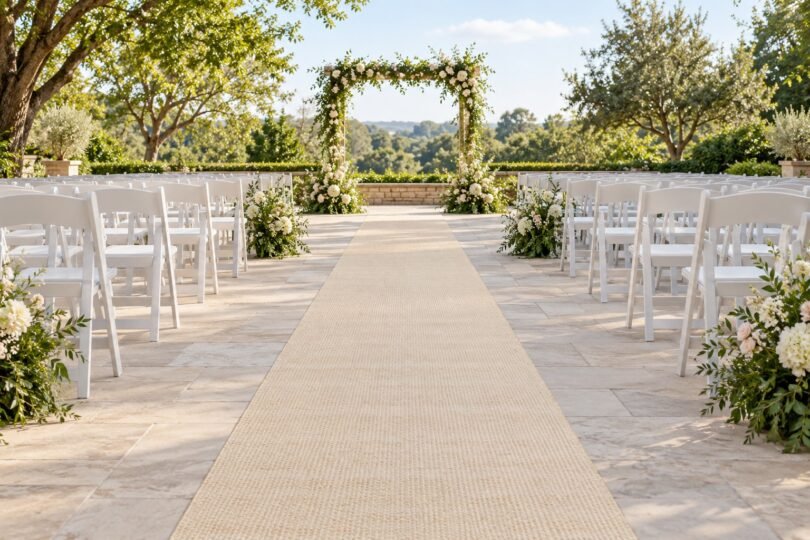

An outdoor wedding aisle runner works best when it adds a finishing touch to a walking surface that is already suitable for the ceremony. Start with the ground, then choose the material, width and installation method. A white fabric runner can dress up a dry patio; it cannot turn wet grass, loose gravel or soft sand into a firm path.
The practical starting point: consider a purpose-made, backed fabric runner for an approved, firm surface; choose burlap for its rustic appearance only after checking its weave and edges; and ask an event-flooring installer about a complete walkway when the ground itself needs attention. Leaving an already suitable aisle uncovered is also a good option.
Choose the aisle surface before choosing the runner
| Ceremony location | What to consider | When to change the plan |
|---|---|---|
| Dry, level concrete or a smooth patio | A runner approved for that surface, with a venue-approved method of securing every exposed edge | The material shifts, curls, catches footwear or cannot be attached without damaging the finish |
| Firm, closely cut grass | Have the venue assess the actual route and the runner supplier confirm the installation | Heels sink, wheels struggle, the ground is soft, or roots and dips remain in the walking line |
| Loose gravel or uneven paving | A different route or professionally specified flooring and transitions | The proposed runner would simply hide loose stones, raised joints or holes |
| Sand or a beach | A venue-approved access mat or installed walkway designed for the site | Fabric alone is being relied on to stop sinking or provide mobility-device access |
| A wooden deck | Check gaps, raised boards, moisture and permitted adhesives before considering a runner | The deck is slippery or damaged, or the attachment method is not approved |
These are planning choices, not guarantees about a particular site. Walk the complete route with the venue, including the entrance, the ceremony position and the exit. A beautiful central aisle is not enough if guests cannot comfortably reach their seats.
For accessibility, the U.S. Access Board’s surface guidance emphasizes firmness, stability and slip resistance. It also explains that loose carpet can interfere with wheelchair movement. Ask the venue to confirm the applicable route requirements; a product’s width or “non-slip” label alone does not establish compliance.
Which outdoor aisle-runner material makes sense?
Backed woven fabric: for a traditional white aisle
A purpose-made woven runner with a backing is worth comparing when you want the familiar white-aisle look. Check the exact backing, the surfaces it is intended for and the supplier’s outdoor instructions. “Fabric” is too broad a description: a thin nonwoven decorative roll and a woven, foam-backed runner are different products.
Even with a backing, confirm how the runner behaves on the intended surface and how its edges will be secured. Do not interpret an outdoor-use claim as permission to use it in rain or on unstable ground.
Burlap or jute: for texture, with edge and weave checks
Burlap offers an understated rustic look, but the natural-fiber appearance does not tell you whether a runner will stay flat. Look at the weave, edge finish, actual finished width and any backing. Inspect a sample for loose fibers and places that could catch footwear or a dress hem.
A narrow table runner is not a substitute for an aisle runner. Neither is a loose strip of craft burlap automatically suitable for people to walk on. Plan the walking surface first and use burlap only where the venue and supplier agree on the setup.
Paper, plastic and lightweight nonwoven rolls: decoration, not flooring
Disposable aisle runners can suit a carefully controlled decorative setup, but they should not be the default answer for grass, sand or gravel. Thin material follows the ground underneath and can wrinkle or move. Read the actual material specification instead of assuming that “cloth,” “outdoor” or “heavy duty” describes a stable walking surface.
If the listing supplies no useful surface or installation guidance, choose another product or leave the aisle uncovered. An attractive photograph is not evidence of how the roll performs in wind or underfoot.
Installed event flooring: when the ground is the problem
A temporary walkway or subfloor is a separate project from laying a decorative runner. Ask an event-flooring provider to assess the ground, drainage, slope, joins, edges and transitions. The finished surface may be left visible or decorated using an approved covering.
Do not assume that placing loose plywood, carpet scraps or interlocking tiles on uneven ground creates a suitable aisle. The installer needs to specify the entire system for that site and explain its weather limits.
Three specific options to discuss with your venue
These options serve different purposes. Match the product and installation to the location before placing an order or requesting a rental quote.
1. The Original Runner Company Marshmallow White: 42-inch fabric runner
The standard Marshmallow White runner is listed at 42 inches wide with a foam backing. The company’s FAQ identifies its fabric as a cotton/polyester blend and provides separate outdoor installation suggestions for different surfaces.
This is a candidate for a traditional white aisle where the venue approves the surface and installation. The manufacturer’s “non-slip” description should not be read as a guarantee against slipping in every condition. Its FAQ also advises obtaining venue permission and testing installation tape discreetly, and does not guarantee the safety of an installation carried out elsewhere.
Check before ordering: the required length, the exact installation instructions and the current production schedule. Do not confuse the standard 42-inch version with the separate wide model, whose stated width is 58 inches.
2. EBP natural burlap aisle runner: approximately 40 inches by 50 feet
EBP’s Aisle Runners listing includes a natural 40-inch-by-50-foot variant. The described 40-inch range uses 10-ounce natural burlap with selvage or cut edges, rather than serged edges. The seller says published dimensions are approximate.
Consider this as a rustic decorative option after approving the underlying path. It is not presented here as waterproof, foam-backed or a solution for soft ground. EBP also lists 36-inch variants with serged edges, so do not assume that the edge finish is identical across its range.
Check before ordering: finished measurements, edge condition, sample appearance, current availability and the supplier’s recommended outdoor installation for your venue. Allow for the fact that a nominal width may differ from the delivered width.
3. Peachy Party ATL Outdoor Ground Runner: an installed flooring service
For an Atlanta-area event, Peachy Party ATL’s Outdoor Ground Runner is an example of the professional-flooring route. The rental company distinguishes it from a direct vinyl overlay and its indoor subfloor option. It describes the outdoor version as a heavier-duty flooring system for outdoor surfaces, with a decorative wrap.
The service includes standard professional installation and takedown; additional accommodations can involve extra labor. Exact dimensions and the site’s suitability need confirmation with the company.
Check before booking: whether your ground and weather conditions are suitable, the required transitions, access needs, delivery area, total installed quote and cancellation terms. Couples outside its service area can ask a local event-flooring provider for a comparable site assessment rather than substituting a decorative roll.
Measure width and length with the chairs in place
Width: measure the clear space between chairs and decorations at the narrowest point. Then rehearse the intended entrance: one person, a couple or a person with two escorts. Include the dress, train and any mobility aid in the planning. A runner’s width and the total usable aisle width are not the same measurement.
Length: measure from the intended starting point to the intended stopping point along the actual route. Decide whether the runner ends before the ceremony position or continues underneath it. If anyone will turn on the runner, that area needs the same attention as the straight walk.
Do not choose length from guest count alone. Chair spacing, row count and the entrance layout can change the distance substantially. For example, a measured 47-foot route does not automatically need a 100-foot roll. Ask whether an appropriate shorter size or an approved trim is possible, and how a cut edge should be finished.
With a monogrammed runner, agree on artwork placement before production. The Original Runner Company’s measuring guide is a useful example of how beginning and ending points affect the order. Cutting a personalized runner without checking the design position can remove the detail you wanted to display.
Get venue permission before planning the anchors
There is no universal outdoor anchoring method. Stakes, staples, tape and weights each have limitations, and some venues prohibit them. Ask the venue and supplier to agree on the complete installation instead of improvising on the morning of the ceremony.
- For ground fixings: ask whether they are permitted and who checks the location for irrigation, utilities, roots and other restrictions. Do not introduce exposed fixings into the walking route.
- For tape: confirm compatibility with both the runner and the surface, including the finish and expected conditions. A discreet test and a removal plan matter.
- For staples: obtain explicit permission from the venue. Do not assume a wooden deck may be stapled.
- For weights: keep the clear path and exits unobstructed. Pots and stones are not a universal substitute for a specified installation.
Ask about runners themselves, not just their fasteners. For example, the Great Smoky Mountains National Park wedding rules prohibit carpet runners among several decorations. That is a site-specific rule, but it illustrates why a shopping list should come after venue approval.
Plan for dew, rain and wind
Inspect the route at roughly the time of day the ceremony will take place. Morning moisture, shade and recent irrigation can make a surface different from the dry lawn seen during an afternoon visit. Check again after rain rather than assuming that the same setup remains suitable.
Agree in advance who can remove the runner, change the route or move the ceremony. If the material lifts, slides, bunches, becomes saturated or conceals a worsening surface, pause use and have the setup reassessed. Do not solve an unsafe aisle by adding another loose layer on top.
Wind can affect even a dry installation. Follow the venue’s and supplier’s weather limits, and make the backup layout workable without a runner. For thunderstorms, follow the event’s shelter plan: the National Weather Service warns that tents and picnic shelters do not provide lightning protection.
A simple ceremony-day checklist
- Confirm that the ground and forecast still match the approved plan.
- Install with enough time for the venue or responsible installer to inspect the full route before use.
- Check edges, joins, wrinkles, fasteners and transitions, including where people enter and turn.
- Keep chairs, floral arrangements, cords and loose decorations out of the usable path.
- Confirm the route works for the wedding party and guests who use mobility aids; do not rely on appearance alone.
- Assign someone to recheck the aisle after guest seating or any weather change, with a clear decision to remove it or move the ceremony if necessary.
Outdoor wedding aisle runner questions
Can you put an aisle runner directly on grass?
Some manufacturers permit particular runners on grass, with specific installation instructions. That does not mean every lawn is suitable. Have the venue assess firmness, level changes, moisture and access first. If the underlying ground is unsuitable, use a different route or discuss installed flooring.
Is burlap better than polyester outdoors?
Not automatically. Fiber type alone does not establish stability or traction. Compare the actual weave, backing, edge finish and installation requirements, then decide which appearance you prefer among the options suitable for the venue.
Will a runner stop heels sinking into wet ground?
Do not rely on a decorative runner for that purpose. Soft ground remains soft beneath paper, burlap or fabric. Ask the venue about relocating the aisle or arranging an appropriate professional walkway.
Can you skip the aisle runner?
Yes. If the existing path is suitable and the venue permits it, flowers or chair decorations beside the aisle can define the entrance without covering the walking surface. Keep those decorations out of the clear route and avoid scattering loose material underfoot.
Bottom line: choose an outdoor wedding aisle runner for the surface you actually have. Prioritize a suitable route and an approved installation; then choose the color, texture and personalization that fit the ceremony.