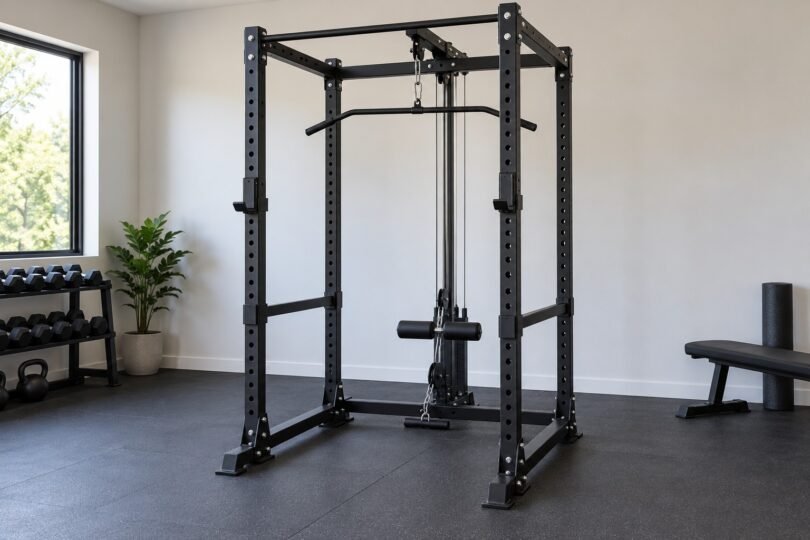

A weight lifting cage with lat pulldown should be bought as a matched system: the rack, the correct cable attachment and the weight-loading arrangement. A photo of a complete gym can still lead to a cage-only listing, an attachment-only listing or a package without plates.
Start with the three configurations below. The two REP options use the same PR-1100 frame with different cable systems; the Titan option uses the shorter 71-inch T-2. None of the base rack listings should be treated as including its lat attachment. Check both line items before comparing the total cost.
Three matched configurations to consider
| Rack and exact attachment | Weight system | Published limits | Main buying consideration |
|---|---|---|---|
| REP PR-1100 + Plate-Loaded Lat Pulldown and Low Row, PRA-1700 | 2-inch Olympic plates, purchased separately | Rack: 700 lb rackable; attachment weight horns: 450 lb | A plate-loaded option for owners of compatible plates |
| REP PR-1100 + Selectorized Lat Pulldown and Low Row, PRA-1700-S | Included 200 lb selectorized stack; optional 250 lb upgrade | Rack: 700 lb rackable; attachment: 540 lb listed capacity, distinct from the supplied stack | Pin-based weight changes, with more depth and a bench/spotter clearance trade-off |
| Titan T-2 71-inch black rack, 401835 + 71-inch Lat Tower, 401378 | Olympic plates on dual sleeves, purchased separately | Rack: 850 lb rackable; lat attachment: 300 lb weight capacity | A lower frame, with a matching-height attachment and manufacturer-recommended anchoring |
These are separate manufacturer ratings for different parts of a system. Do not add them together, apply the barbell rating to the cable station or treat a cable’s strength rating as permission to load the entire machine to that figure.
REP PR-1100: choose the cable system before ordering
The PR-1100 power rack has a 58.1-inch width, 48.5-inch depth and 85-inch height. REP lists a 44-inch-wide by 24-inch-deep working area, 3-inch hole spacing, J-cups, extended safeties and a multi-grip pull-up bar. The black rack variant is PR-1100; other colors have different SKU suffixes.
Its important limitation is stability under the intended use: REP says the PR-1100 cannot be bolted down and does not recommend banded movements or muscle-ups. If your planned use needs an anchored rack, choose a rack designed for that installation rather than modifying this one.
Plate-loaded PRA-1700: for using your own Olympic plates
The PRA-1700 attachment provides high and low cable positions, a 1:1 pulley ratio, a lat bar and a straight bar. It accepts 2-inch Olympic iron or bumper plates and has 8.25 inches of loadable sleeve length on each side. Thick plates may fill the sleeves before you reach the listed load limit.
The attachment stands 86 inches high and adds about 17 inches to rack depth. REP also suggests 10 inches behind it for loading plates. There is no low-row footplate on this plate-loaded 1000 Series version.
Capacity check: REP separately lists a 450 lb weight-horn capacity and a 1,000 lb cable rating. The latter does not turn this into a 1,000 lb pulldown station. The product page does not publish usable cable travel, so confirm that measurement for your planned handle position before buying.
Selectorized PRA-1700-S: for quicker weight changes
The PRA-1700-S attachment uses a pin-selected stack with a 20 lb minimum setting, 10 lb increments and a 1:1 ratio. It includes pulldown and low-row bars plus an adjustable footplate. REP’s technical specifications list 53.4 inches of cable travel; its FAQ rounds that to approximately 54 inches.
It adds 23.6 inches of depth and 1 inch of height. REP specifically flags insufficient room to bench with a spotter inside the rack because of the footplate. Resolve your bench and spotting arrangement before purchase. This is a separate design, and REP says there is no conversion kit from the plate-loaded 1000 Series attachment.
The 540 lb specification is an attachment capacity, not the weight of the included stack. Do not assume it authorizes improvised extra loading.
Titan T-2 71-inch: a shorter matched frame and tower
For this comparison, select the black 71-inch T-2 rack, SKU 401835, and the 71-inch Lat Tower, SKU 401378. Titan also sells an 83-inch version of each; do not mix heights. Its lat-tower listing specifies compatibility with T-2 racks purchased after September 2020, so older used racks need a separate compatibility check.
The rack’s published footprint is 57 by 50 inches, with a 42-by-26-inch interior. Its included equipment includes J-hooks, pin-and-pipe safeties and a pull-up bar. Titan recommends bolting the rack down for added stability.
The tower supplies lat and low-row handles and footplates. Its Olympic sleeves are 48 mm in diameter and 9.25 inches long. The attachment dimensions are 71 inches high, 22 inches wide and 32 inches deep. Those attachment dimensions are not a verified combined rack footprint; get the final installed layout before placing it against a wall.
Capacity check: Titan distinguishes an 850 lb rackable limit from a 2,200 lb whole-rack figure. Neither replaces the lat tower’s 300 lb rating. The optional leg-holder kit is a separate accessory, not an included seat or restraint.
Measure the operating space, not just the frame
| Configuration | Height planning | Depth planning | Cable travel |
|---|---|---|---|
| PR-1100 + PRA-1700 | 86-inch attachment | 48.5-inch rack + about 17 inches; then allow REP’s suggested 10-inch rear loading clearance | Not stated in the checked product specification |
| PR-1100 + PRA-1700-S | About 86 inches, calculated from the rack plus the stated 1-inch addition | About 72.1 inches, calculated from 48.5 + 23.6; allow operating and service space too | 53.4 inches in the technical specification |
| T-2 71-inch + 401378 | Both listed at 71 inches | 57-by-50-inch rack footprint; confirm combined installed dimensions with Titan | Usable travel not stated in the checked specification |
Manufacturer dimensions describe equipment, not a minimum ceiling height for every room. Allow for flooring thickness, overhead obstructions, assembly access and the user’s movement above the pull-up bar. Inverting a rack’s pull-up bar does not shorten a separate rear cable tower. If the room is close to the listed height, obtain the assembly and operating clearances before ordering.
Cable length and cable travel are different measurements. A cable winds around pulleys; its end-to-end length does not tell you how far the handle can move. Do not use Titan’s support-listed cable length as the missing travel figure. Ask for usable movement at both the high and low outlets with the supplied handles.
Check the load limits by station
- Barbell support: confirm the rating of the rack and the exact J-cups and safeties you will use. Do not assume that a compatible-looking third-party attachment carries the frame’s rating.
- Cable loading: use the permitted carriage or stack loading for the specific attachment, along with any lower handle or connector limit. A strong cable alone does not establish a machine’s safe working load.
- Pull-up bar and other accessories: check their own user-weight and movement limits. A rackable barbell number is not a rating for every station.
- Stored plates: storage capacity and operating capacity are different. Follow the approved storage layout; do not improvise ballast or assume stored weights eliminate tipping risk.
Also compare the smallest useful resistance. A stack that starts above the resistance you want can be less convenient than a plate-loaded carriage. With either design, check the empty carriage or starting resistance rather than assuming an unloaded machine begins at zero.
Installation and ownership questions to settle first
Read the exact T-2 rack manual and matching tower manual, or REP’s instructions for your selected frame and attachment, before arranging assembly. Follow the supplied bracing, cable-routing and hardware requirements. An attachment that needs a rack is not a freestanding machine.
Confirm the floor can support the assembled system, plates and users. A protective mat does not establish the load-bearing capacity of the building. If the floor or anchoring arrangement is uncertain, have a qualified installer or structural professional assess it; do not invent a bolt pattern or drill new mounting holes in the equipment.
Allow room to move a bench, load a barbell from both sides, access cable parts and keep an exit clear. Ask which parts can be replaced, including cables, pulleys and plastic liners, and read the warranty and return terms for the exact purchase. Heavy freight returns and optional assembly services deserve attention before checkout.
After assembly, follow the manufacturer’s inspection and maintenance schedule. Keep children away from moving carriages and weight stacks. Take damaged equipment out of use and get the correct replacement part rather than substituting a general-purpose hook, chain or cable from a hardware store.
Which configuration makes sense?
Consider the REP plate-loaded pairing if you already own suitable plates and want its simpler loading arrangement. Consider the separate selectorized version when pin changes and a published travel specification matter more, provided the extra depth and spotter restriction suit your room. Consider the 71-inch Titan pairing when lower equipment height matters and its anchoring and usable-range requirements work for you.
Before paying, your order should identify the exact frame and lat attachment, the included handles, and any plates, bench or leg support you still need. If the seller cannot confirm that combination or a room-critical dimension, resolve it before purchase.