
A Wolfgang Puck knife set is easiest to choose by its actual contents, handle design, and storage needs. The brand has sold more than one six-piece collection, and six pieces does not mean six knives. A block and kitchen shears can count toward the total, while similarly named sets can contain different blade lengths.
Start with the tasks you do most often: chopping vegetables, preparing small fruit, slicing bread, or carving cooked meat. Then check that the exact box supplies those tools. The two manufacturer-listed collections below offer different combinations, so neither should be selected on piece count alone.
Wolfgang Puck knife sets: the key differences
6-Piece Knife Set with Knife Block
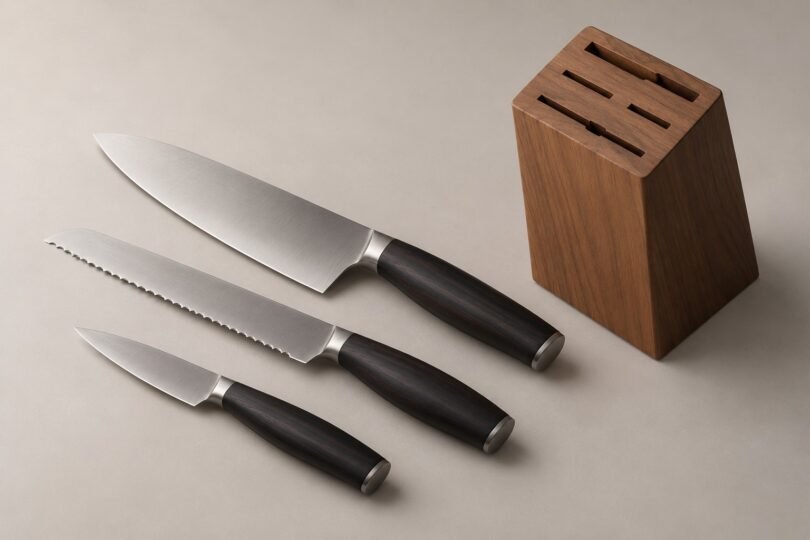
The stainless-handled six-piece collection lists five knives: an 8-inch chef’s knife, 8-inch bread knife, 8-inch slicing knife, 4-inch utility knife, and 3-inch paring knife. Its sixth piece is a wooden block with an acrylic front shield. The manufacturer describes forged carbon-stainless-steel construction and full-tang support.
This is the more relevant starting point if your shopping list includes separate bread and carving knives. It also suits someone who prefers the appearance of all-metal handles. Whether that handle shape feels comfortable is a personal fit question; product photographs cannot establish grip comfort, weight distribution, or how securely a handle sits in your own hand.
The blade selection matters more than the display block. If you rarely slice whole loaves or roasts, consider whether those two longer knives will earn their counter space. Conversely, someone who regularly cooks those foods may find their presence more useful than several near-duplicate small blades.
6-Piece Riveted Knife Set
The riveted six-piece collection contains four knives, kitchen shears, and a block. The listed knives are a 7-inch chef’s santoku, 5-inch santoku, 6-inch scalloped utility knife, and 3.5-inch paring knife. The maker specifies black triple-riveted handles, full-tang high-carbon stainless-steel blades, and a bamboo-and-stainless-steel block.
Availability note: On October 7, 2026, the maker’s page marked this set sold out. It is included here as a feature reference; check availability before treating it as a purchase option.
Consider this arrangement if shears and two sizes of santoku fit your usual preparation better than separate carving and bread knives. Its scalloped utility knife should not automatically be counted as an equivalent replacement for the other set’s longer bread knife. Blade length and profile are different, even when both can be used for some overlapping foods.
Before choosing, picture one ordinary dinner. Which knife would handle the onion, which would trim a small piece of produce, and would you use the shears? That exercise is a better way to compare the sets than assuming the one with more knives must be better.
Check the model and the box, not just the name
There is a specification mismatch worth checking. The brand’s product-instructions page links an angled-set manual identified as SWP6FCSETA. That document lists a 3.5-inch paring knife and 5-inch utility knife, whereas the stainless-handled product page lists 3-inch and 4-inch versions. Do not combine those measurements into a supposedly universal specification.
Ask the seller for the model identifier and contents printed on the actual packaging if blade length is important to you. A product page may describe a different production version, and a marketplace listing may group multiple options under one heading. The useful purchasing record is the selected variant and its included tools.
Keep a copy of the listing and order details. On arrival, compare the box contents with that record before discarding the packaging. Missing shears, the wrong handle style, or different blade lengths are easier to resolve when you can show precisely what was ordered.
What the steel and edge descriptions tell you
Descriptions such as high-carbon stainless steel identify a broad material category. They do not, by themselves, provide a steel grade, measured hardness, sharpening angle, or a prediction of how long an edge will last. The reviewed product descriptions do not establish all of those specifications. Avoid filling in the gaps with assumptions about German steel, Japanese steel, or a particular Rockwell hardness.
Likewise, forged construction, full tang, and a honed edge are construction or finishing descriptions, not proof that a knife will outperform every alternative. Treat promises about effortless cutting or lifelong durability as marketing unless supported by a specific warranty or relevant testing. A knife can be suitable for everyday cooking without needing an exaggerated performance claim.
For a practical purchase decision, prioritize whether the blade sizes suit your food, whether the handle suits your grip, and whether you can maintain the edges. If you have strong requirements for a specific alloy or sharpening system, request those details before buying rather than choosing from appearance alone.
Choose the tools you will actually use
- Frequent vegetable preparation: compare the main chef’s knife or santoku first. Make sure the length feels manageable on your cutting board.
- Small trimming jobs: give the paring knife real consideration. A large main knife does not make a smaller tool unnecessary for every cook.
- Whole loaves and larger cooked cuts: decide whether dedicated longer blades belong in your routine.
- Limited counter space: measure the intended storage area and allow room to withdraw the longest knife.
- Existing knives you already like: list the gaps in your collection. A full matching set may duplicate tools you do not need to replace.
Do not feel obliged to replace a useful collection simply to make every handle match. A set makes the most sense when several included tools and the storage solution solve genuine needs at the same time. Compare the total purchase against buying only the missing tools, including any safe storage those tools require.
Care, storage, and sharpening
The SWP6FCSETA use-and-care manual calls for hand washing, prompt drying, and storage only when blades are clean and dry. It rules out dishwasher cleaning and prolonged soaking, and recommends wood or polypropylene cutting boards rather than glass, stone, ceramic, or metal. Follow the instructions supplied with your exact set.
That manual also excludes cutting frozen food and using knives as improvised tools. A damaged blade or loose handle needs attention rather than continued use. Keep storage inaccessible to children; an attractive counter display is not childproof storage.
Build cleanup into the decision. If your household routinely leaves utensils submerged or puts every item in the dishwasher, first decide whether a hand-washed set is realistic. Buying more pieces also creates more items to clean, dry, store, and eventually maintain.
For sharpening, identify the edge type and obtain instructions for the particular knife. Do not assume a sharpener intended for a plain edge is suitable for a scalloped or serrated blade. If the angle or method is unclear, a qualified sharpening service can help assess it. Avoid promises that any knife set will remain sharp without maintenance.
Before you place an order
- Confirm the identity. Match the full collection name, model if supplied, handle style, and block design.
- Count useful tools. Separate knives, shears, storage, guards, and other accessories instead of comparing only the advertised total.
- Resolve conflicting details. Ask about the exact blade lengths if a manual and listing disagree.
- Check practical fit. Consider board size, storage clearance, washing habits, and whether your existing knives already cover the same jobs.
- Read the seller’s terms. Confirm who handles returns, what condition is required, and how to obtain model-specific warranty support.
Be especially careful with open-box or secondhand offers. Ask whether every listed component is included and whether there is visible damage. A low asking price is difficult to evaluate if the block, a frequently used knife, or the original documentation is missing.
Common questions
Does a six-piece set contain six knives?
No. The collections described above count storage and, in one case, shears toward the total. Read the itemized contents for the selected version.
Are all Wolfgang Puck knife sets the same?
No. Similar product names can conceal different blade selections, handle styles, and measurements. Use the specific model and included-pieces list when comparing offers.
Which set is the better starting point?
Choose according to the tools you need and the handles you prefer. For most buyers, identifying the main knife they will use every day is more valuable than chasing the largest advertised set. Complete that check, verify the actual contents, and buy only when the care requirements fit your kitchen.