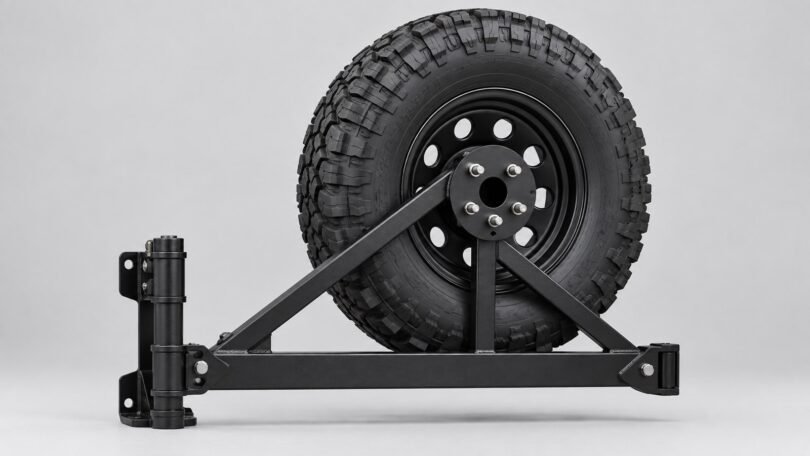

A YJ rear tire carrier needs to match two things: your 1987–1995 Jeep Wrangler and the hardware that supports the spare. Before buying, identify whether you need a replacement tailgate mount, a small relocation bracket or a bumper-mounted swing-away system. They solve different problems, and a carrier arm sold separately may be unusable with the bumper already on your Jeep.
The two Smittybilt options below are carrier assemblies for specific matching bumpers. Both have documented YJ compatibility, but neither is a complete bumper-and-carrier package. This guide is based on manufacturer product pages, installation manuals and exact retail listings; it does not claim hands-on trail testing.
Choose the support system before the carrier
If you are retaining a stock-size spare, first inspect the existing mount, tailgate and hinges. A replacement mounting plate may be all the repair needs, but cracked metal, loose hinges or damaged mounting points need attention before another spare is fitted.
A relocation bracket moves the wheel’s mounting position to gain clearance. It does not by itself establish a higher safe load for the original tailgate or hinges. If you are adding a much heavier wheel and tire, compare a properly specified swing-away system that supports the spare through its matching bumper and mounting structure.
For either approach, record the spare’s actual assembled weight, tire diameter and width, wheel bolt pattern, center opening and backspacing. A maximum tire-diameter claim cannot answer all of those compatibility questions.
Smittybilt 76651-02 SRC Classic carrier
The SRC Classic 76651-02 is worth comparing if you already have, or plan to install, the compatible Smittybilt bumper. The manufacturer names 76651D-01 or 76621-01 as the matching bumper parts. Do not assume another Smittybilt bumper, an original Jeep bumper or a generic receiver hitch provides the required mounting points.
The current manufacturer page specifies a textured-black finish and a maximum tire size of 37 by 12.50 inches. That is a published dimensional limit, not a verified weight allowance for every wheel-and-tire combination. Ask Smittybilt to confirm your assembled spare if its weight or fit is uncertain.
The 76651-02 instructions show the carrier mounting on the bumper’s pivot post, with a separate tire mount and top post. They call for positioning the tire flush against the carrier and post, and for fitting the supplied rubber spacer to reduce movement against the rear of the vehicle. Those contact points are part of the installation, not optional cosmetic details.
Best fit: an owner building around the compatible SRC bumper system who wants the corresponding swing-away arm. The linked item is one carrier assembly, not the bumper, wheel or tire. Amazon’s “Box 2 of 2” wording should not be read as a promise that both boxes are included.

Smittybilt 76651-02 SRC Classic Rear Tire Carrier, Textured Black, Carrier Only, One Assembly
As an Amazon Associate we earn from qualifying purchases.
Smittybilt 76654 XRC rear swing arm
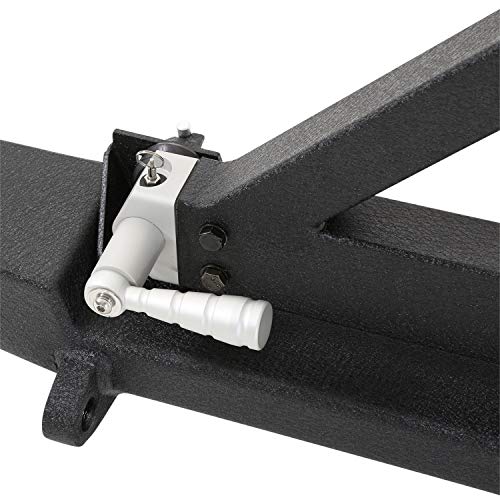
The XRC 76654 requires the separate Smittybilt 76653 rear bumper. Its distinguishing features include an adjustable tire mount, a billet-aluminum handle with a cam-lock mechanism and a safety catch that holds the arm open.
Check the tire limit before buying: the current manufacturer page says the adjustable mount accepts up to a 40-inch tire, while the selected Amazon listing says 37 inches. Because those published limits disagree, obtain confirmation from Smittybilt for the exact supplied carrier and your complete spare before choosing it for a larger tire. This guide does not resolve that discrepancy by assuming the higher limit applies.
The 76654 installation manual includes a YJ-specific support plate, separate TJ hardware arrangements, latch adjustment and a third-brake-light bracket. Check for the YJ parts when unpacking. A used or incomplete carrier missing those pieces can become a much larger project than the price suggests.
Best fit: a YJ owner using the 76653 XRC bumper who wants this adjustable, hold-open carrier arrangement. Budget for the bumper separately if it is not already installed.
Check these details on your Jeep
- Exact bumper part number: Match the pivot, latch and reinforcement arrangement to the carrier instructions. A similar-looking bumper is insufficient evidence.
- Condition of the mounting structure: Inspect for rust damage, cracking, loose hardware and earlier modifications. Have questionable frame or body mounting points assessed before adding weight.
- Wheel fit: Confirm stud pattern, center clearance, lug-nut seat and thread engagement for the actual spare. Axle and wheel conversions can change what is on a YJ.
- Tire depth: Backspacing and tire width determine how far the spare sits from its support. Set the mount according to the carrier instructions instead of adding unapproved spacers.
- Opening clearance: Check access to the tailgate and rear opening, plus clearance to the bumper, body and any hitch-mounted accessories.
- Visibility: Confirm that required rear lighting and the license plate remain visible after the spare is installed.
Do not count a bumper’s receiver rating as the Jeep’s towing rating or as a tire-carrier load rating. Those are different limits. Also include the carrier and bumper themselves when thinking about the weight being added to the vehicle.
What installation may involve
Read both the bumper and carrier manuals before starting. The XRC instructions distinguish the YJ support plate from the TJ plate and describe adjustment of the swing height, latch and open-position catch. They also warn that overtightening the pivot pinch bolts prevents free movement. Use the exact fastening guidance rather than applying one generic torque value to every bolt.
The same XRC manual describes trimming and drilling the original third-brake-light housing to fit its relocation bracket. That means “bolt-on carrier” should not be interpreted as “no modification anywhere in the installation.” Confirm how the instructions apply to your Jeep’s existing light arrangement before purchasing.
After installation, check that the loaded carrier moves freely, closes without lifting or forcing it and positively latches. Confirm that the hold-open feature works where provided. If you find movement, sag or a recurring rattle, inspect the specified contact points, adjustments and fasteners rather than simply tightening every component harder.
Common questions
Why do the listings say 1987–2006 if a YJ ends in 1995?
That range covers several Wrangler generations. For this article, YJ means 1987–1995; the later years in the manufacturer listing refer to TJ/LJ fitment. Installation hardware can still differ by generation.
Will a JK or JL carrier fit my YJ?
Do not assume so. A listing must explicitly support the YJ and the intended mounting arrangement. Later-generation hinge carriers and relocation brackets are not interchangeable merely because they are sold for a Wrangler.
Can I add fuel cans or a trail jack?
Only with accessories and total loads approved for the specific carrier. The published tire-size limit does not establish capacity for additional cargo.
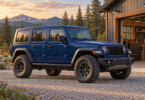
Image note: AI-generated editorial illustration; not a photograph of the named product.