
When shopping for 1080 steel for sale, start with the material specification, then choose the stock shape, condition and dimensions. A recognizable supplier name is useful, but it does not replace a written grade designation or a clear description of the bar you will receive.
For small flat bars, Jantz publishes a dedicated 1080 listing with selectable dimensions. For industrial shapes or a specification-driven order, King Steel and Ohio Bar & Metal provide quotation routes. The right choice depends on whether you need a convenient stock size or documented material made to an agreed requirement.
What grade are you actually buying?
1080 is a high-carbon steel grade, not a brand. King Steel’s 1080 data gives carbon at 0.75–0.88%, manganese at 0.60–0.90%, phosphorus at 0.04% maximum and sulfur at 0.05% maximum. These are composition limits, not the measured chemistry of an individual bar.
The nearby numbers 1084 and 1095 identify different grades. PSG Steel Group’s composition reference lists the following carbon and manganese ranges by percentage:
- 1080: carbon 0.75–0.88%; manganese 0.60–0.90%.
- 1084: carbon 0.80–0.93%; manganese 0.60–0.90%.
- 1095: carbon 0.90–1.03%; manganese 0.30–0.50%.
Overlapping chemistry does not make grades automatically interchangeable. If a drawing or customer requires 1080, obtain approval before substituting another grade. A listing that says only “high carbon,” “spring steel” or “tool steel” leaves important questions unanswered. Likewise, a trade name or a designation with an added suffix needs its own specification.
Supplier descriptions may give typical chemistry rather than the full grade limits. Jantz’s 1080 page, for example, states carbon at 0.75–0.80% and manganese at 0.60–0.90%. Read those numbers in the context of that supplier’s material; they are not a universal redefinition of 1080.
Where to look for 1080 stock
Jantz: specified small flat-bar variants
Jantz’s 1080 Hi-Carbon Steel listing describes hot-rolled, annealed material. Its product variants and catalog stock chart identify these nominal examples, in thickness × width × length:
- XB0810: 1/8 × 1 × 18 inches.
- XB0815: 1/8 × 1-1/2 × 18 inches.
- XG0810: 1/8 × 1 × 36 inches.
- XG1212: 3/16 × 1-1/4 × 36 inches.
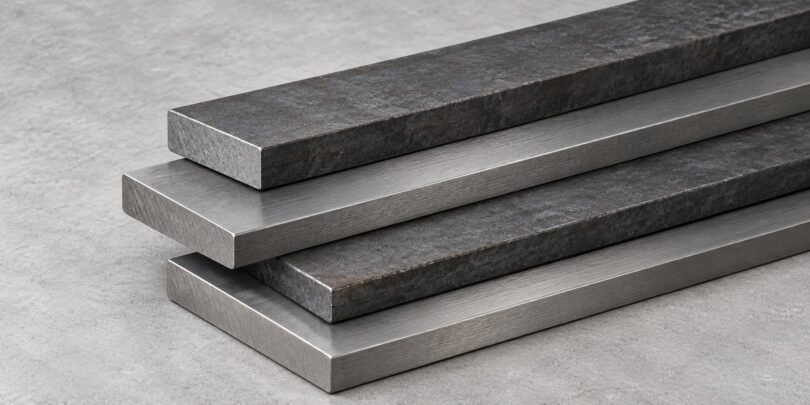
The selector orders individual variants in whole-number quantities. Confirm the piece count on the order; do not interpret a photograph showing several bars as a multipack. Numeric thickness, width and flatness tolerances are not stated in the reviewed product description. Request them if your finished size is critical.
King Steel: shapes and specification-based inquiries
King Steel lists 1080 in round, square, round-corner-square, hex and flat forms, and identifies ASTM A29 and ASTM A576 among requirements it can meet. The page also lists processing services. Treat this as a quotation starting point: it does not establish a particular small-bar size, minimum quantity, tolerance or immediate availability.
Ohio Bar & Metal: round-bar quotations
Ohio Bar & Metal’s 1080 page covers round bar, with other long-product forms by inquiry. It asks buyers to define size, supply condition, quantity, testing and delivery. Hot-rolled, cold-finished, annealed or heat-treated conditions are discussed as requirements to specify, rather than a promise that every combination is on the shelf.
Annealed, hot-rolled and precision-ground mean different things
Annealed describes the material’s thermal condition. Hot-rolled describes processing. Precision-ground describes a finishing operation. A bar can be both hot-rolled and annealed, as the Jantz listing illustrates. Neither term alone supplies a finished-part hardness guarantee.
New Jersey Steel Baron’s finish guide distinguishes scaly hot-rolled stock, wide-belt-ground stock with scale removed, and precision-ground material with tighter thickness and flatness control. Those categories help explain preparation work, but they do not establish a universal numerical tolerance.
If you need ground 1080, request that exact combination. Do not select a different grade simply because its listing says precision-ground. Ask which faces are ground, what thickness remains after finishing, and what flatness and parallelism the supplier will guarantee. A smooth-looking photograph answers none of those questions.
Specify usable dimensions, not just nominal size
Write dimensions in a fixed order and include units. For flat stock, use thickness × width × length; for round stock, use diameter × length. Include the number of pieces separately. Avoid requests such as “two lengths of 1080” without defining how long each piece must be.
Nominal stock dimensions are purchasing labels, not a promise that every surface is ready for final assembly. Leave an appropriate machining allowance for your drawing and process. Ask about minimum delivered thickness, edge condition, cut-end allowance, straightness and surface defects before choosing the thinnest usable option.
For context, New Jersey Steel Baron’s FAQ says its bar stock is cut oversize and directs buyers to product-specific finished thickness and oversize information. That policy belongs to that supplier; it should not be transferred to a Jantz or King Steel order.
Ask for documentation before paying
If traceability matters, request the certificate with the quotation. Ask whether it is a mill test report with heat-specific results or a certificate of conformity stating compliance. Also confirm whether the document covers the actual material being shipped and whether certification costs extra.
A useful documentation request identifies the ordered grade, controlling specification, heat or lot number, chemistry and any required condition or mechanical test results. Ask how the supplier will maintain identification when a longer bar is cut into smaller pieces. Keep the invoice, labels and report together after delivery.
New Jersey Steel Baron’s FAQ says it provides mill certificates and third-party testing for standard grades and thicknesses. That is a reason to ask about the documentation for a specific order, not proof that every supplier includes the same paperwork. A downloadable generic data sheet is not a certificate for your shipment.
Compare the delivered order, then inspect it
Compare quotes using the same grade, condition, dimensions, tolerances and documentation. Check whether a price is per bar, per foot, per pound or per bundle. Add cutting, grinding, certificates, tax and shipping before deciding which offer costs less. Ask about minimum orders and returns on custom-cut material.
On arrival, count and measure the pieces before cutting or machining them. Check the labels against the invoice and certificate, and record visible damage or substantial bow. Photograph discrepancies while the packaging is available. Do not mix unidentified offcuts with traceable stock.
Store bars dry, supported and labeled. Handle cut edges carefully, and follow the supplier’s safety information and your equipment’s instructions for any subsequent workshop operation. If the finished part has safety-critical duties, have the responsible engineer specify the material and required verification.
A practical order checklist
- Exact grade and applicable specification, with substitutions agreed in advance.
- Stock shape, delivery condition and surface finish.
- Dimensions, units, permissible variation and required piece count.
- Heat or lot traceability and the documents to accompany the shipment.
- Total delivered cost, processing lead time and return restrictions.
The strongest 1080 purchase is the one whose order confirmation clearly describes the material you need. Choose a listed small-bar variant when it fits, or obtain a written quote when the project requires different sizes, tighter tolerances or stronger documentation.