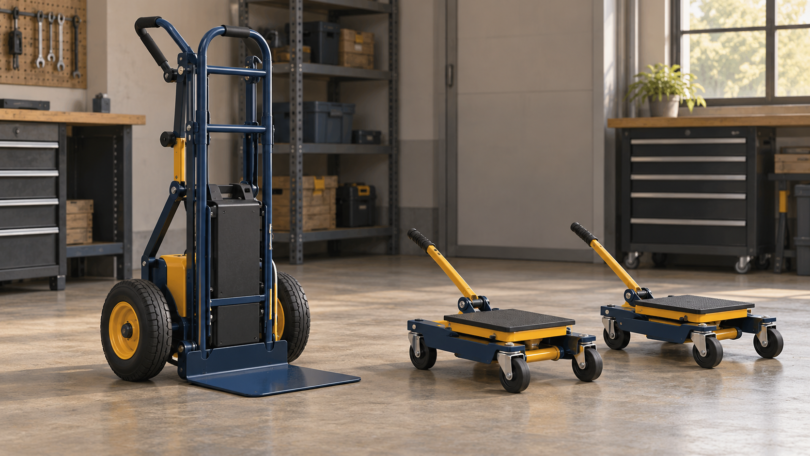

The PowerMate M-1 and Rol-A-Lift M-4 are two purpose-appropriate options to discuss with a qualified safe mover or equipment supplier. The M-1 is the powered stair-climbing option; the M-4 is a pair of hydraulic machinery movers to consider for an approved floor route. Both manufacturers list safes among their applications.
The best dolly to move a gun safe depends on the entire move. A capacity label alone does not establish that equipment will support your safe correctly, fit through the route or work on its floors and stairs. Get the actual safe weight, dimensions and route assessed before buying or renting. For a one-time household move, request a professional moving quote first.
Two safe-moving equipment options at a glance
| Equipment | Best reason to shortlist it | Published capacity and qualification | Main buying consideration |
|---|---|---|---|
| PowerMate M-1 | Powered stair-climbing equipment for a trained professional team | 1,500-lb machine capacity; the summary chart lists 1,500 lb on flat surfaces and 1,000 lb on stairs with two qualified operators and evenly distributed loads. Detailed load-position limits still apply. | Ask PowerMate to assess the load, route, training and required configuration. |
| Rol-A-Lift M-4 | A matched hydraulic pair for a professionally approved floor route | 4,000 lb per pair. This is not a rating for each unit or a stair-climbing approval. | Specify the complete pair, casters and load restraints; confirm floor and safe-base compatibility. |
The figures above come from PowerMate’s M-1 loading specifications and the Rol-A-Lift M-4 product specification. They are manufacturer ratings, not results from hands-on testing or approval for a particular safe.
1. PowerMate M-1: best to discuss when the route includes stairs
The M-1 combines a powered stair climber with a retractable dolly arrangement. Its steel frame, automatic braking system and two adjustable strapbars make it a relevant commercial equipment candidate. PowerMate specifically includes safes in the model’s intended applications. The machine itself weighs 165 lb, which matters when planning transport and assessing the route.
Why shortlist it: a moving business or trained team needs equipment that can serve a stair route as well as flat-floor work. PowerMate also provides operator training and service support, useful considerations for repeat professional use.
The key limitation: “1,500 lb” is not a universal stair capacity. The manufacturer’s operating manual and detailed load chart change the allowable load with the center of gravity, operation and number of qualified operators. Even the 1,000-lb two-operator stair figure in the summary is conditional. Have PowerMate or a competent equipment specialist confirm the applicable limit for the actual safe and supplied machine.
Before ordering: request the current manual, exact machine dimensions and a written list of included equipment and required accessories. PowerMate’s online pages show differing overall widths, so confirm the dimensions of the unit being quoted rather than relying on a single brochure measurement.
View the PowerMate M-1 and discuss a suitable configuration.
2. Rol-A-Lift M-4: best to discuss for an approved floor route
The M-4 is sold as a pair and uses hydraulic lifts with adjustable forks. Rol-A-Lift identifies safes as a suitable type of load. The standard pair weighs 325 lb, has phenolic wheels and carries a published 4,000-lb pair rating. It is substantial commercial equipment to evaluate with a mover or rental specialist.
Why shortlist it: you need to compare a paired machinery-moving system for a floor route, with capacity specified for the complete pair. It offers a different format from an upright powered hand truck.
The key limitation: the pair rating does not establish how your safe’s weight will be shared or whether its base can accept the equipment’s contact points. The manufacturer’s operating instructions warn against overloading and side-loading. Ask the supplier to approve load distribution, restraint selection and floor suitability. This shortlist does not recommend the M-4 for stairs.
Before ordering: the manufacturer photo shows optional dual polyurethane casters, while the standard specification lists phenolic wheels. Confirm your selected casters and restraints in writing. The product page also excludes residential shipping and lists a 20% restocking fee for approved returns; clarify delivery and return terms before paying.
View the Rol-A-Lift M-4 pair and its configuration choices. For occasional work, LGH lists the M-4 among its Rol-A-Lift rental models; ask about local availability, the supplied configuration and whether it suits your assessed route.
What to establish before choosing either model
The actual safe and its load distribution
Give the mover or supplier the safe manufacturer, exact model, current configuration, verified moving weight and external dimensions, including projecting handles and hinges. An advertised weight for a different size or version is not enough. Have them assess the base, center of gravity, suitable contact points and restraint requirements. Do not assume that two independently rated dollies can simply have their capacities added together.
The complete route and supporting structure
Provide route photos and measurements covering doorways, turns, thresholds, slopes, stairs, landings and the destination. T&T Liberty Safe’s moving guidance makes stair acceptance dependent on the safe’s size and weight, staircase and landing dimensions, and stair stability. Buying a stair climber does not resolve those site constraints.
Ask for an assessment of the combined safe, equipment and crew loads and the concentrated loads at wheels or contact points. PowerMate’s manual requires the supporting surface to carry the loaded machine and its operators. Floor protection and structural capacity are separate questions. If the floor’s ability to support the safe is uncertain, Liberty recommends having the supporting structure evaluated. Obtain qualified building or structural advice when needed; a surface-protection product does not establish a floor’s load capacity.
A complete purchase, rental or moving quote
Compare the total cost of the approved configuration: equipment, required accessories, training, freight or collection, rental duration and any transport needed for the equipment itself. For a moving service, confirm that the quote covers the assessed route and final placement, along with the provider’s insurance and damage terms. Request a new assessment if the safe, route or conditions change.
Which option should you choose?
Shortlist the PowerMate M-1 when a qualified team needs a powered stair-climbing option and its specific load chart allows the planned job. Shortlist the Rol-A-Lift M-4 pair for a floor route only after the supplier approves the support, load distribution and configuration.
For most readers arranging one household safe move, start with a specialist’s quote and let the assessed job determine the equipment. Liberty strongly recommends an authorized safe mover. If the weight, supporting structure or route remains uncertain, resolve that uncertainty before purchasing or renting a dolly.