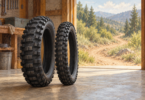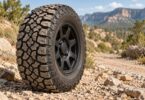


If your trailer calls for a 5.70-8 tire, match that size and the required load range before comparing brands. The “8” refers to the wheel diameter, not the tire’s overall height. A tire-only listing, a mounted tire-and-wheel assembly, and an inner tube are three different purchases.
Two clearly identifiable replacement tires are the Carlisle Sport Trail 5193191 in Load Range B and 5193201 in Load Range C. The C version carries more load at its specified pressure, but it does not increase the trailer’s legal or mechanical capacity. This guide compares published specifications and fitment requirements; it does not claim hands-on road testing.
Start with the trailer, not the shopping title
Read the trailer certification label and owner’s manual, then photograph the existing tire sidewall and wheel markings. Confirm the original specification rather than assuming a previous owner installed the right tire. A search for “5.7 8 tire” can return agricultural tires, tubes, or unrelated sizes.
- Size: verify 5.70-8, sometimes written 570-8 or 5.70 x 8.
- Use: confirm the product is intended for your trailer’s road use, not simply an 8-inch utility wheel.
- Capacity: check the exact load range and per-tire load at the stated cold pressure.
- Wheel: confirm approved rim width, condition, load rating, and pressure rating.
- Speed: verify the tire manufacturer’s rating for that exact part number.
Write those requirements down before opening product listings. That keeps an attractive price, a different pack quantity, or a misleading generic specification from determining the purchase.
Carlisle Sport Trail 5193191 for a specified Load Range B fitment

Carlisle Sport Trail 5193191, 5.70-8 Load Range B, 4-Ply Rated, 1 Tire Only
As an Amazon Associate we earn from qualifying purchases.
This is the tire-only 5193191, not a mounted spare. Carlstar’s Sport Trail specification table lists 715 pounds per tire at 50 psi, an 18.1-inch mounted diameter, and a 62 mph rated speed for this exact size and load range.
Best fit: replacing the specified B-range tire on a compatible trailer whose actual loading remains within every applicable rating. There is no reason to buy a wheel assembly if the existing wheel is sound and correctly matched.
Trade-off: B range has less carrying capacity than the C option below. Do not choose it simply because the dimensions resemble the old tire; check the load requirement. Mounting, valve service, and inspection of the existing wheel are separate from the tire purchase.
Carlisle Sport Trail 5193201 for a specified Load Range C fitment

The manufacturer lists 910 pounds per tire at 75 psi, an 18.4-inch mounted diameter, and a 62 mph rated speed for 5193201. Its tire catalogue identifies the 3.75-inch rim width and the bias-ply Sport Trail family.
Best fit: a trailer requiring this C-range specification, with wheels and valves approved for the operating pressure. It is also a possible replacement to discuss with the trailer or tire manufacturer when considering a change from a lower load range.
Important listing discrepancy: the Amazon page for this part currently contains a 2,755-pound capacity field and “C” in a speed-rating field. Those entries do not match the manufacturer’s 5193201 specification. Use the part number and manufacturer data, and verify the delivered sidewall before mounting.
Why Carlisle and Carlstar both appear
The manufacturer announced a transition from Carlisle branding to Carlstar. Retail titles and product markings can therefore use either name. Compare the actual model, size, load range, and specifications rather than assuming that the name change alone identifies a different tire.
Ask the seller to confirm the supplied part when a listing combines several variants. The same product family can contain several sizes and load ranges, and reviews or photographs may cover more than the currently selected option.
Load range does not tell you the whole capacity
Load range describes a tire’s load-and-pressure capability. A “6-ply rated” description is not a promise of six physical casing plies. The usable limit comes from the exact tire specification together with the trailer’s axle, wheel, and overall ratings.
As another example, Kenda’s Loadstar K353 table lists 5.70-8 B, C, and D versions with different pressure and load limits. The size marking alone does not select among them. Do not transfer one brand’s D-range capacity or speed claim to a different tire carrying the same nominal size.
Two tires rated at 910 pounds each have a combined tire rating of 1,820 pounds under their specified conditions. That arithmetic is not a new trailer rating or a guarantee that both tires share the load equally. Dexter’s running-gear manual says to account for the heaviest wheel position when loading is unequal. Obtain actual loaded weights when capacity is uncertain.
Pressure and speed need separate checks
Use the cold inflation requirement appropriate to the trailer and approved tire fitment. The published maximum load is tied to its stated pressure; a C-range tire at a lower pressure should not be assumed to retain its full listed capacity. If the trailer label and replacement tire instructions differ, resolve the change with the manufacturers or a qualified tire professional.
Kenda’s tire-safety guidance warns against exceeding load and pressure limits. Never exceed the wheel’s pressure rating to reach a tire’s advertised capacity. Do not bleed a hot tire down to a cold-pressure number.
These two Sport Trail variants are specified at 62 mph. A highway speed limit above that number does not authorize exceeding the tire rating. Conditions, the trailer, and towing equipment may require an even lower speed. Broad descriptions such as “highway tire” are not a numerical speed approval.
Tire only or a complete wheel assembly?
Buying a mounted assembly can be useful for a ready spare, but matching 5.70-8 is only the beginning. Confirm bolt count and bolt-circle diameter, hub clearance, offset, wheel load rating, and pressure capability. A four-lug assembly cannot replace a five-lug wheel.
Dexter emphasizes matching replacement wheel offset and bolt circle to the original equipment. Similar-looking bolt patterns can still be wrong. Provide the wheel markings and trailer information to the seller instead of relying only on a photograph.
An inner tube is not a substitute for a worn tire or a damaged wheel. Have a tire professional determine whether the tire-and-wheel combination is tubeless or requires an approved tube. Do not install a tube to conceal a cracked or leaking rim.
Checks before the next tow
NHTSA’s tire guidance recommends checking pressure cold and inspecting for damage and aging. Tread depth alone cannot establish that a trailer tire is serviceable. Check the date code, cracking, bulges, uneven wear, and repeated pressure loss, including on the spare.
Use the tire maker’s replacement guidance and have questionable tires inspected. For wheel installation, follow the trailer or axle manufacturer’s specified tightening sequence, torque, and recheck procedure. A universal torque value is inappropriate without knowing the wheel and stud combination.
The practical choice is the exact approved replacement: 5193191 for the appropriate B-range fitment or 5193201 for the appropriate C-range fitment. Confirm the delivered markings, have it mounted correctly, and treat load, pressure, speed, and wheel compatibility as one complete setup.
Image note: Existing category illustration retained from original article.