
For 33-inch tires on a Jeep Wrangler, confirm the complete tire size and vehicle fit before choosing a tread. “33-inch” describes an approximate outside diameter. It does not specify the wheel diameter, tire width, load rating, or clearance your Wrangler needs. A 33×12.50R15 tire and an LT285/70R17 tire cannot use the same wheel.
For a Wrangler that spends substantial time on pavement, start by evaluating a suitable all-terrain tire. A mud-terrain makes more sense when its off-road purpose matches how you use the Jeep. Below are two documented examples for different wheel setups, followed by the checks that determine whether either belongs on your vehicle.
This guide compares published product information. We have not road-tested these tires or measured their braking, noise, or tread life against each other.
Two 33-inch-class tires to compare
| Tire | Selected size and rating | Purpose | Key limitation |
|---|---|---|---|
| BFGoodrich All-Terrain T/A KO2, part 24481 | LT285/70R17, 116/113S, load range C | All-terrain candidate for a compatible 17-inch-wheel setup | This exact part carries BFGoodrich’s FOR original-equipment designation; it is not presented as Jeep’s original-equipment part |
| Cooper Evolution M/T, part 170167035 | 33×12.50R15LT, 108Q, load range C | Mud-oriented candidate for an appropriately prepared 15-inch-wheel setup | Needs an approved 8.5–11-inch-wide wheel and sufficient vehicle clearance |
Each linked product is one tire without a wheel. Budget for the quantity your replacement plan requires, mounting, balancing, valves or TPMS work, and any necessary vehicle changes. These two variants differ substantially in width, wheel diameter, and load capacity; they are not interchangeable alternatives for the same wheels.
1. BFGoodrich All-Terrain T/A KO2: a 17-inch all-terrain candidate
The selected KO2 is part 24481, an LT285/70R17 load-range-C tire with a 116/113S service description. BFGoodrich’s exact-size listing identifies this part and its FOR designation. That is a product-identity detail, not proof of fit on a Wrangler.
The KO2 product page identifies an all-terrain design with CoreGard sidewall construction and the three-peak mountain snowflake symbol. It is a candidate when you need a tire for mixed paved-road and unpaved-road use rather than selecting a dedicated mud pattern solely for its appearance.
Why consider it: the metric size offers a narrower nominal section than a 12.50-inch flotation size, and the exact C-load version is identifiable. What to check: approved wheel width, actual mounted clearance, required load and speed ratings, and whether the shop recommends this particular OE-marked variant for your Jeep. Do not order an E-load KO2 or a KO3 and assume it is the same product.
If replacing fewer than a full set, match the existing tire’s complete designation and consult the installer about tread-depth and rolling-circumference compatibility. Matching the KO2 name alone is insufficient.

BFGoodrich All-Terrain T/A KO2 24481, LT285/70R17 116/113S Load Range C FOR, One Tire
As an Amazon Associate we earn from qualifying purchases.
2. Cooper Evolution M/T: a wider 15-inch mud-terrain option
The selected Cooper is a 33×12.50R15LT 108Q load-range-C tire, part 170167035, with outlined white lettering. Cooper’s Evolution M/T specification sheet lists a 32.83-inch overall diameter, 12.1-inch section width on its measuring wheel, and an approved wheel-width range of 8.5–11 inches.
That specification illustrates two important points: a tire labeled 33 inches can measure less than 33 inches, and a 12.50-inch nominal width is not a promise that every installed tire measures exactly 12.50 inches. Wheel width and the manufacturer’s measuring conditions matter.
Cooper describes the Evolution M/T as a mud-oriented off-road tire. Its tread uses substantial lugs rather than the more closely packed appearance of many road-oriented tires. Choose it because muddy terrain is a real part of your use, and evaluate the road-driving compromises with your tire shop.
Why consider it: you already have, or are professionally planning, a compatible 15-inch wheel setup and want this mud-terrain design. What to check: brake clearance, wheel width, offset, suspension travel, and the 108Q service description. A 15-inch wheel should never be assumed to clear a JK or JL’s brakes simply because older Wranglers used that diameter.
The selected listing is a single tire, not a four-tire package. An M+S marking does not, by itself, establish three-peak mountain snowflake qualification or dedicated winter-tire performance.
What size is a 33-inch Wrangler tire?
In a flotation size such as 33×12.50R15LT, the first number is nominal overall diameter in inches, 12.50 is nominal section width, R indicates radial construction, and 15 is wheel diameter. The 15 does not describe tire height.
In LT285/70R17, 285 is nominal width in millimeters, 70 is sidewall height as a percentage of width, and 17 is wheel diameter in inches. Calculating 17 + 2 × (285 × 0.70 ÷ 25.4) gives approximately 32.7 inches. That is a nominal calculation; use the exact tire manufacturer’s measured dimensions for fit planning.
An LT285/70R17 and a 33×12.50R17 may be in a similar diameter class, but the latter is substantially wider nominally. A 285/70R18 is also not the same height as a 285/70R17: changing the wheel-diameter number while keeping the other numbers increases nominal outside diameter.
Will 33-inch tires fit without a lift?
There is no answer that covers every Wrangler. Record the year, generation, trim, body configuration, factory packages, existing wheel specifications, and any suspension or fender modifications. In the 2018 model year especially, identify JK versus JL rather than relying on the year alone.
Factory equipment varies even within one generation. For example, Jeep’s 2024 Wrangler announcement describes upgraded Willys equipment with 33-inch tires and certain Rubicon X configurations with 35-inch tires. That does not establish clearance for another trim, model year, or wheel.
- At the wheel: verify diameter, approved width, bolt pattern, offset or backspacing, load rating, and brake clearance.
- At the front axle: check steering-lock clearance to suspension links, sway-bar components, liners, and bumper areas.
- Through suspension travel: assess compressed and articulated positions, not only a parked Jeep with its wheels straight.
- At the rear: check body, fender, suspension, and spare-carrier clearance.
A lift changes ride height but does not automatically solve wheel-width, steering-lock, or full-compression conflicts. Do not use a generic lift-height recommendation as a substitute for a vehicle-specific installation plan.
Load range and pressure: do not buy by ply rating alone
The two selected tires both use load range C, yet their service descriptions are different. That alone shows why a load-range letter cannot establish equal carrying capacity. For a Wrangler with single wheels, the first number in a two-number load index describes the single-tire application; the second concerns dual-wheel applications.
Have the tire professional preserve the vehicle’s required load capacity and appropriate speed capability. Include the actual travel load: people, recovery equipment, roof loads, and trailer tongue weight if applicable. Installing higher-rated tires does not raise the Jeep’s GVWR, axle ratings, payload limit, or towing rating.
NHTSA’s tire guidance directs drivers to the vehicle placard or owner’s manual for the specified cold pressure. The sidewall’s maximum pressure is not an everyday target. If converting tire size or construction, obtain a manufacturer-supported load-and-inflation recommendation for the replacement rather than copying another owner’s pressure.
The USTMA replacement guidance also calls for checking load capacity, wheel limits, offset, diameter, and inflation when departing from the original fitment. Do not assume an LT tire supports the same load as the previous passenger-type tire at the same pressure.
Plan the spare and the total installation
Include a compatible spare in the plan, following the instructions for your Jeep’s drivetrain and tire arrangement. Check total wheel-and-tire weight against the carrier’s rating, plus tailgate clearance, third brake-light visibility, and the rear camera where fitted. A spacer creates clearance; it does not automatically increase the carrier’s load rating.
After a size change, have the shop assess speedometer calibration, relevant vehicle settings, alignment, and steering or suspension condition. A hypothetical change from a true 31-inch diameter to a true 33-inch diameter is about 6.5%; that is large enough to make an uncorrected speed reading materially different. It is an illustration, not the measured change on your Jeep.
Frequently asked questions
Are 33-inch tires the same as 285 tires?
No. “285” gives width, not diameter. Aspect ratio and wheel diameter determine nominal height. LT285/70R17 is in the 33-inch class; other 285 sizes can be considerably taller or shorter.
Should I choose all-terrain or mud-terrain?
Begin with where you drive most often. An all-terrain is a sensible category to evaluate for mixed road and trail use. A mud-terrain deserves consideration when mud performance is important enough to accept its compromises. There is no measured braking, noise, or durability winner between the two examples in this guide.
Can I buy four and keep the old spare?
Only if the vehicle’s instructions and tire professional approve that spare arrangement. A visibly similar spare can have a different rolling circumference, load capacity, or operating restriction. Check before the trip, not after a puncture.
What should I ask the installer before ordering?
Ask for approval of the exact tire part number, wheel dimensions, load and pressure plan, clearance through steering and suspension travel, spare arrangement, and any calibration work. Then compare complete installed quotes for that approved configuration.
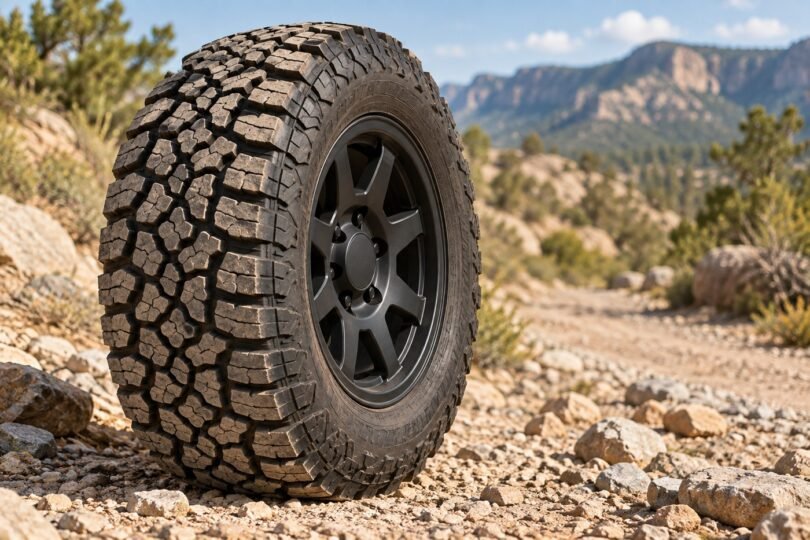
Image note: AI-generated editorial illustration; not a photograph of the named product.