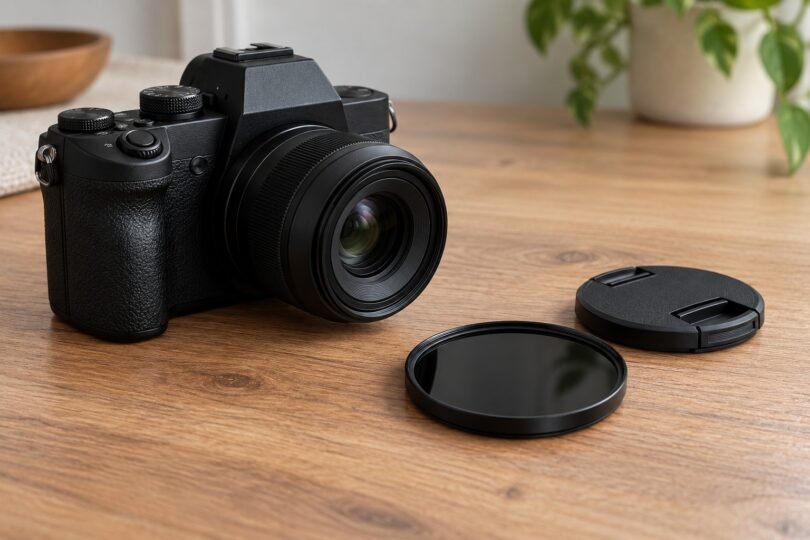

A 67mm solar eclipse filter should be a purpose-made solar photography filter with documented instructions for your equipment. A 67mm UV protector, circular polarizer, diffusion filter or ordinary variable ND filter is not an acceptable substitute. Matching the thread diameter does not establish solar safety.
Protect your eyes separately from your camera. NASA warns that viewing the bright Sun through unfiltered optics can cause severe eye injury. Eclipse glasses belong in front of your eyes for unaided viewing; they must not be used behind a camera lens, telescope or binoculars. Camera equipment needs the appropriate filter secured over the front of its optics. Read NASA’s eclipse safety guidance before planning a shoot.
Start with the intended use, then choose the size
Three different uses are easy to confuse:
- Solar photography: a manufacturer may authorize a filter for recording the Sun with a camera while prohibiting eye use.
- Unaided solar viewing: eclipse glasses and handheld viewers have their own safety requirements. A camera filter is not automatically a handheld viewer.
- Viewing through magnifying optics: the complete instrument needs an appropriate front-mounted solar filter and manufacturer-supported instructions. Never assume a photographic filter makes an optical viewfinder safe.
The American Astronomical Society recommends seeking expert advice before using solar filters with optics. Its eye-safety instructions also require checking filters for damage and following their supplied directions. If the instructions for a particular filter and camera do not clearly support your intended setup, get clarification from the manufacturers before aiming it at the Sun.
Two documented 67mm solar photography options
These are specific products with manufacturer documentation for solar imaging. They are not interchangeable with other filters from the same brands, and neither entry guarantees compatibility with an unspecified lens.
NiSi 67mm Solar Filter Pro Nano UV/IR Cut ND100000 (5.0)
NiSi’s exact 67mm product page identifies USA SKU NIR-ND5.0-67. It specifies optical glass, an aluminum frame, UV/IR attenuation and a stated 16.6-stop reduction for solar photography.
The important limitation is explicit: NiSi restricts this filter to photographic use, says it is unsuitable for naked-eye solar observation, and prohibits optical-viewfinder use when aligning the camera. It recommends live view for alignment and viewing. Its warnings require inspection before every use, full attachment to the lens, and pointing the camera away from the Sun when fitting or removing the filter. The filter can become hot.
This is a candidate for a documented, compatible 67mm-thread camera setup operated through live view. Do not treat its density number or UV/IR wording as permission to look through it with your eyes.
Thousand Oaks Optical SolarLite 67-T
The manufacturer’s threaded camera filter chart pairs a 67mm thread with part number 67-T. This is a SolarLite polymer filter, rather than the optical-glass construction specified for the NiSi option. The page requires installation ahead of every lens or mirror and rules out rear drop-in holders.
The linked SolarLite threaded-filter instructions describe a yellow-orange solar image, require a firmly secured front mounting, and warn against touching or damaging the film. They instruct the owner to inspect it before every use and avoid leaving the instrument unattended.
Choose it for photography only after confirming the exact thread fit and reviewing that manual with your camera’s instructions. This guide does not recommend viewing the Sun through an optical viewfinder or using a loose camera filter as eye protection.
What 67mm does and does not tell you
For a screw-in filter, 67mm describes the lens’s filter-thread diameter. Check the lens manual or its filter-size marking, commonly shown with the diameter symbol, rather than choosing by camera brand or focal length. A lens’s zoom range and its filter size describe different things.
Thread pitch matters as well. NiSi’s thread-pitch guide places its 67mm circular filters in the 0.75mm-pitch group. A same-diameter filter with an incompatible pitch can bind, cross-thread or sit loosely. Stop if attachment is not smooth; forcing the ring is not a compatibility test.
A filter that fits over the outside of a lens uses a different measurement: the outer dimension of the part it grips. A 67mm screw-thread specification cannot establish that outside diameter. Nor does a diameter match alone prove that a mounting covers the complete light-entry opening. Ask the filter maker to confirm the mounting and coverage for the exact lens, including any hood or accessory that affects attachment.
Why an ND number is not a safety certificate
An ND factor or optical-density value describes attenuation; it does not by itself establish suitability for solar observation. Darkness, a pleasing exposure or a brand name cannot confirm the required spectral transmission and physical quality.
The AAS explains that ISO 12312-2 concerns nonmagnifying solar viewers, such as suitable handheld or wearable products. It does not directly apply to filters mounted over camera lenses. Relevant transmission and quality requirements can inform assessment of solar-filter material, but a reference to the standard on another product cannot validate your camera setup.
NASA’s eye-safety reference identifies ordinary photographic ND and polarizing filters as unsafe for solar viewing. Purpose-designed solar photography products require their own documented scope and restrictions, as the options above illustrate. Keep ordinary ND filters, variable NDs, polarizers, UV protectors and improvised combinations out of the selection unless the exact product has appropriate solar-use documentation. Do not stack ordinary filters to create a supposed solar filter. More darkness is not evidence that a combination is safe.
Front mounting and secure coverage are essential
A solar filter must intercept sunlight before it enters the lens. The AAS guidance for filters on optics explains that this placement keeps intense sunlight and heat out of the instrument. A rear-mounted filter or a filter held near the viewfinder does not provide the required front protection.
The mounting must remain secure if the equipment is bumped or the wind changes. Follow the maker’s attachment instructions rather than inventing a holder. Inspect the filter and mounting before each session. If the material is scratched, punctured, torn, separated from its mount or otherwise damaged, do not use it. Follow the manufacturer’s storage and cleaning directions; film and glass products need different handling.
Plan for the eclipse phase and your equipment’s limits
Special-purpose solar filters must remain attached during partial phases and throughout an annular eclipse, according to the AAS eclipse-imaging guidance. An annular eclipse has no total phase, even when it looks like a thin ring. A nearly covered Sun is still not totality.
For telephoto photography inside the path of totality, the AAS cautions against screw-in filters because removing and replacing them rapidly creates a risk of dropping or damaging them. That is a practical limitation of the 67mm screw-in options above. If photographing totality is your goal, obtain expert help choosing an appropriate purpose-made mounting and planning the transitions. This selection guide is not a filter-removal timetable.
Live view avoids looking through an optical viewing path, but it does not replace front filtration or override camera and lens restrictions. Check both manuals for solar-use limitations. Do not assume that a short shutter speed, small aperture or brief recording protects equipment that is already receiving concentrated sunlight.
A useful checklist before buying
- Identify the exact camera and lens, including filter diameter and pitch.
- Match the exact product name and size to manufacturer solar-imaging instructions.
- Confirm secure front mounting, full coverage and any equipment limitations.
- Keep camera operation and unaided viewing protection as separate decisions.
- Choose a manufacturer or an authorized specialist seller with traceable product information.
The AAS supplier directory is a useful starting point, but a supplier’s listing is not blanket approval of every item it sells. Check the exact model and instructions.
If the setup cannot be verified, skip direct solar close-ups. NASA’s photography guide suggests recording the surrounding landscape and human experience, too. Scenes on the ground and changing shadows can make worthwhile eclipse photographs without directing your camera at the Sun.