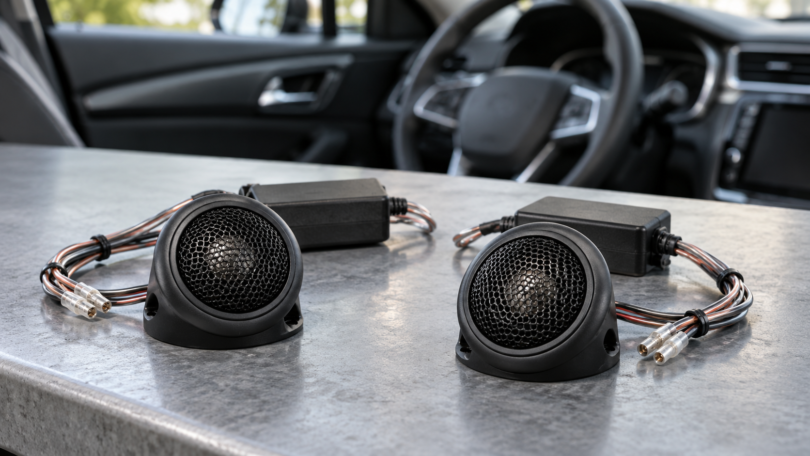

The best car tweeters are the ones that fit both the mounting space and the audio system. For a compact kit with documented protection, start with the Kicker 46CST204. The Rockford Fosgate R1T-S is a useful alternative with its high-pass filter integrated into the tweeter. The Skar Audio TWS-01 is worth comparing when you want a silk-dome pair with separate included crossovers.
All three selections are complete automotive tweeter pairs. Choose them by mounting dimensions, crossover requirements and amplifier compatibility. A larger peak-watt number does not establish better sound, and none is a universal plug-and-play replacement for every factory tweeter.
Three car tweeter kits to shortlist
| Exact kit | Impedance | Manufacturer power specification | Flush-fit dimensions | Included filtering |
|---|---|---|---|---|
| Kicker 46CST204 / CST20, two 3/4-inch titanium-dome tweeters | 4 ohms | 10–50 W RMS recommended amplifier power; 100 W peak handling | 40 mm hole; 14.5 mm depth | Separate inline crossovers, 4.5 kHz at 6 dB/octave; poly-switch protection |
| Rockford Fosgate R1T-S, two nominal 1-inch tweeters | 4 ohms | 40 W RMS / 80 W maximum, as listed by Rockford | 46.4 mm mounting diameter; approximately 19.4 mm depth | Integrated high-pass filter, 4.5 kHz at 6 dB/octave |
| Skar Audio TWS-01, two 1-inch silk-dome tweeters | 4 ohms each | 80 W RMS / 240 W peak for the pair | 1.64-inch cutout; 0.58-inch depth, as listed by Skar | Crossovers included; cutoff and slope not stated in the captured specification |
These dimensions are planning figures, not cutting templates. Allow room for mounting hardware, wire exits and any separate crossover, and compare the supplied parts with the actual trim panel before cutting. Kicker labels its RMS figure as recommended amplifier power; it should not be silently relabeled as a measured continuous power-handling result.
1. Kicker 46CST204: the clearest choice for a compact protected kit
Kicker 46CST204 CST20 3/4-inch 4-ohm Tweeters with Crossovers, Pair
As an Amazon Associate we earn from qualifying purchases.
Choose it for: a small titanium-dome kit with flush, surface and angled mounting choices. The exact 46CST204 package contains two tweeters and two CS crossovers, along with the mounting rings and hardware listed in the Kicker installation sheet. It is not a pair of full-range door speakers or the larger component-speaker bundle.
The 40 mm flush mounting hole and 14.5 mm depth give it the smallest stated hole requirement in this shortlist. That makes it a useful starting point for a tight sail-panel location, provided the surrounding cup, panel thickness and wiring also fit. The 3/4-inch dome measurement is not the diameter of the hole you need to cut.
Kicker specifies a 4.5 kHz, 6 dB/octave high-pass crossover and built-in poly-switch protection. Retain the supplied crossovers in the documented installation. The manufacturer product page lists 100 W peak handling and 50 W RMS recommended amplifier power; the manual expresses the recommendation as 10–50 W RMS. Neither figure is a reason to drive an unfiltered tweeter with bass.
Tradeoff: there are two separate crossover assemblies to secure and protect behind the trim. This is a good general-purpose starting point because the electrical protection and mounting requirements are documented, not because a titanium dome guarantees a particular sound in every car.
2. Rockford Fosgate R1T-S: for an integrated crossover
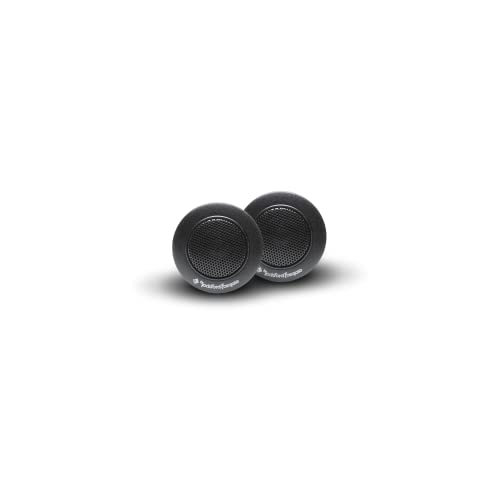
Choose it for: a tweeter pair that includes its high-pass filtering within the assembly. The R1T-S product page identifies a 4-ohm kit sold as two tweeters, with flush, surface and angle mounting components. Rockford calls it a nominal 1-inch tweeter kit while also specifying a 1/2-inch Mylar balanced dome; those descriptions refer to different measurements.
Rockford lists 40 W RMS and 80 W maximum handling, with a 4.5 kHz high-pass filter at 6 dB/octave. The captured specification does not explicitly state whether those figures apply per tweeter or to the pair, so confirm the basis with Rockford before choosing amplifier power. Keep the maximum figure separate from RMS, and do not read the two-speaker package as permission to feed 80 W RMS to each unit.
The manufacturer manual gives a 46.4 mm mounting diameter and 19.4 mm mounting depth. The product page rounds flush depth to 0.76 inch and lists a 1.06-inch dimension for the surface/angle configuration. Use the appropriate mounting drawing for your chosen arrangement; a dimension for one mounting style does not establish clearance for another.
Tradeoff: the flush opening is larger than the Kicker’s, and the nominal “1-inch” label will not tell you whether it fits an OEM housing. Its integrated filter simplifies the parts you need to accommodate, but does not make it electrically interchangeable with an unknown factory tweeter or crossover.
3. Skar Audio TWS-01: for a silk-dome pair

Choose it for: a 1-inch silk-dome option with two tweeters and included crossover networks. Skar’s TWS-01 specifications rate the pair at 80 W RMS and 240 W peak. Those are pair totals, equivalent to 40 W RMS and 120 W peak per tweeter when divided between the two identical units. They are not 80 W continuous and 240 W peak for each tweeter.
Each unit has a nominal 4-ohm voice coil. Skar lists a 1.64-inch cutout and 0.58-inch mounting depth, plus a crossover enclosure approximately 1.96 × 0.79 × 0.52 inches. The same table also lists the outside diameter as 1.64 inches. Because that leaves the relationship between the mounting flange and cutout unclear, confirm the supplied mounting parts and physical template before making an irreversible cut.
Tradeoff: the captured manufacturer specification confirms that crossovers are included but does not state their cutoff frequency or slope. The listed 2 kHz–20 kHz response is not an instruction to set a high-pass filter at 2 kHz. Use the included networks and obtain model-specific guidance from Skar before designing an active crossover arrangement or changing the supplied filtering.
Check the system before buying
Identify what the factory system already does. An OEM tweeter may be fed by a passive network, a separate amplifier channel or a processor-controlled signal. Have an installer establish that signal path and the required load before choosing a replacement. An aftermarket 4-ohm marking alone does not establish compatibility with the factory amplifier.
Plan the whole speaker load. Adding a tweeter alongside an existing speaker changes the circuit. These kits do not establish the resulting amplifier load in an unknown installation, and their included high-pass filters do not guarantee a complete acoustic match with an unrelated woofer. For a larger system redesign, a matched component set may be easier to integrate.
Budget for mounting and installation. Factory locations can need adapters, wiring connectors or custom brackets. Check behind the trim for window mechanisms, wiring and other vehicle equipment before choosing a location. Use the vehicle service information and the tweeter’s instructions; have a qualified installer handle unfamiliar trim, airbag areas or amplifier wiring. Keep playback at a level that allows safe driving.
For most buyers choosing among these three, the Kicker is the first kit to investigate because its small flush-fit requirements and protection are clearly specified. Choose the Rockford when an integrated crossover suits the installation, or the Skar when you prefer its silk-dome construction and can verify the mounting details. The current seller, warranty eligibility and exact package matter more than an inflated headline wattage.
Frequently asked questions
Can I connect car tweeters without a crossover?
These selections require their supplied or integrated high-pass filtering. Do not feed them an unrestricted full-range signal. An active system needs a properly designed signal path and manufacturer-approved protection; a frequency-response specification is not a crossover setting.
Will any of these fit my factory tweeter location?
Not automatically. Check the opening, mounting depth, cup and flange dimensions, wiring and factory signal path for your exact vehicle. Adapters or custom brackets may be needed even when the nominal tweeter size looks similar.
Does 240 watts make the Skar TWS-01 more powerful than the others?
No. Skar’s 240 W figure is peak power for the pair, while its RMS rating is 80 W for the pair. Compare ratings on the same per-tweeter or per-pair basis, and keep peak figures separate from continuous ratings and recommended amplifier power.
Can I add a 4-ohm tweeter in parallel with a door speaker?
Do not assume that is suitable. The complete speaker and crossover circuit determines the load seen by the amplifier. Have the wiring, amplifier limits and filtering checked before adding a tweeter to an existing speaker circuit.
Are silk-dome tweeters always better than titanium or Mylar?
No single dome material establishes the best result in every car. Crossover design, mounting angle, level matching and the rest of the system also matter. Use material as one preference alongside verified fit and electrical compatibility.