
A dog water raft can mean a soft pool lounger, a floating boarding ramp or a much larger platform. Choose the type that solves your actual problem: a comfortable place to rest beside you, or a way for your dog to climb out of the water. Neither replaces supervision or a properly fitted canine flotation device.
Choose the right kind of dog float
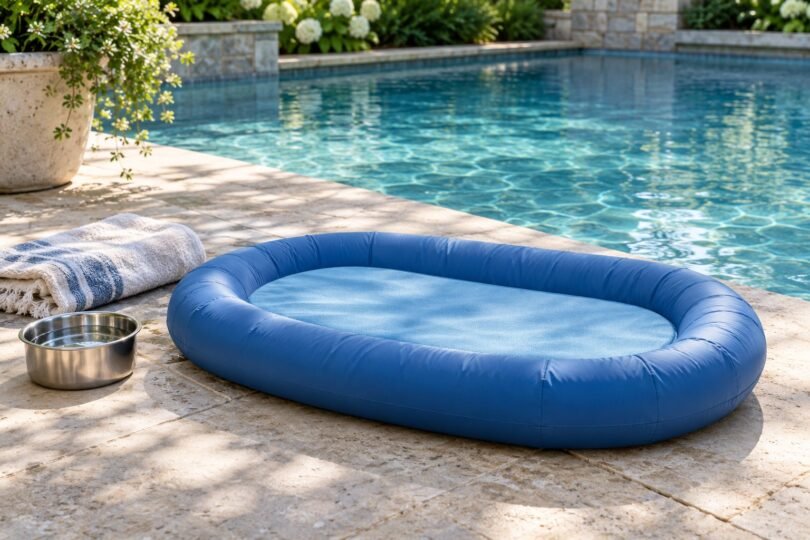
For quiet time in a swimming pool, a purpose-built pet lounger is the simpler option. Check the dog-weight limit and the space inside the inflated sides. The overall footprint can look generous while leaving much less room for a long dog to lie down. An adult hammock float, inflatable toy or floating key holder is not a substitute for a product intended to support dogs.
If the difficult part is getting back onto a dock or boat, look for a secured boarding ramp. Its submerged entry and attachment system matter more than a lounge-style cushion. A raft that drifts away from the exit does not solve the access problem. Plan the route from the water to dry ground before introducing either type.
PoolCandy PC2302BL: a pool lounger for dogs up to 100 pounds
The PoolCandy Large Inflatable Dog Pool Float, model PC2302BL, is a recreational pool float. PoolCandy specifies PVC construction and a maximum dog weight of 100 pounds. The matching PC2302BL listing gives an overall size of 54 by 40 inches, an inflatable floor and the blue paw-print design. That measurement is not a published usable-floor dimension, so check the central resting area if your dog is long-bodied or likes to stretch out.
This is a sensible design to consider for supervised pool lounging when your dog already feels comfortable around water. The maker describes the PVC as puncture-resistant; that does not mean claw-proof or chew-proof. Inspect the material and seams before each use. A dog who paws, bites or struggles to stay aboard may be happier resting in the shade on land.

PoolCandy PC2302BL Large Dog Pool Float, 54 x 40 Inches, Blue Paw Print, 1 Float
As an Amazon Associate we earn from qualifying purchases.
Match model PC2302BL and the 100-pound size when comparing offers. A smaller float, different pattern or multipack can appear beside it in search results. Do not assume that every item sold under the same brand has the same capacity.
Solstice Pup Plank XL 33248: a boarding ramp for sheltered water
The Solstice Pup Plank XL, model 33248, addresses a different need: climbing from the water toward a boat, dock or pool edge. The manufacturer’s manual lists 48 by 32 by 5 inches. Its PVC body uses drop-stitch construction, with a weighted mesh entry that extends into the water. This is not the same layout as a soft, enclosed pool lounger.
Solstice’s support guidance explicitly states a capacity of up to 200 pounds for the XL and Sport versions and says they are intended for dogs. The manufacturer also addresses older references to 100 pounds. Check the model and instructions supplied with your unit, and ask Solstice to resolve any conflicting label before relying on the higher figure.
The kit uses four D-rings and two 8-foot ropes; the support page recommends attachment at two points. Those secure the ramp to the structure. They are not instructions to tether a dog to it. Check the height of the exit, the landing space and the actual boarding route, because a weight rating alone does not establish whether your dog can make the climb.
The Pup Plank instructions restrict use to sheltered water, require competent supervision and prohibit towing, diving or jumping onto or off the product. They also rule out full deployment against a bulkhead where the tidal range exceeds 6–8 inches. Treat those limits as part of the buying decision.
Check size, setup and the exit before buying
- Weight: use a recent weight for your dog. Do not interpret a single-dog rating as permission for a person and dog to share the float.
- Resting space: measure the area your dog occupies while lying comfortably. Compare it with the usable center, not just the outside dimensions.
- Entry: decide how your dog will get aboard without being forced, pulled or lifted awkwardly. A tall inflated rim and a submerged ramp are different access arrangements.
- Exit: ensure there is an accessible way out of the pool or onto the shore. Practice finding that route with close supervision.
- Storage: account for drying space, the pump and the packed size. Wet equipment needs attention after the outing.
Introduce the equipment on dry land first, then progress gradually in a controlled setting. Stop if your dog appears anxious or repeatedly tries to escape. Buying a larger float will not necessarily fix fear of the water, balance difficulties or an unsuitable exit.
A floating platform is not a life jacket
Solstice’s manual expressly identifies its ramp as a recreational product rather than a lifesaving device and recommends a pet flotation device. Cornell’s veterinary guidance also recommends flotation support, especially for dogs with age, health or mobility limitations, and for dogs riding in boats on open water. Choose canine flotation equipment using its own fit instructions; the raft’s weight limit tells you nothing about life-jacket fit.
Stay close enough to intervene throughout the activity. Do not leave a dog alone on a raft, use the float to carry a dog into currents or assume that it will stay upright when the dog changes position. If health or mobility issues affect swimming, discuss the outing with your veterinarian before trying it.
Water time still needs shade and drinking water
Being on a float does not remove heat risk. The American Veterinary Medical Association advises access to shade and fresh water, frequent breaks and particular care with warm-weather exercise. End the activity if your dog shows distress. Excessive panting or drooling, unsteadiness, abnormal gum or tongue color and collapse warrant emergency veterinary attention.
Bring a drinking bowl and fresh water. Cornell warns that swallowing excessive fresh water or saltwater can cause serious illness. Its summer safety advice also explains the hazards of concentrated pool chemicals and recently shocked pools. Follow the pool-treatment instructions before allowing access, and avoid water affected by algae warnings.
Inflation, cleaning and storage
Use the instructions for the exact product. For the Pup Plank models covered by the linked manual, the operating guidance is 5–7 PSI; the broader product-page reference to drop-stitch construction up to 10 PSI is not an instruction to inflate that unit to 10 PSI. The manual also says to stop using a suspected leaking ramp, rinse after use, clean with mild soap and store it dry in a cool place.
A good purchase matches your dog’s size, the water setting and an exit you can manage. For pool relaxation, start with the lounger measurements. For boarding, start with the ramp’s fit against the structure. In both cases, keep the session supervised and let your dog’s comfort determine when it ends.