
For a French bulldog, choose a collar primarily for identification and a properly fitted harness for attaching the walking leash. A flat collar may suit ID tags if your veterinarian is comfortable with it, but neck pressure is an important concern in this flat-faced breed.
The shortlist below compares the Ruffwear Front Range Collar, PetSafe KeepSafe Collar, and Ruffwear Front Range Harness. The harness is included because a collar-only shopping list would leave out the most important walking consideration. No product is a universal fit for every Frenchie.
Research checked October 4, 2026. These selections are based on manufacturer information and veterinary guidance, not hands-on testing. We have not tested escape resistance, buckle strength, or comfort. Confirm current sizing and the exact product instructions before ordering.
Start with breathing and leash pressure
VCA’s guidance on brachycephalic obstructive airway syndrome advises a harness that does not tug at the neck for affected dogs. A regular neck collar can put undue pressure on that area. Ask your vet about the appropriate arrangement if your dog has breathing difficulties, a diagnosis of BOAS, neck discomfort, or a history of coughing on leash.
If your vet advises avoiding a neck collar altogether, use an appropriate alternative for identification and follow their plan. A harness cannot diagnose or treat an airway problem, and comfortable-looking equipment is not proof that breathing is normal.
Three options with different jobs
| Option | Role in this guide | Useful feature | Main limitation |
|---|---|---|---|
| Ruffwear Front Range Collar | Flat ID collar, if appropriate for the dog | Separate ID attachment and side-release buckle | Not a breakaway collar |
| PetSafe KeepSafe Collar | Breakaway ID-collar option | Buckle designed to separate under pressure | Can release; not the primary restraint here |
| Ruffwear Front Range Harness | Walking-harness candidate | Four adjustment points and back leash attachment | Chest size alone cannot guarantee a good fit |
1. Ruffwear Front Range Collar: straightforward identification
The Front Range Collar uses polyester webbing and a side-release buckle. A separate tag attachment and silicone tag silencer are practical details for carrying identification.
Its listed neck ranges are 11–14, 14–20, and 20–26 inches. The smallest range uses 0.75-inch webbing; the other two use 1-inch webbing. Measure your dog’s actual neck rather than ordering by breed or assuming that all medium collars fit alike.
Tradeoff: this buckle requires manual release. The collar should not be treated as snag-proof, and the presence of a leash ring does not make neck attachment the right walking choice for your dog. Check that the webbing and buckle fit comfortably within the available neck space.
2. PetSafe KeepSafe Collar: a breakaway design
The PetSafe KeepSafe has a buckle designed to separate when the collar snags and pressure is applied. That is a meaningful design difference from an ordinary side-release buckle.
PetSafe lists small at 10–14 inches, medium at 14–20 inches, and large at 18–28 inches. Its particular sizing instruction is to measure the neck and add one inch. Follow that product-specific method and confirm the finished fit; do not automatically apply the same allowance to another brand.
Tradeoff: releasing is part of this collar’s function, so it may come off with the tags attached. Do not rely on it as the walking restraint in this setup. Read the instructions for correct use and inspection, and do not interpret marketing language as a guarantee against every entanglement.
3. Ruffwear Front Range Harness: try it with your dog
The Front Range Harness has padding, four adjustment points, a back aluminum V-ring, and a front attachment. For ordinary walking, discuss back attachment and fit with your vet, especially when avoiding neck pressure is the priority.
Ruffwear measures around the widest part of the rib cage. Published sizes include XS at 17–22 inches and S at 22–27 inches; these are examples from the chart, not breed recommendations. The complete range extends from XXS to L/XL.
Tradeoff: matching chest girth is only the first check. The neck opening, chest panel, and leg clearance also need to suit this individual dog. Try it indoors and inspect for rubbing, shifting, restricted movement, or pressure toward the throat before a walk. The ID pocket may be useful when your vet recommends avoiding a collar.
Fit checks that matter more than a breed label
- Measure neck and chest separately. Record both in the units used by the manufacturer. Collar size does not determine harness size, even within one brand.
- Check the adjusted fit. Ruffwear’s collar safety guidance uses room for two fingers as a fit check. That is a check on a correctly selected collar, not permission to leave it loose enough to catch a mouth or paw.
- Recheck as the dog changes. Growth and weight changes can alter fit. Inspect under the gear for redness, dampness, hair loss, or friction, and stop using anything that irritates the skin.
- Inspect the hardware. Replace damaged webbing or faulty buckles. Keep tags small enough that they do not interfere with the dog’s movement or the gear’s function.
Ruffwear also recommends removing collars before crating, leaving a dog unattended, and play with other dogs because collars and tags can catch. A breakaway feature is not a reason to ignore the surroundings or abandon supervision.
When equipment shopping should wait
PDSA’s BOAS advice identifies noisy breathing, excessive panting, poor exercise tolerance, and difficulty coping with heat as concerns worth discussing with a vet. Sudden breathing difficulty or collapse needs immediate veterinary attention. Do not try to solve those signs by loosening a collar and continuing the walk.
Frequently asked questions
What size collar does a French bulldog need?
There is no dependable breed-wide size. Measure the individual neck, use that product’s chart, and check the adjusted fit in person.
Can my Frenchie wear a collar and harness together?
That can be a practical ID-and-walking arrangement if both fit comfortably and your vet considers the collar appropriate. Ensure they do not bunch together or press into the throat.
Will a padded collar make pulling safe?
Padding does not remove leash pressure on the neck. Choose a suitable harness and get qualified, reward-based training help for persistent pulling.
Bottom line: start with the dog’s breathing and fit needs. Choose identification gear thoughtfully, and put walking comfort and veterinary guidance ahead of a collar’s appearance.
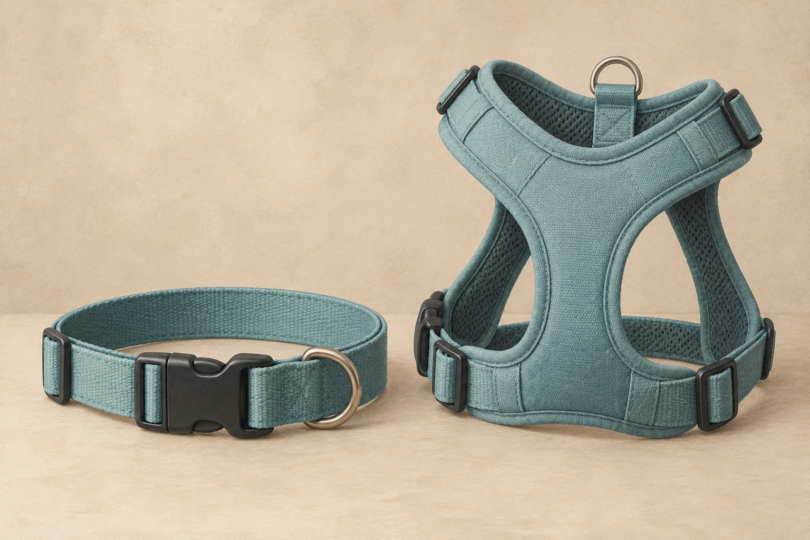
Image note: Generic collar-and-harness illustration; it does not establish fit or suitability for an individual French bulldog.