
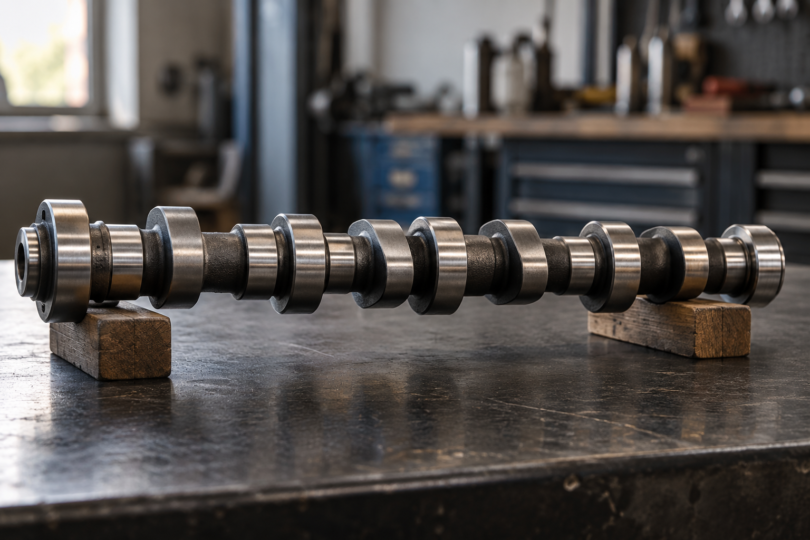

The best cam for a 350 Chevy truck depends first on which engine and lifter system are actually installed. For a conventional Gen I small-block build retaining hydraulic flat tappets, COMP Cams 12-230-2 XE250H is a useful starting point. For a compatible Gen I engine with the factory-style hydraulic roller system, compare COMP Cams 08-411-8 X4260HR.
These are two conditional choices with different applications. Confirm the block, heads and valve train with your engine builder before ordering, especially if the truck has an engine swap.
Two camshafts to compare
| Camshaft | Manufacturer application | Duration at 0.050 inch, intake/exhaust | Listed valve lift, intake/exhaust | Listed operating range |
|---|---|---|---|---|
| COMP 12-230-2 XE250H | Standard Chevrolet small-block 262–400 c.i.; hydraulic flat tappet | 206° / 212° | 0.432 / 0.444 inch with 1.5:1 rockers | 600–4,600 rpm |
| COMP 08-411-8 X4260HR | Chevrolet 305–350 c.i. OE-roller small block; hydraulic roller | 210° / 214° | 0.474 / 0.474 inch | 1,200–5,200 rpm |
Both part numbers are camshafts sold separately from the maker’s kit upgrades. The operating ranges describe the manufacturer’s intended use; they do not predict output from your engine.
1. COMP 12-230-2 XE250H: best starting point for a flat-tappet build
Check the COMP 12-230-2 camshaft and specifications.
Why consider it: its published range starts lower than the roller option here, making it the first of these two to discuss for a conventional flat-tappet truck build focused on lower engine speeds. It has a 110° lobe-separation angle and a three-bolt cam-gear attachment.
What it needs: plan for new compatible flat-tappet lifters, matched springs and the correct supporting hardware. COMP lists lifters, springs, retainers, locks, pushrods and timing components separately, along with distinct CL, K and SK kit upgrades. Check each package’s contents before comparing the total project cost.
Limitation: do not assume the current valve springs are suitable or that this cam will deliver a particular fuel-economy or torque improvement. Flat-tappet installation also requires the manufacturer’s lubrication and break-in procedure. A cam-only purchase is just one part of the job.
2. COMP 08-411-8 X4260HR: best starting point for an OE-roller build
Check the COMP 08-411-8 camshaft and specifications.
Why consider it: this Xtreme 4×4 model is explicitly cataloged for the 305–350 c.i. OE-roller small-block family. It has a 111° lobe-separation angle and provides an architecture-specific option when your engine already has the appropriate factory-style roller arrangement.
What it needs: confirm compatible hydraulic roller lifters, matched springs and retainers, pushrod length, timing components and cam retention. The maker’s recommended parts and separate kit upgrades are a starting point for an engine builder’s parts list.
Limitation: 08-411-8 alone is not a conversion kit for an older flat-tappet block. Its 0.474-inch listed valve lift also needs a clearance check against the actual heads and hardware; a “350” badge does not establish that those parts will work together.
Confirm the engine family before buying
COMP’s GM technical guide distinguishes its standard small-block, OE-roller, LT1/LT4 and LS cam families. These two selections concern the conventional Gen I small-block families. They are not recommendations for an LT1/LT4 or LS engine.
The OE-roller block has provisions for a cam-retention plate and lifter anti-rotation hardware. Have the installed block and lifter arrangement identified directly. Changing between flat-tappet and roller systems can require changes to lifters, pushrods, timing and thrust control, so choose a complete compatible combination before ordering individual parts.
Budget for the complete installation
COMP’s installation and degreeing instructions explain why the cam must be checked as part of the assembled valve train. Ask your builder to verify spring installed height and pressure, coil-bind margin, retainer-to-seal clearance, rocker and pushrod clearance, and piston-to-valve clearance where required.
Provide the builder with the head casting or model, compression ratio, induction system, transmission, converter if applicable, axle ratio, tire size and intended load. That gives the recommendation a useful context for your truck. For road use, also confirm the selected part’s emissions compliance for the exact vehicle and location before purchase.
Choose 12-230-2 when a confirmed flat-tappet combination and its lower listed operating range suit the build. Choose 08-411-8 when a confirmed OE-roller combination suits the truck. If the installed engine architecture is still uncertain, identify it before buying either cam.
