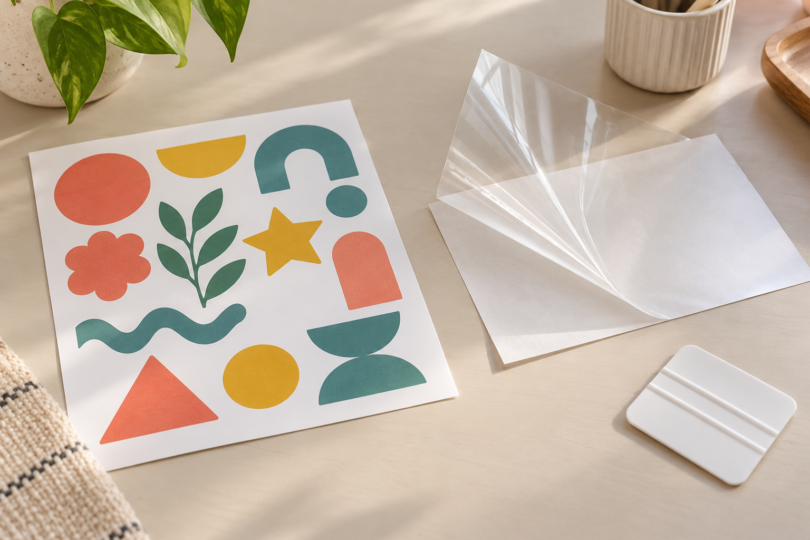

For peel-and-stick projects, the best laminating sheets for stickers are clear adhesive films that cover the printed face while leaving the sticker’s own backing usable. Avery 73601 is a straightforward choice for indoor craft stickers. ORAGUARD 210 Gloss is worth comparing when you use compatible printable vinyl and want the manufacturer’s documented UV-protection features.
Both options below use adhesive rather than a heat-sealed document pouch. Choose the film and the printable sticker material as a pair: a clear top layer cannot by itself guarantee that the ink, exposed edges or sticker adhesive will withstand washing.
Two clear laminating films to compare
| Option | Exact format | Film and adhesive | Best fit |
|---|---|---|---|
| Avery 73601 | 50 sheets, 9 × 12 inches, clear gloss | Polypropylene; approximately 2-mil film face; permanent self-adhesive | Indoor stickers and general craft overlays |
| ORAGUARD 210 Gloss, Atlanta Vinyl pack | 10 sheets, 8.5 × 11 inches | 2.5-mil PVC film, excluding liner and adhesive; clear permanent solvent-based adhesive | Flat graphics using qualified printable media |
1. Avery 73601: best for straightforward indoor sticker projects

Avery 73601 Self-Adhesive Laminating Sheets, 9 x 12 Inches, 50 Sheets
As an Amazon Associate we earn from qualifying purchases.
Avery 73601 contains 50 individual sheets with a glossy clear finish and a gridded release liner. The 9 × 12-inch format gives you room to align and trim film over a letter-size printed sheet.
Why choose it: no laminating machine is needed, and the maker specifically includes custom stickers among its suggested projects. Peel-and-stick application works well for a small craft workflow where you want to cover a printed face without enclosing the whole sheet in a pouch.
Thickness matters: Avery’s thickness guidance gives about 2 mils for the film face and 7.5 mils for the full construction. Those are different measurements; this is not a 7.5-mil plastic overlay.
Limitations: Avery says 73601 is water resistant, but not UV resistant. Choose it primarily for indoor projects, and do not treat it as a guarantee against fading, soaking or dishwasher cycles. Permanent adhesive also makes careful alignment important.
2. ORAGUARD 210 Gloss: best for compatible printable-vinyl graphics
The exact option here is Atlanta Vinyl’s 8.5 × 11-inch, 10-sheet Gloss pack. The same page has other finishes and counts, so confirm all three selections before adding it to your cart.
Why choose it: ORAFOL specifies 2.5-mil clear PVC film with permanent adhesive for flat printed graphics, including stickers and decals on qualified ORAJET media. Its technical data identifies UV-protection benefits. The ten-sheet format also lets you try the material without ordering a full roll.
For desktop inkjet projects, ORAJET 1917 Craft is a concrete manufacturer-listed pairing to investigate. Confirm your printer, ink and media instructions; that pairing does not establish compatibility with every paper or vinyl sold for home printers.
Limitations: ORAFOL’s outdoor figures apply under specified exposure and application conditions. They are not a fixed lifespan for every finished sticker or a promise that ordinary ink will never fade. The manufacturer says it is not designed for vehicle or trailer graphics or wrapping. Although the retailer’s general description mentions broader uses, follow the manufacturer’s narrower application limits.
Cold film, thermal pouches and sticker paper are different products
A clear self-adhesive film goes over the artwork. Printable sticker paper or vinyl is the layer you print on, with its own adhesive and release backing. A thermal pouch encloses an item and needs its specified laminator process. Buying a pack of thermal pouches does not give you the same one-sided sticker overlay.
Avery’s document-lamination instructions use two sheets to cover a document’s front and back. For a sticker-face overlay, keep the sticker’s release backing in place and cover the printed face only; try a scrap first to check adhesion, appearance and cutting.
Check the finished sticker before making a batch
- Let the print dry: follow the ink and printable-media manufacturer’s drying instructions before applying film. Do not use one universal drying time for every ink system.
- Test the combination: check for bubbles, haziness, ink movement and edge lifting on a small sample. Permanent film can be difficult to reposition.
- Check the cut: added film changes the material stack. Use a small test cut to find a setting that cuts the sticker and overlay while preserving the release backing when you want a kiss-cut sheet.
- Match the exposure: water resistance at the printed face does not prove that cut paper edges or the adhesive underneath are waterproof. Neither selection here is a verified dishwasher-safe finished-sticker system.
Which should you buy?
Choose Avery 73601 for indoor projects where a larger, simple-to-trim sheet and a 50-sheet pack suit your workflow. Choose the exact ORAGUARD 210 Gloss ten-sheet pack when you can match the film to qualified printable media and need to evaluate its UV-protection features. For frequent washing or demanding outdoor use, require evidence for the entire printed sticker construction before relying on it.