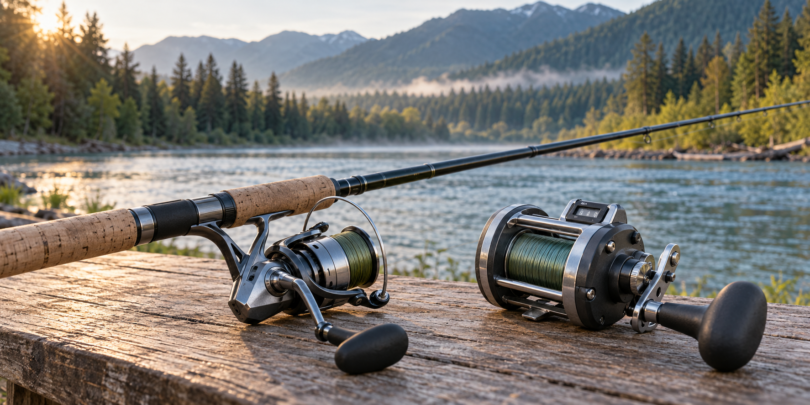

The best reel for salmon fishing depends first on how you fish. For casting lures with a spinning rod, compare the standard PENN Battle IV 4000 and 5000 against the line capacity your trip requires. For boat trolling, the Okuma Cold Water A CW-30DA adds a mechanical line counter and a conventional-reel layout. These are different tools, so choose the fishing method before choosing a size.
A reel suitable for a local coho or pink-salmon casting setup is not automatically the right purchase for Chinook in strong current, long open-water runs or a loaded trolling rig. Tell a local tackle shop or guide the species, water, rod and intended line before settling on capacity. Fish size alone does not determine the answer.
Three exact models to compare
| Model | Use to consider | Maker-listed specifications | Main limitation |
|---|---|---|---|
| PENN Battle IV BTLIV4000 | Spinning-rod lure casting | 6.2:1; right/left retrieve; 15 lb maximum drag; 220 yards of 10 lb mono or 260 yards of 20 lb braid | Capacity must suit the run, current and line diameter |
| PENN Battle IV BTLIV5000 | Casting when the chosen line requires more capacity | 5.6:1; right/left retrieve; 25 lb maximum drag; 200 yards of 15 lb mono or 300 yards of 30 lb braid | A larger spinning reel still is not a line-counter trolling reel |
| Okuma Cold Water A CW-30DA | Conventional boat trolling | Right-hand retrieve; 4.3:1; 20 oz; 21 lb maximum drag; counter reads in feet | Counter accuracy depends on spool fill and the actual line |
The capacity examples above are alternative line ratings, not amounts to combine on one spool. Maximum drag is a manufacturer rating, not a recommended fishing setting or a promise about the size of fish you can land.
1. PENN Battle IV BTLIV4000: the smaller casting option
The standard Battle IV BTLIV4000 is the starting point here for a spinning outfit when its capacity matches your planned line and local fishery. PENN lists a metal body and sideplate, carbon-fibre drag washers and sealing at critical areas.
Choose it when: you want to cast with a spinning rod and do not need the larger model’s line capacity. Check first: the model must read BTLIV4000. The separately listed 4000HS has a different gear ratio and capacity; specifications should not be swapped between them.
2. PENN Battle IV BTLIV5000: more capacity with heavier line
The standard Battle IV BTLIV5000 is worth comparing when your chosen braid or mono calls for a larger spool. Its published capacity gives you a concrete alternative to the 4000, rather than relying on a universal “salmon reel size.”
Choose it when: your guide or tackle shop recommends the line capacity and it balances with your spinning rod. Check first: hold the complete outfit before buying if possible. Extra capacity is useful only if you need it; a reel that feels cumbersome may be a poor match for repeated casting.
3. Okuma Cold Water A CW-30DA: for line-counter trolling
The Cold Water A CW-30DA belongs on the shortlist for salmon trolling with a compatible conventional rod. Okuma markets this family for salmon and describes a corrosion-resistant frame and sideplates for saltwater use. This is the current A-series model, not the older CW-303D.
The selected CW-30DA is right-hand retrieve. If you crank with your left hand, compare the separately listed CW-30DLA; do not assume the right-hand reel converts. The CW-30DHA is another distinct, high-speed model. Confirm the full suffix on the reel and box.
Choose it when: you want to repeat a trolling line-out measurement. Check first: ask the seller or Okuma to confirm capacity for the exact line type and diameter you will use, including any backing. Do not substitute a mono figure for braid, leadcore or copper.
Okuma says the counter measures spool rotations in feet and is calibrated for a full spool with monofilament. Its line-counter guidance explains why line diameter and spool fill change accuracy. Check it against a measured length with your actual setup. Line paid out is not the same thing as lure depth.
How to choose for your salmon trip
Start with the method and rod
Decide whether you are casting, trolling, fly fishing or using a specialist float setup. This shortlist covers spinning and conventional trolling. If your trip uses a fly rod or centrepin outfit, ask for a reel intended for that system rather than adapting one of these choices.
Compare the actual line, not just the spool number
Make a shopping note with the line type, diameter, strength, planned backing and the reserve your local conditions require. Two lines with the same breaking-strength label can have different diameters. Use the maker’s capacity table as a starting point and confirm the whole rig with someone who knows the water.
Account for fresh water, estuaries and salt water
Consider where the reel will get wet, not just where the fish was hooked. For saltwater trips, check the maker’s care instructions and service options before buying. Sealing and corrosion-resistant materials do not make a reel maintenance-free or a reason to submerge it. Rinse and service it only as the manufacturer directs.
Budget for the complete outfit
Compare reel-only prices with the cost of the matching rod, line, leader and any trolling equipment you need. Confirm the exact model, retrieve hand, seller, return terms and local service support. An inexpensive combo is not a substitute for verifying the identity and capacity of the reel it contains.
Frequently asked questions
Is a 4000-size spinning reel enough for salmon?
It can be a candidate if its exact line capacity suits the species, current, fishing method and rod. A size number alone cannot establish that. For larger fish or longer runs, get local advice before assuming the 4000 is sufficient.
Do I need a line counter?
Consider one when repeating line-out distances is part of your trolling method. It is less central to ordinary lure casting. A counter needs checking with your actual line, and its reading does not directly measure lure depth.
Should I choose the reel with the highest maximum drag?
No. Match the reel to the rod, line, leader, method and required capacity. Maximum drag is a rating ceiling, not a target setting; more of it does not by itself establish a better salmon outfit.
Which is the simplest starting point?
For spinning-rod casting, compare the two standard Battle IV sizes after defining your line needs. For conventional trolling, begin with the Cold Water A and choose the correct hand. Have the local fishery and complete rig settle the final choice.