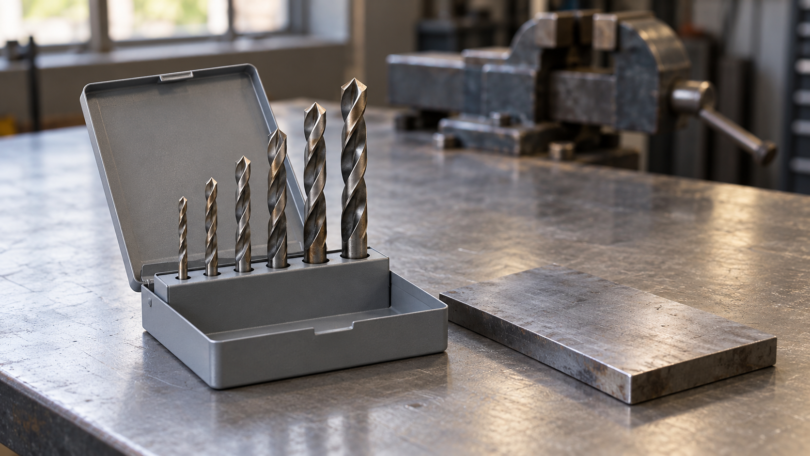

The right drill bit for hardened steel depends on the hardness of the workpiece and the machine holding it. A set advertised for “metal” is not automatically suitable for a heat-treated tool-steel part, and the hardness of a drill bit itself is not a rating for the steel it can drill.
For a known hardened-steel job, the two useful starting points below are the OSG EXOCARB WH70-DRL for a controlled machining setup and the ARTU Multi-Purpose bit for its specifically documented drill-press application. The Bosch CO14B is a separate cobalt alternative for stainless and general metal work when that is what the job actually requires.
Quick comparison
| Exact choice | Where it fits | Main limitation |
|---|---|---|
| OSG WH70-DRL 3318600, 6 mm | Documented cutting-data bands of 55–60 and 60–70 HRC | Requires tightly clamped work and a suitable rigid machining setup |
| ARTU Multi-Purpose 01030, 1/4 inch | Maker-described hardened-steel range of 35–70 HRC | Drill press only for hardened steel; not its recommended choice for mild steel or stainless |
| Bosch CO14B, 14-piece M42 cobalt set | Stainless-steel and general metal-drilling needs | No HRC workpiece limit established by the published Bosch specification; not a blanket hardened-steel recommendation |
1. OSG EXOCARB WH70-DRL: for a known hard-steel machining job
OSG part 3318600 is a single 6 mm carbide drill with a WXS coating. Its listed dimensions are a 6 mm shank, 35 mm flute length and 74 mm overall length. OSG gives it a 4×D drilling designation and specifies that it has no through-coolant passage. A 6 mm hole is not the same size as a 1/4-inch hole, so order from the drawing rather than choosing the nearest familiar fraction.
This is the clearest choice here when the workpiece falls within OSG’s List 5171 cutting-data bands: 55–60 HRC and 60–70 HRC. The maker uses differing lower limits in its marketing descriptions, so get application advice for material below the documented bands rather than assuming the broadest label applies.
Why choose it: the exact tool has dimensional data and hardness-specific machining guidance. That is more useful for a defined hole in heat-treated steel than a large general-purpose assortment.
What to plan for: OSG says tight clamping is critical, specifies a high-concentration water-soluble oil, and calls for step feeding beyond three diameters or when chips pack in the flute. Arrange a rigid machine setup that can follow its diameter-specific cutting data. Do not read the 35 mm flute length as permission to drill that entire depth, or buy this as a handheld-drill upgrade.
2. ARTU Multi-Purpose 01030: a carbide-tipped drill-press option
The ARTU 01030 is the carded, straight-shank 1/4-inch Multi-Purpose bit: 4-1/8 inches overall with a 2-1/4-inch flute. The bulk version is 01025; the 1/4-inch quick-connect version is 01464. Those part numbers should not be mixed when ordering.
ARTU uses a cobalt-and-tungsten-carbide tip on a chrome-vanadium steel shank and describes its tip as working with a filing action. Its manufacturer application explanation includes hardened steel from 35 to 70 HRC, subject to the correct drill and operating conditions.
Why choose it: it offers an exact fractional-size option with an explicit hardened-steel application, useful when a suitable drill press is available and a 1/4-inch hole is actually required.
What to plan for: ARTU’s material-specific instructions say drill press only for hardened steel. Its general compatibility with handheld drills applies to other materials and does not override that restriction. The current tips table and older explanatory article use slightly different speed wording; confirm the settings for the exact diameter and workpiece with ARTU. Do not substitute generic “slow speed for metal” advice or another brand’s feed and coolant recipe.
Multi-purpose also has limits: ARTU does not recommend this range for mild steel, stainless steel, copper, aluminum or brass. Its instructions direct those jobs toward HSS or cobalt bits. It is therefore a specialized choice, not the one bit to buy for every metal repair.
3. Bosch CO14B: the cobalt alternative for a different metal-drilling job
If the job is stainless or general metal work rather than a known high-hardness tool-steel application, the Bosch CO14B M42 set is a practical size assortment. Its 14 bits span 1/16 through 1/2 inch; the count includes two 1/8-inch bits, so there are 13 distinct diameters.
Bosch lists this family for rotary drills/drivers, emphasizes stainless-steel drilling and uses three-flat shanks on sizes 3/16 inch and larger. Choose the CO14B 14-piece option specifically, rather than the CO14, CO21B or an individual bit displayed in the same shopping selector.
Why choose it: it supplies a range of commonly used metal-drilling sizes in one case when the workpiece is within the maker’s intended application.
When to skip it: Bosch’s published specification does not give this set a workpiece HRC limit. M42, cobalt content and a surface-hardened tip do not establish that it will drill an arbitrary hardened shaft, bearing or 60 HRC blade. For those jobs, start with the hardness-rated options above and verify the complete setup.

Bosch CO14B 14-Piece Cobalt Drill Bit Set
As an Amazon Associate we earn from qualifying purchases.
What to establish before buying
- The actual material and hardness. Get the steel grade, heat-treatment condition and workpiece hardness from a specification or a machinist. “Steel,” “stainless” and “hardened” are not interchangeable purchasing instructions.
- The required hole. Specify diameter, depth, whether it is blind or through, and the required finish or tolerance. Match the tool’s working-depth designation; flute length alone is not the allowed hole depth.
- The available setup. Check workholding, machine rigidity, chuck or holder compatibility, and the ability to follow the maker’s feed, speed and coolant instructions. Clamp the work securely and follow the machine’s operating instructions.
- The exact application limits. A titanium-colored coating, carbide tip or large piece count cannot replace a documented material recommendation. If the grade, hardness or setup is unknown, resolve that uncertainty before buying another set.
Frequently asked questions
Will cobalt drill bits drill hardened steel?
There is no universal yes. Look for an application range for the exact bit and the hardness of the workpiece. The Bosch set here is a stainless/general-metal alternative; its published specification is not a promise for high-hardness tool steel.
Is every carbide bit suitable?
No. Carbide is used in many tools, including masonry, tile and metalworking bits with different geometries. OSG’s carbide drill and ARTU’s carbide-tipped design have their own material and setup instructions. Those instructions do not transfer to a generic masonry bit.
Can I use a hand drill?
Neither hardened-steel choice here is recommended as a handheld solution. ARTU explicitly requires a drill press for that material, and the OSG option belongs in a controlled, rigid setup with tight clamping. If you cannot provide the required setup, have a machine shop assess the part.
What speed should I use?
Use the exact tool maker’s guidance for the diameter, workpiece hardness and setup. The different cutting designs here do not share one universal RPM. Ask the supplier when its published instructions do not resolve your application.
Which should you choose?
Choose the OSG WH70-DRL for a defined machining job within its documented hard-steel bands. Consider ARTU 01030 when its fractional size and drill-press-only application fit the job. Choose Bosch CO14B for the separately identified stainless/general-metal task. The best purchase starts with the workpiece specification and suitable equipment.