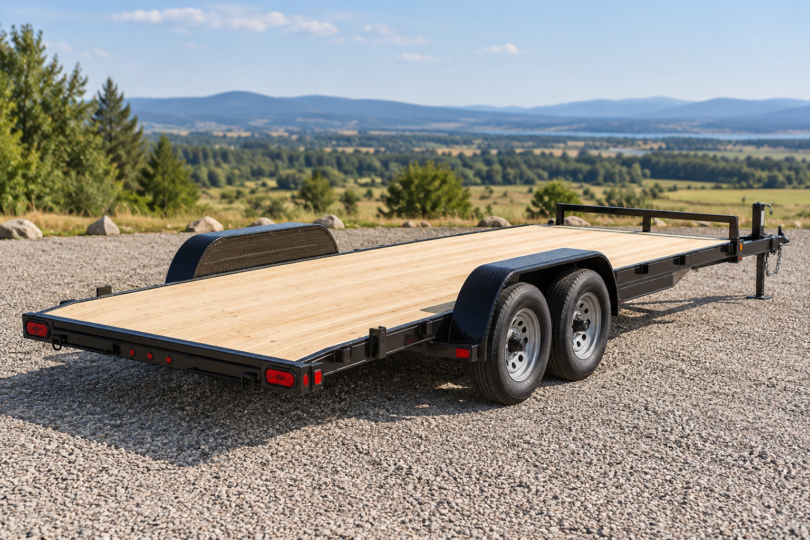

A trailer for car hauling needs enough payload for the actual car and gear, enough usable deck space, and a loading arrangement that clears the car’s underside. For an open bumper-pull trailer, the Big Tex 70CH-18 is a lower-capacity wood-deck option, the Big Tex 10CH-20 adds deck length and payload, and the BWise CH10 in its 18-foot configuration offers a steel deck and dovetail.
Start with your tow vehicle’s limits before choosing among them. The trailer’s advertised capacity does not establish that your truck, hitch or car fits the combination.
Three car-hauler trailers compared
| Exact configuration | GVWR | Listed empty weight | Listed cargo capacity | Deck dimensions |
|---|---|---|---|---|
| Big Tex 70CH-18 | 7,000 lb | 1,910 lb | 5,090 lb | 18 ft × 83 in |
| Big Tex 10CH-20 | 9,990 lb | 2,280 lb | 7,710 lb | 20 ft × 83 in |
| BWise CH10, 18 ft | 9,990 lb | 2,255 lb | 7,735 lb | 18 ft × 82 in |
These are manufacturer-published figures for the stated configurations. Options and the actual trailer’s weight can change available payload. Use the unit’s certification label, cargo placard and measured weight before loading; brochure dimensions do not establish bumper, door or ramp clearance.
1. Big Tex 70CH-18: a wood-deck option for lighter loads
The 70CH-18 makes sense to compare when the car, restraints and other carried gear fit comfortably within its 5,090-pound published cargo capacity. It has a treated-pine deck, removable fenders and stake pockets. Its lighter listed empty weight leaves less trailer weight to carry than the two higher-GVWR choices here.
Check the exact build: Big Tex lists a standard 2-inch adjustable coupler and an electric brake on the front axle; second-axle brakes and alternative couplers are options. The page describes 4-foot ramps inconsistently as standard and optional. Get the included ramps, their rating, brake configuration and coupler size confirmed in the written quote.
Tradeoff: its payload ceiling leaves less room for heavier cars and extra equipment. A straight deck and short ramps also deserve a careful clearance check for low cars.
Compare 70CH configurations at Big Tex.
2. Big Tex 10CH-20: more room and a higher payload ceiling
The 10CH-20 is the option to compare when the 70CH’s payload or 18-foot deck is too restrictive. Its published 20-foot deck is 83 inches wide, with a treated-pine floor, stake pockets, electric brakes and an adjustable 2-5/16-inch Demco EZ Latch coupler.
Tradeoff: the extra deck length needs more parking and maneuvering space. This is still an open trailer, and a higher GVWR does not increase your tow vehicle’s capability.
Check the ordered configuration: the page’s ramp and dovetail descriptions are not fully consistent. Confirm whether ramps and a dovetail are included, the ramps’ type, dimensions and ratings, and the resulting usable level deck. Do not infer your car’s loading clearance from a feature photo.
Compare the 10CH-20 at Big Tex.
3. BWise CH10, 18-foot: steel deck with a dovetail
This CH10 configuration is worth comparing if you want a diamond-plate steel deck. BWise lists a 20-inch deck height, removable steel fenders, 5-foot slide-in punched ramps, a dovetail and four welded D-rings. It also specifies electric self-adjusting brakes, a 7-way RV connector and a 2-5/16-inch A-frame coupler.
Tradeoff: the 82-inch deck is an inch narrower than the Big Tex models’ listed decks. That small difference can matter near a car’s tire-width limit, while door and body clearance need separate checks. A dovetail and longer ramps are useful features to investigate, but they do not promise clearance for a low splitter or long wheelbase.
Ask the dealer for the ramp and D-ring ratings and a loading demonstration with your car. The 20-foot CH10 is a different configuration with a different empty weight and payload.
See the CH10 specifications at BWise.
Calculate the load before choosing a trailer
Available cargo capacity starts with GVWR minus the trailer’s actual empty weight. The car, spare wheels, tools, straps and anything else carried on the trailer all use that allowance. Equipment added after manufacture also adds weight.
For example, a 4,500-pound car plus 200 pounds of carried equipment is a 4,700-pound load. Against the 70CH-18’s published figures, that leaves only 390 pounds below its listed cargo capacity and produces a 6,610-pound loaded trailer. This is an arithmetic example, not approval to tow: actual weights, individual axle and tire limits, load distribution and the tow vehicle still need checking.
Big Tex’s owner’s manual requires an adequately rated tow vehicle and hitch for the trailer’s GVWR. It also calls for checking the combination against the tow vehicle’s gross combined weight rating. Follow the manual for your exact trailer and tow vehicle; do not assume that staying under one advertised number satisfies every limit.
Five checks to make with the dealer
- Car fit: measure tire outside width, wheelbase, overall length, ground clearance and front/rear overhang. Check usable deck and fender clearance, door opening and where the car must sit to achieve the required tongue load.
- Loading: confirm each ramp’s load rating, width, attachment and spacing. Check the transition at the ramp-to-deck joint with your car; deck length alone cannot answer this.
- Tow vehicle and hitch: check the exact vehicle configuration, GVWR, axle ratings, payload, towing limit and GCWR. Account for passengers, truck cargo, hitch hardware and trailer tongue weight. Match ball size and every hitch component’s rating to the actual trailer.
- Brakes and electrical connection: verify the installed brakes, compatible controller, wiring, lights and breakaway equipment. A 7-way socket alone does not confirm a working braking system. Have the dealer explain operation and pre-tow testing.
- Restraints: obtain an appropriate vehicle-securement plan using rated anchors and the car’s approved attachment points. Check working load limits and the complete strap assembly, not just an advertised breaking strength.
The Big Tex manuals and BWise manual library are starting points; BWise labels the posted manual “Legacy,” so have the dealer supply the instructions applicable to your unit. Keeper explains the difference between working load limit and break strength. Ask the relevant authorities about registration, licensing, brake and commercial-use requirements for your route and operation.
Frequently asked questions
Is a 7,000-pound trailer enough to haul my car?
Not necessarily. The 7,000-pound figure includes the trailer itself. The 70CH-18 lists 5,090 pounds of cargo capacity before changes to the actual configuration. Weigh the car and everything carried with it, then verify all trailer and tow-vehicle limits.
Will an 18-foot deck fit any passenger car?
No. Width, wheelbase, body overhang, door access, ramp clearance and the required loading position all matter. Verify your car against the actual trailer, preferably with a dealer-assisted loading check.
Can I use ordinary cargo straps?
Only if the complete restraint system is appropriate for the vehicle and loading arrangement. Select by the manufacturer’s working load limits and instructions, and confirm anchor and vehicle attachment ratings. A break-strength number by itself is not enough.
Does having brakes on one axle meet the law?
That cannot be answered without the applicable jurisdiction and use. Check the requirements for your route and the actual trailer configuration before buying. Do not assume a base specification is the configuration you need.
Should I buy an open or enclosed car trailer?
An enclosed trailer is worth considering if weather exposure and enclosed storage are priorities. Compare its own weight, payload, opening dimensions and tow-vehicle requirements separately. The three options above are open trailers.
What should be in a comparable quote?
Specify the exact length, GVWR, deck, ramps, brakes, coupler, tires, spare, anchors and any winch or other options. Ask for the resulting weight and payload, delivery costs and applicable taxes or fees. Comparing only the advertised starting price can hide important equipment differences.
Which trailer should you shortlist?
Start with the 70CH-18 if its actual payload and loading geometry meet your needs. Compare the 10CH-20 for a longer wood deck and more cargo capacity, or the 18-foot BWise CH10 for a steel deck and dovetail. Make the final decision around measured car fit and the complete towing combination.