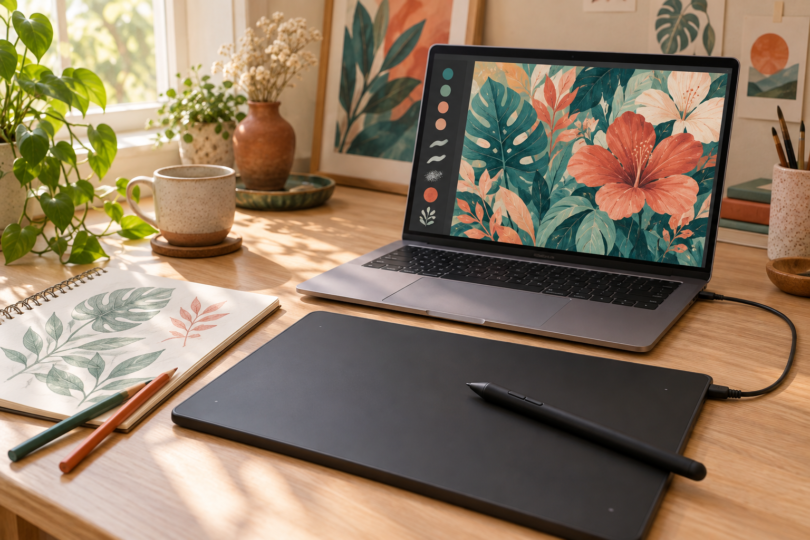

Krita is our first pick for free drawing software for a Wacom tablet if your main goal is sketching or digital painting. FireAlpaca standard is an alternative for illustration and comic-style work, GIMP suits photo-based artwork, and Inkscape is the choice for editable vector drawings. Each has a free desktop option, so you can choose around the kind of art you make.
This guide focuses on a Wacom pen tablet or pen display connected to a Windows, Mac or Linux computer. The drawing application runs on that computer. Check the tablet’s exact model, operating system and driver before installing an app; a moving cursor alone does not show that pressure sensitivity is working.
We selected these apps using current publisher downloads, feature documentation and Wacom driver information. The recommendations reflect their documented tools and different workflows; they are not hands-on performance rankings.
Quick comparison: four free drawing apps
| App | Best fit | Free edition | Desktop platforms |
|---|---|---|---|
| Krita | Painting and sketching | Free, open-source direct download; optional paid store builds | Windows, macOS, Linux |
| FireAlpaca standard | Illustration and comic-style linework | Freeware; paid SE is a different edition | Windows, macOS, Linux |
| GIMP | Photo editing with painted elements | Free, open-source desktop application | Windows, macOS, GNU/Linux |
| Inkscape | Vector illustration and lettering | Free, open-source vector editor | Windows, macOS, GNU/Linux |
1. Krita: best starting point for painting and sketching
Krita combines a broad brush collection, stroke stabilizers and layer tools in a painting-focused workspace. It also includes a 2D animation workspace. That makes it the most useful starting point here if you want to develop a sketch into a layered illustration without immediately looking for a second program.
Strengths: Brush customization, stabilization and layered artwork. Trade-off: There are many controls to learn. Start with a few brushes and a simple canvas instead of changing every setting at once. Treat that as learning advice, not a claim that one app is faster or easier for every artist.
The project’s direct download is free and open source, with no trial period. Paid store versions are optional and help fund development; paying for one is not required to use the free desktop application. Krita’s FAQ also permits commercial use of your original work.
Use the official Krita download page. Its published application minimums include Windows 8.1 or later, macOS 10.15 and Linux, with 4 GB RAM required and 16 GB recommended. These are app requirements: your Wacom driver may require a newer OS. The project does not offer an iPad or iPhone version.
2. FireAlpaca standard: best for illustration and comic tools
FireAlpaca standard offers customizable brushes, pressure-aware linework, a frame tool, halftones and perspective-grid tools. Try it if those illustration tools match the way you draw, particularly when panels and clean lines matter more than a photo-editing workflow.
Strengths: Illustration tools in a free standard edition, with personal and commercial use permitted. Trade-off: FireAlpaca SE is a separate paid edition. Its ad-free experience, exclusive brushes, layer masks and Projects feature should not be counted as standard-edition benefits. Choose the standard download when you want to keep the software free.
The official FireAlpaca download page lists the standard release for 64-bit Windows 10 or later, macOS 12 or later, and Linux. Its listed Linux baselines are Ubuntu 23.04, Fedora 36 and Debian 12 or later. Follow the current download requirements and test pen pressure with your own tablet and driver before starting a large project.
3. GIMP: best for drawing as part of photo editing
Choose GIMP when your work begins with a photograph and then adds retouching, a composite or painted details. It is a free, open-source image editor. Its paint dynamics can connect pen pressure to brush behavior, including size, so a Wacom pen can do more than simply position a cursor when the input is configured correctly.
Strengths: Combining image manipulation and painting in one application. Trade-off: For drawing sessions built mainly around brushes, our preference is to start with Krita. If GIMP’s stroke width stays constant, check both the input-device settings and the chosen dynamics; the brush needs to use pressure for that effect.
Use GIMP’s official downloads. The current direct Windows installer requires Windows 10 version 1903 or later; the Microsoft Store build has a different, higher OS requirement. The macOS download requires macOS 11 or later and offers separate Intel and Apple Silicon packages. Linux packages include AppImage, Flatpak and Snap; the AppImage lists Debian 13 or a newer distribution as its baseline.
On a Mac, use the publisher’s download page: GIMP says it does not provide an official Apple App Store package. A similarly named store listing is not automatically the project’s own build.
4. Inkscape: best for vector illustration and lettering
Inkscape is the free, open-source choice here for drawings built from editable shapes and paths. Its tools include freehand drawing, Bézier curves, text and node editing, and it works with SVG. Choose it for artwork you want to adjust as separate objects, such as lettering or a graphic mark. For a brush-painted image, start with one of the other apps.
Strengths: Editable vector shapes and a Calligraphy tool that can use a supported pen’s pressure and tilt. Trade-off: Tablet sensitivity needs configuration, and tilt requires a pen and tablet that provide it. Inkscape’s tutorial explains the input-device setup and the Calligraphy toolbar toggles; do not assume every tool responds to pressure in the same way.
Get it from the official Inkscape release page, which offers Windows, macOS and GNU/Linux options. Match the build to your computer: Windows downloads include x86-64 and ARM64, while Mac downloads distinguish Intel and arm64. Check the selected build’s requirements; older-version compatibility notes on a download page do not establish the minimum for every current installer.
Check the Wacom model, driver and operating system together
Start at Wacom’s official driver page and search the model code from the tablet’s back or packaging. Then read the matching driver’s compatible-products list. A family name such as Intuos or Cintiq is not enough to identify every generation.
For example, the Windows 6.4.15-1 list includes Wacom Intuos CTL-4100/4100WL/6100/6100WL, One by Wacom CTL-472/672 and Intuos Pro PTH-460/660/860. The same release explicitly excludes some older MobileStudio Pro and Cintiq Pro products and directs their owners to an older driver. Check your exact code instead of installing the newest release automatically.
The 6.4.15-1 release notes list Windows 10 and 11 on x64, plus Windows 11 on ARM64. Its Mac release lists macOS 13–15, 26 and 27. An application that can run on an older OS therefore does not prove that the current Wacom driver will run there. Check both sides before an OS upgrade, and follow Wacom’s model-specific guidance when an older driver is required.
On Linux, Wacom contributes to the open-source linuxwacom driver stack but does not provide desktop Linux end-user support. Many distributions already include the components. Recognition and pen features still depend on the device, installed driver stack and configuration, so check your distribution’s documentation if the tablet is missing or pressure fails.
Check pressure before judging the app
Create a small test canvas, choose a pressure-responsive brush and draw several strokes with light and firmer pressure. If the stroke never changes, investigate the driver, input API and brush settings separately. A problem with that setup is not a useful comparison of the apps’ drawing quality.
On Windows, the input API can matter. Krita’s documentation distinguishes WinTab from the Windows pointer API, and GIMP’s Input Devices preferences let you choose Windows Ink or Wintab. Follow the app’s instructions for your setup rather than changing unrelated settings at random.
Before committing to an app, make one small project, save it, close it and reopen it. Then try the export format you need to share. Keep an editable working file as well as the version you send, and test a copy before moving an important project between programs.
Free software and a free trial are different
A Wacom bundle may include a limited period of another application. For example, Clip Studio Paint’s Wacom offer describes free usage periods and an additional period tied to purchasing a monthly plan. That is a different proposition from choosing an ongoing free desktop edition. Check the exact offer, device eligibility, expiry and renewal terms; a bundle name does not establish a permanent license.
Frequently asked questions
Which free app should a beginner try first?
Start with Krita if painting or sketching is the goal. Try FireAlpaca standard for its illustration tools, GIMP for photo-based work, or Inkscape for editable vector art. The best choice is the one whose workflow fits your project and whose pressure input works on your setup.
Do these apps require a new Wacom tablet?
Choose the app around your existing setup first. Verify the exact tablet model and its supported driver against your computer’s OS. Installing free drawing software does not itself add driver support to an older Wacom model.
Are all four options free beyond a trial?
The selected Krita, GIMP and Inkscape desktop downloads are free and open source. FireAlpaca standard is freeware without a license fee. Optional paid store builds, FireAlpaca SE and time-limited bundled software are separate choices.
Why does the pen work like a mouse?
The cursor can move even when the app is not receiving usable pressure input. Check the correct tablet driver, the app’s input settings and a brush that responds to pressure. In GIMP, pressure-driven brush size is controlled through paint dynamics.
Can I use the same downloads on an iPad or Chromebook?
Do not assume desktop installers apply to another platform. This shortlist compares Windows, Mac and Linux workflows; Krita explicitly says its desktop download is not an iPad or iPhone app. Check the app’s current mobile or ChromeOS offering and your exact Wacom connection separately.