
For a small, loose piece of confirmed annealed glass, our first choice for edge work is the CRL DHP220 diamond hand pad. Choose the Glass Polish GP15017 five-pad set when you need several abrasive grades, or Norton Black Ice T401 2000-grit paper when the edge is already shaped and needs fine finishing. A fine sheet and a shaping pad solve different problems.
Before buying, identify the glass. Do not sand, grind, drill or cut tempered or heat-strengthened glass after treatment. Installed windows, shower panels, doors and other safety glazing need assessment by a qualified glazier. Laminated, coated, cracked or unidentified glass is also outside this guide’s small craft-project scope.
These recommendations compare manufacturer specifications, exact product listings and intended uses. They are buying guidance, not results from hands-on speed, finish or durability tests.
Quick comparison: three useful hand abrasives
| Pick | Exact selection | Best fit | Main limitation |
|---|---|---|---|
| CRL diamond hand pad | DHP220; red; 220 grit; one pad | A single hand-held option for eligible glass-edge work | One abrasive grade; finer finishing may need another product |
| Glass Polish PRO set | GP15017; five pads: 60, 120, 200, 400, 600 | Several grades for varied hand-sanding tasks | Coarse pads can remove more material than a light touch-up needs |
| Norton Black Ice paper | T401 00491 / 07660700491; 2000 grit; 9 × 11 inches | Fine wet finishing after shaping | Not a starting abrasive for substantial edge correction |
1. CRL DHP220: best single pad for eligible edge work
The DHP220 uses a plated diamond surface on a rigid foam support. CRL lists it for glass and other hard materials, with wet or dry use permitted. Its 220-grit red pad measures 95 × 57 mm. The supported hand-pad format makes it our practical first pick when you need one identified abrasive for an appropriate glass-edge task.
Why choose it: You can buy one specified grade without buying a whole assortment. Trade-off: It is one stage of abrasion, not a complete polishing system. CRL says grade selection depends on the finish and material removal required; its 60-grit option is for high removal. Do not assume the coarsest pad is the right starting point.
Look for CRL DHP220, sold individually. Match the item number and 220-grit description. A similarly colored pad from another range is not automatically the same abrasive.
2. Glass Polish GP15017: best set for several grades
The GP15017 set contains five foam-backed diamond pads, one each in 60, 120, 200, 400 and 600 grit. Each measures 95 × 55 × 28 mm. The manufacturer describes a flexible backing and finger grooves, and lists glass among its wet-or-dry applications. It suits a buyer who wants several grades on hand instead of purchasing each separately.
Why choose it: The package provides a defined range from coarse to finer grades. Trade-off: Owning every grade does not mean every job should start at 60 or use all five. Choose the least aggressive suitable starting point for the actual work, with advice from the glass supplier when needed. Buying a larger set also makes little sense if you only need a finishing sheet.
Match GP15017, pack of five, with those five grit numbers. Single pads and other bundles are different purchases. Treat claims about exceptional lifespan or dramatic time savings cautiously; this comparison does not independently verify them.
Glass Polish GP15017 Diamond Hand Pad Set, 5 Pads
As an Amazon Associate we earn from qualifying purchases.
3. Norton Black Ice T401 00491: best paper for fine finishing
Norton’s 00491 retail selection is a 9 × 11-inch, 2000-grit T401 silicon-carbide sheet. The maker describes JIS-graded abrasive on waterproof latex paper with a resin bond, and includes glass and sanding blocks among the family’s applications. Choose it for fine wet finishing, with an appropriate supporting block.
Why choose it: A flexible waterproof sheet is useful when you need finishing paper rather than another foam pad. Trade-off: This very fine grade is a poor first purchase for an edge that still needs substantial shaping. It also cannot guarantee a transparent, factory-polished result.
Check Norton’s specification table for 07660700491 and verify the seller’s sheet count. Do not confuse this retail item with the 50-sheet, 2000-grit industrial listing 66261139378, a different grit, or an aluminum-oxide product with a similar family name.
Choose the glass type before choosing the grit
Annealed glass: This is the ordinary float-glass starting material that can undergo further fabrication. That does not make every loose piece suitable for a home repair. Ask the supplier to confirm the glass type, condition and intended use before touching an edge. For this shortlist, think small uncoated craft glass whose suitability is already established.
Tempered or heat-strengthened glass: Arrange sizing and edge preparation with the fabricator before heat treatment. Vitro warns that later grinding and edging can reduce resistance to mechanical and thermal stress and affect safety performance. A panel that survives an attempted alteration is not proof that it remains suitable for service.
Laminated glass: It combines glass sheets with an interlayer that holds pieces together after breakage. The glass layers can also be heat-treated. “Laminated” therefore does not establish that a pane can be cut or sanded. Have a glazier assess the exact assembly and its edge requirements.
What matters more than the number of pieces in a pack
Start with the result you need: edge preparation, refinement or fine finishing. A coarse diamond pad and 2000-grit paper are not substitutes. Avoid a fixed internet recipe that tells everyone to begin at a coarse grade, regardless of the glass or defect. For a chip, crack, size mismatch or structural concern, ask a glazier whether replacement is required.
Match the abrasive family as well as the printed number. Norton identifies its selected paper as JIS graded; the diamond pads are separate products. Do not assume that equal-looking grit numbers across materials and grading systems produce identical scratches. A progression recommended for one product is not automatically a recipe for another.
Check the exact product’s wet-use rating. The selected Norton paper is intended for wet applications, and both selected diamond-pad ranges permit wet use. For an eligible hand-sanding task, our preference is a controlled wet setup with the work supported securely. Water does not remove the need for eye, hand and dust precautions.
Before checkout, confirm the model, abrasive material, grit, dimensions and quantity. Compare the total cost of the tools you actually need, including a suitable support and protective equipment. A large assortment is not automatically better value than one pad or a small paper pack.
Handling and dust precautions
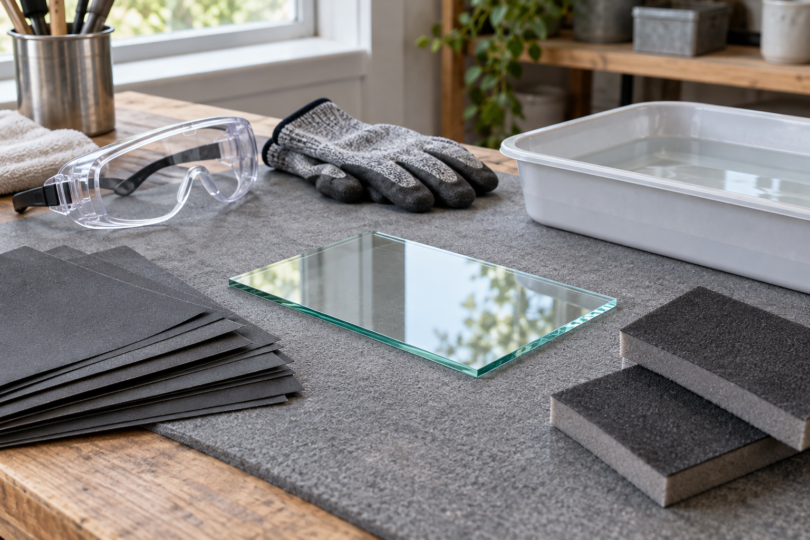
Glass can cut even when it has been treated for safety. Use suitable eye protection and cut-resistant hand protection, with arm protection for sharp edges. Vitro’s uncoated-glass guidance specifies safety glasses with side shields and recommends rubber-dipped anti-lacerative gloves. Keep the glass supported; stop if you cannot hold and work on it without exposing yourself to an edge.
Sanding and grinding create dust that can irritate the eyes and respiratory system. Use appropriate controls for the glass, abrasive and task. Vitro calls for engineering controls where dust is generated and suitable certified respiratory protection when exposure exceeds applicable limits. A casual mask recommendation cannot replace that assessment. If the necessary controls are unclear, use a glass professional.
This comparison is for hand abrasives. It is not a guide to using a household power sander on glass, or to adding water to a power tool. Follow the glass supplier’s guidance and the abrasive’s instructions; keep children and bystanders away from the work area.
Frequently asked questions
What is the best sandpaper for glass edges?
For eligible edge work, start by considering the CRL DHP220 hand pad. Choose GP15017 if several grades are useful. If the edge is already shaped and needs fine wet finishing, consider Norton T401 00491 2000-grit paper. The glass type and task decide which is appropriate.
Can I sand a tempered shower panel to make it fit?
No. Do not alter a tempered or heat-strengthened panel after treatment. Contact the glazier or supplier about a correctly sized replacement; abrasive selection does not solve this safety limitation.
Does a smooth edge mean the glass is safe?
No. Smoothing an edge does not establish that damaged glass has regained its strength or that the piece meets the needs of its installation. Have cracks, chips, unknown glass and safety-glazing concerns assessed professionally.
Will 400 or 600 grit leave a clear polished edge?
Do not assume so. Finish depends on the abrasive system, starting condition and work required. Buy a hand pad for its documented grade and intended task; if a clear display edge is essential, ask a glass fabricator to provide the specified finish.
Can I use a nail file or ordinary sanding sponge?
Choose an abrasive whose manufacturer specifically identifies glass and the intended wet or dry use. A nail file, wood-sanding sponge or generic assortment name does not establish that suitability. The documented glass applications are why these three selections made the shortlist.