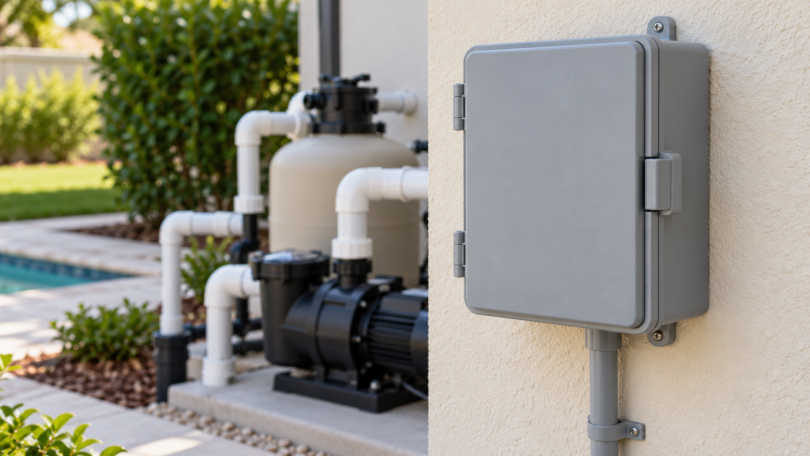

A pool-pump timer must match the pump’s voltage, motor load, connection type and control system. A large amp figure or an “outdoor” label alone does not establish compatibility. Start with the pump nameplate and manual, then have the complete installation checked.
For straightforward daily on/off scheduling, three Intermatic models cover distinct needs: T101R for a compatible hardwired 120-volt pump, T104R for a compatible hardwired 240-volt pump, and P1121 for a suitably rated 120-volt plug-in pump. These are mechanical schedules, without app control or different programs for each weekday.
The U.S. Consumer Product Safety Commission recommends inspection by an electrician qualified in pool and spa work and GFCI protection for pool electrical equipment. Follow the device instructions for testing that protection. An indoor smart plug, extension cord or weatherproof connection cover is not a substitute for an appropriate pool-pump control and properly installed supply.
Compare the exact models
| Timer | Supply and motor rating | Connection and enclosure | Best use |
|---|---|---|---|
| Intermatic T101R | 120 VAC, 60 Hz; 2 HP / 24 FLA at 120 V | Hardwired; SPST; indoor/outdoor Type 3R metal enclosure | A matching single-speed 120 V installation |
| Intermatic T104R | 208–277 VAC, 60 Hz clock supply; 5 HP / 28 FLA motor rating at 240 V | Hardwired; DPST; indoor/outdoor Type 3R metal enclosure | A matching single-speed 240 V installation requiring two-pole switching |
| Intermatic P1121 | 120 VAC, 60 Hz; 1 HP / 15 FLA / 90 LRA | Grounded NEMA 5-15 plug and receptacle; outdoor raintight housing | A compatible cord-connected pump within all listed limits |
FLA means full-load amperes; LRA means locked-rotor amperes. SPST switches one pole; DPST switches two poles together. The P1121 documentation reviewed identifies its grounded plug-in connection but does not specify a pole configuration; it should not be substituted for a hardwired two-pole control.
Before buying for a variable-speed or two-speed pump: check the pump’s own scheduling and external-control instructions. The three choices here are conditional on/off controls, not universal speed controllers.
1. Intermatic T101R: for a matching 120-volt hardwired pump
The T101R has a 120 VAC, 60 Hz clock motor and a single-pole switch. Intermatic’s current technical data lists a 2 HP, 24 FLA motor rating at 120 VAC, separately from its 40-amp resistive-load rating.
Why choose it: it gives a simple repeating daily schedule with mechanical trippers and a manual override. One ON and one OFF tripper are included. Additional trippers can support up to 12 ON/OFF operations daily, subject to the one-hour minimum ON/OFF time.
What to check: order T101R specifically for the included outdoor Type 3R metal enclosure. T101 is the indoor-enclosure version; T101M is a mechanism rather than this complete enclosed timer. Neither is the same purchase.
Have a licensed electrician confirm the pump’s supply, nameplate motor load and switching requirements. The T101R instructions also require installation at least five feet from the pool edge, suitable outdoor fittings and a closed enclosure door when it is not being serviced. An older instruction sheet lists additional contact ratings at other voltages, but that does not change the T101R’s required 120-volt clock supply or make it a general 240-volt replacement.

Intermatic T101R 120V SPST Outdoor Timer, One Unit
As an Amazon Associate we earn from qualifying purchases.
2. Intermatic T104R: for a matching 240-volt hardwired pump
The T104R uses a 208–277 VAC, 60 Hz clock motor and a double-pole, single-throw switch. For a 240-volt motor, Intermatic specifies 5 HP and 28 FLA. The 40-amp headline contact rating should not replace that motor rating when selecting it.
Why choose it: it offers the same straightforward daily dial and manual override as the T101R, with two poles switched together. It includes one ON/OFF tripper pair and supports additional daily events with extra trippers, with one-hour minimum ON/OFF times.
What to check: the exact T104R comes in an outdoor Type 3R metal enclosure. T104 and T104M are different enclosure/mechanism configurations. Do not assume a similar yellow dial identifies the correct voltage or product.
The T104R instructions require the specified clock supply and identify pool-equipment use only when installed at least five feet from the pool edge. They also require appropriate outdoor fittings and keeping the door closed when it is not being serviced. Have a licensed electrician apply the complete instructions and local requirements; the enclosure rating does not make exposed connections safe.

3. Intermatic P1121: for a compatible 120-volt plug-in pump
The P1121 is the compact plug-in choice. It has a grounded NEMA 5-15 plug and receptacle, a 13-inch cord and a flip-cover outdoor housing. Its specific motor limit is 1 HP, 15 FLA and 90 LRA at 120 VAC.
Why choose it: it avoids a separate hardwired timer installation when the pump manufacturer allows an external plug-in timer and the existing connection is suitable. Two ON and two OFF trippers are included; the minimum ON/OFF period is 30 minutes.
What to check: the manufacturer’s safety instructions require a grounded, GFCI-protected 120-volt circuit and vertical installation at least three feet above ground and five feet from a pool or spa. The timer is not a power disconnect. Follow the pump’s own instructions as well; do not bypass a GFCI or alter a safety plug to make scheduling work.
The short cord is part of the installation constraint. Do not solve an unsuitable outlet location with an improvised extension-cord arrangement. Have an electrician assess a suitable supply and confirm whether the pump restarts as permitted after power is restored.
Variable-speed pumps need a separate control check
A pump with onboard scheduling may already provide the timer you need. For example, the Pentair SuperFlo VST / SuperFlo VS / SuperMax VS manual describes internal schedules and model-dependent external digital or RS-485 control. Those functions are different from repeatedly interrupting line power.
Use the pump’s built-in schedule or an explicitly supported controller when its manual calls for that arrangement. Have the installer check the precise model and production version, power requirements and any heater, sanitizer or booster-pump interlocks. A timer’s horsepower rating alone does not establish variable-speed compatibility, and a basic on/off switch does not select two-speed motor windings.
Frequently asked questions
Can I use a smart plug or outdoor dimmer?
Only an exact device documented for the pump’s motor load and installation is a candidate. An outdoor lighting dimmer is not a pool-pump speed control. For example, TP-Link’s KP405 specification rates dimmable lighting loads; it does not establish pool-pump compatibility. A water-resistant housing does not change the load type.
Is a 40-amp timer enough for my pump?
That number is insufficient by itself. Match voltage and the applicable motor HP/current ratings, along with switching poles and connection requirements. The installer also needs to account for the rest of the circuit and equipment; do not convert watts to amps and assume the result proves suitability.
Will these timers remember the correct time after a power cut?
These mechanical clocks require their time-of-day setting to be corrected after a power failure. Their instructions describe resetting the clock and using manual override without cancelling the next scheduled event. Check the dial against the actual time before relying on the schedule.
How many hours should the pump run?
There is no single timer setting established for every pool. Follow the pump, filtration and sanitation equipment requirements and have a pool professional confirm the operating schedule for your system. None of these timers measures whether the water is clean or properly sanitized.
Which timer should I buy?
Choose T101R for the verified 120-volt hardwired application, T104R for the verified 240-volt two-pole application, or P1121 for an allowed 120-volt plug-in installation within its motor limits. For a variable-speed pump, start with its existing controller and manufacturer-approved scheduling options.