
The right stump bucket for a tractor is the one your exact loader, coupler and operating limits can support. For a subcompact, the GWT Mini Wrecker is a useful starting point because its published dimensions and attachment weights are modest. For a suitably equipped compact tractor, compare the deeper GWT Heavy Duty Wrecker. Owners of a GWT VersaFrame should also check the separate Add-A-Wrecker system.
These are conditional recommendations. A matching attachment plate and a horsepower figure do not establish that your tractor can safely remove a particular stump. Obtain confirmation for the tractor, loader and task before purchasing.
Research checked October 4, 2026. We reviewed manufacturer specifications and safety resources; we did not test digging performance, structural strength or stump-removal time. Prices and stock are not verified.
Compare the attachment you will actually mount
| Option | Connection | Dimensions and weight | Published tractor range |
|---|---|---|---|
| Mini Wrecker | Choose JDQA, SSQA or Yanmar QA | 18-inch-deep shovel; 9-inch digging edge. JDQA: 103 lb; SSQA: 91 lb; Yanmar QA: 111 lb | Up to 25 hp on the current standalone product page |
| Heavy Duty Wrecker | Choose JDQA or SSQA | 27-inch-deep shovel; 9-inch digging edge. JDQA: 190 lb; SSQA: 165 lb | 25–60 hp |
| Mini Add-A-Wrecker | Requires GWT VersaFrame; frame offered in JDQA or SSQA | 18-inch-deep shovel; 9-inch digging edge; 50 lb bucket module, plus the frame | Up to 32 hp for this distinct modular product |
The horsepower ranges above are attachment-maker recommendations, not lifting capacities or maximum stump diameters. Different versions have different specifications. Confirm the current SKU and mounting option in writing.
Mini Wrecker: the first comparison for a subcompact
The standalone Mini Wrecker uses a 1/4-inch A36 steel shovel and backplate, with a replaceable 1/4-inch AR400 digging edge. GWT names the John Deere 1025R, Kubota BX23S, Kioti CS2510 and Mahindra eMax20 as examples of the intended tractor class.
Those examples do not mean every loader fitted to those tractors has the same coupler. The useful buying advantage is a short, comparatively light attachment with multiple mounting versions. Check the loader’s permitted use and remaining capacity before choosing it, even when the tractor appears in the examples.
Heavy Duty Wrecker: more reach with a weight trade-off
The Heavy Duty Wrecker has a longer shovel and thicker 3/8-inch A36 body and backplate. Its replaceable digging edges are 3/8-inch AR400 steel. It is worth comparing when the Mini’s size is insufficient and the loader manufacturer permits the application.
The heavier attachment leaves less of the loader’s capacity available for material. Its longer projection also changes the loading geometry. Do not select it simply because heavier steel sounds safer: the tractor-loader combination remains the limiting system.
Add-A-Wrecker: check the complete frame system
The Add-A-Wrecker connects to GWT’s VersaFrame rather than directly providing a complete loader interface. Include the frame’s weight and cost when comparing it with a standalone bucket.
There is also an HD module, but it has an important compatibility condition: GWT says it requires the newer gusseted VersaFrame; older frames need the specified reinforcement. Ask GWT to identify your frame and the approved configuration. Do not assume that all past VersaFrames or all pallet-fork frames accept the same digging attachment.
Confirm the coupler and loader separately
- Record both model numbers. Supply the tractor model, loader model, year or serial information, and clear photographs of the existing attachment interface.
- Identify the connection. SSQA means skid-steer-style quick attach; JDQA and Yanmar QA are different offered options. A generic “quick attach” description is insufficient.
- Do not assume adapter compatibility. Pin-on, Euro/Global and other interfaces need their own documented solution. Adapters add weight and move the load; request approval for the entire assembly.
- Get a model-specific answer. Confirm latching, full movement without interference, permitted loading and any operating restrictions with the loader dealer and attachment supplier.
A removable loader is not proof that its bucket uses the required quick-attach interface. Make the purchasing decision from the equipment fitted to your machine, not its paint color.
Capacity: why one impressive number is not enough
John Deere’s 120R specification table, for the listed 2025R/2026R configuration, illustrates the distinction: full-height lift is listed as 803 lb at the pivot and 553 lb at 500 mm ahead of it. The same page lists separate breakout and rollback forces. These are different measurements, not interchangeable payload ratings.
Use your own loader’s manual and configuration. Ask how its published capacity accounts for the supplied bucket, replacement attachment, adapter and load position. Do not subtract a stump bucket’s weight from an arbitrary headline rating and treat the result as a safe root-ball allowance.
We found no verified universal stump-diameter or root-ball-weight capacity for the compared attachments. Soil, remaining roots and the machine’s permitted forces prevent a simple diameter promise. Photographs of a large removed stump do not provide that rating.
Safety checks before any ground disturbance
Kubota’s attachment-safety guidance stresses the appropriate manuals, proper ballast, working safety devices, exclusion of bystanders and shutting down before adjustments or maintenance. Use the tractor and loader manufacturer’s required ballast and rollover-protection instructions. Keep people clear and stop if stability or visibility is inadequate.
Do not ram an immovable stump, apply uncontrolled side loads or improvise shock pulling with the loader. Have a qualified operator assess jobs that exceed the machine’s approved application. A professional stump-removal service or different equipment may be the better purchase decision.
In the US, contact 811 before digging, follow your state’s waiting period and confirm all required utility responses. Also arrange identification of private lines where necessary; OHIO811 explains the private-locating distinction. Outside the US, use the local utility-location service and requirements.
Frequently asked questions
Will an SSQA bucket fit any John Deere tractor?
Only if the fitted loader interface and complete attachment combination are compatible and approved. The tractor brand alone does not answer that question.
Is the 50 lb Add-A-Wrecker lighter than a complete Mini Wrecker?
That figure is for the module. Add the correct VersaFrame and any other fitted components before comparing total attachment weight.
Can horsepower tell me the biggest stump I can remove?
No. Treat horsepower as an initial product-selection filter, then check the loader’s application limits and have the specific job assessed.
Did you test these buckets on the same tractor?
No. This is a specification-based buying guide, and it makes no measured performance ranking.
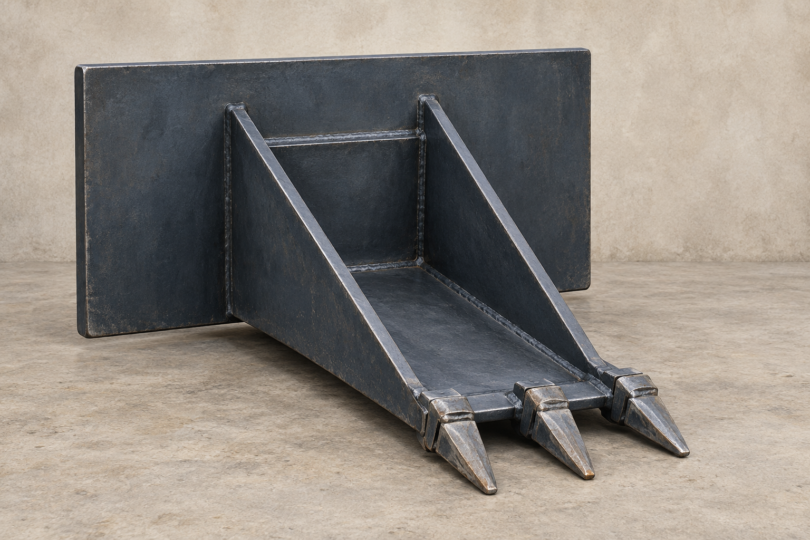
Image note: Generic stump-bucket attachment illustration; it does not establish tractor compatibility, capacity or an operating procedure.