
The best lens for the original Sony A7C depends on what you want to carry and photograph. Choose the Sony FE 40mm F2.5 G for a small everyday setup, the Sony FE 20–70mm F4 G for broad travel coverage, or the Sigma 28–70mm F2.8 DG DN Contemporary for a constant-f/2.8 standard zoom. These are three full-frame options with different strengths, rather than a single winner for everyone.
Research checked October 4, 2026. This guide compares manufacturer specifications and documented compatibility. We have not conducted hands-on sharpness, autofocus, flare or durability tests. Prices and stock are not verified.
Start with the original A7C’s mount and sensor
This guide concerns the ILCE-7C, rather than the A7C II or A7CR. Sony lists a 24.2-megapixel full-frame sensor, E-mount and five-axis sensor-shift stabilization in its original A7C specifications. The camera weighs approximately 509 g with battery and memory card.
Check both mount and image-circle coverage. Sony FE lenses are full-frame E-mount lenses. An APS-C E-mount lens can physically fit, but crop-mode use gives up sensor area: Sony lists the A7C’s large 3:2 APS-C still image at approximately 10 megapixels, versus 24 megapixels in full-frame mode. For a new general-purpose purchase, the full-frame choices below avoid that compromise.
Three lenses compared
| Lens | Focal range and maximum aperture | Lens weight / filter | Best reason to choose it | Main trade-off |
|---|---|---|---|---|
| Sony FE 40mm F2.5 G | 40mm; f/2.5 | 173 g / 49mm | Small everyday kit | No zoom; limited wide-angle coverage |
| Sony FE 20–70mm F4 G | 20–70mm; constant f/4 | 488 g / 72mm | Travel, landscapes and tight spaces | One stop slower than f/2.8 |
| Sigma 28–70mm F2.8 DG DN Contemporary | 28–70mm; constant f/2.8 | 470 g / 67mm | People and general photography with a brighter zoom | Starts at 28mm; limited sealing |
1. Sony FE 40mm F2.5 G: for keeping the camera small
The 40mm G measures 68 × 45mm and weighs 173 g. Its autofocus minimum focusing distance is 0.28m, and it has no lens-based optical stabilization. The A7C’s sensor-shift system remains relevant, but stabilization does not freeze a moving subject.
Choose it when: your priority is taking the camera on walks, photographing everyday life or carrying a discreet single-prime setup. A 40mm view sits between familiar 35mm and 50mm perspectives. Our recommendation is about its useful focal length and low weight, not a claim that it outperforms every other prime optically.
Think twice when: you regularly photograph cramped interiors, distant subjects or events where you cannot change position. A prime requires composing around one focal length; cropping later has limits. Try setting an existing zoom to 40mm for an outing before committing.
2. Sony FE 20–70mm F4 G: for a versatile travel lens
The 20–70mm G extends from an ultra-wide 20mm to a short-telephoto 70mm while maintaining f/4. Sony’s specifications list 488 g and dimensions of 78.7 × 99mm. Compared with the Sigma below, its principal attraction is the wider starting point.
Choose it when: buildings, landscapes, group photographs and indoor spaces share the same trip. The ability to go wider without changing lenses can matter more than a brighter aperture. It also offers flexibility for environmental portraits, where surroundings are part of the photograph.
Think twice when: dim-light action or strong background separation is the priority. At the same shutter speed and nominal exposure, f/4 needs about twice the ISO of f/2.8. That is a general exposure comparison, not a measured transmission test. This lens also makes the small A7C substantially less pocketable than the 40mm prime.
3. Sigma 28–70mm F2.8 DG DN Contemporary: for a brighter standard zoom
Buy the Sony E-mount version of this full-frame DG lens; Sigma also offers an L-mount version. The Sony version weighs 470 g and measures 72.2 × 103.5mm. Its constant f/2.8 aperture makes it a sensible candidate for family photographs, indoor occasions and general people photography.
Choose it when: you value a brighter zoom more than ultra-wide coverage. You can change framing between 28mm and 70mm without swapping lenses, while retaining the same maximum aperture.
Think twice when: 28mm will be too tight indoors or for your preferred landscapes. Sigma describes dust-and-splash resistance at the mount only; do not treat that as comprehensive weatherproofing. Check Sigma’s camera-compatibility information and current firmware guidance for your exact camera and lens before buying used.
Buying checks that matter more than a ranking
- Review your photographs. Identify whether your current limitation is width, reach, low-light shutter speed or carrying weight.
- Consider the complete kit. Adding the published lens weights to the A7C’s 509 g gives approximately 682 g, 997 g and 979 g respectively, before caps, hood, strap and other accessories.
- Check accessories. These lenses use different filter diameters. Include filters, hood, storage and any gimbal balance requirements in your decision.
- Confirm the exact version. Sony E, Sony A and L-mount are different purchase choices. A listing that mentions Sony somewhere in the title is insufficient.
- Evaluate the actual sample. During the seller’s return period, check autofocus, controls, mount condition and results at the focal lengths you use. No specification sheet establishes the condition of a used lens.
Frequently asked questions
Which is the best first lens?
Pick the 20–70mm for wide coverage, the Sigma for an f/2.8 zoom, or the 40mm for minimum bulk. If your existing kit lens already serves you well, identify a specific missing capability before replacing it.
Do I multiply these focal lengths by 1.5?
No, not when using the A7C’s full-frame capture area. Crop-factor comparisons become relevant when using APS-C capture or comparing with an APS-C camera.
Are these wildlife or dedicated macro recommendations?
No. This shortlist covers everyday and travel use. Distant wildlife and high-magnification close-ups usually need a different lens category.
Will a new lens add newer A7C II features?
A lens purchase does not upgrade the original camera’s processor or recording features. Check functionality against the ILCE-7C documentation, especially when following video advice written for later bodies.
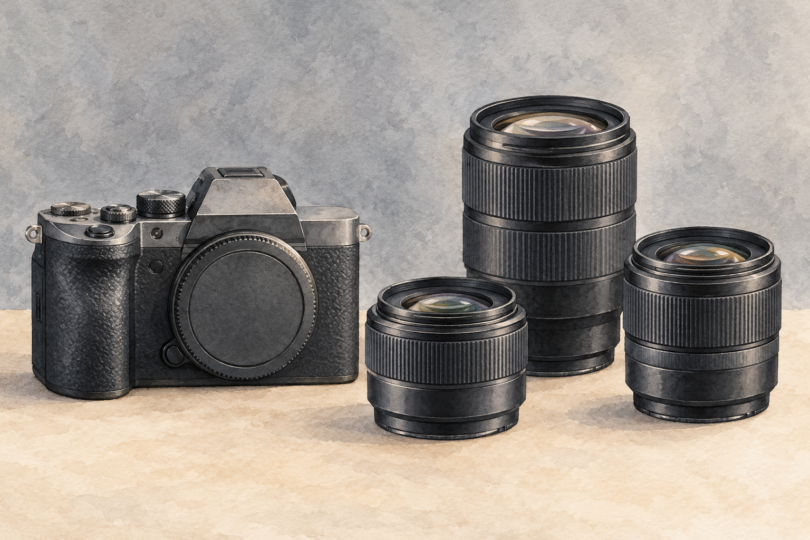
Image note: Generic editorial illustration of a camera and lenses; it does not depict the Sony A7C or a specific lens model or establish compatibility.