
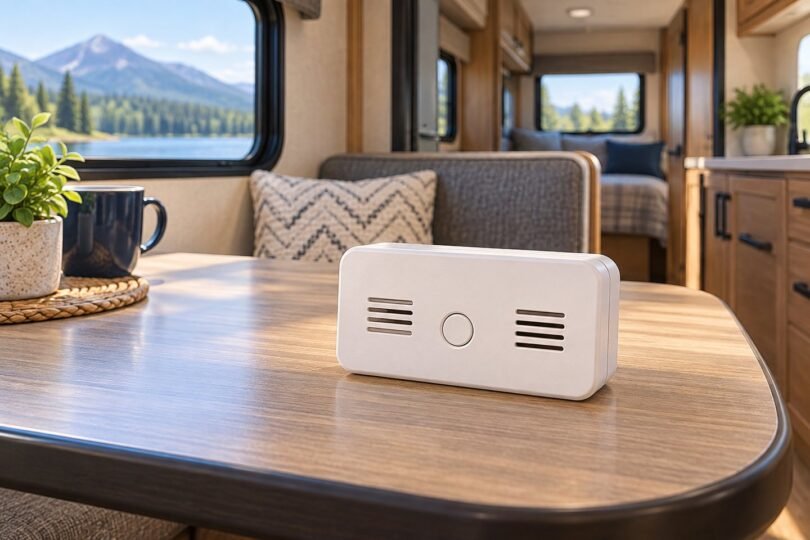

For protection from engine, generator or fuel-appliance exhaust in an RV, you need a carbon monoxide alarm, labeled CO. A carbon dioxide monitor, labeled CO2, serves a different purpose. If your RV uses propane, it also needs appropriate propane-leak detection. A combination CO/LP alarm can cover those two hazards, while smoke detection remains a separate requirement unless a device explicitly includes it.
If an alarm is sounding or anyone has possible CO symptoms, leave the RV for fresh air and call 911 or your local emergency service from a safe location. Do not stay inside to shop for a replacement, troubleshoot wiring or prove that the warning is real. Do not re-enter until responders say it is safe.
First identify which hazard you need to detect
| Device | What it addresses | What it does not replace |
|---|---|---|
| CO alarm | Dangerous carbon monoxide exposure | Propane-leak or smoke detection unless explicitly combined |
| CO/LP combination alarm | Carbon monoxide and propane gas | A smoke alarm or a ventilation monitor |
| CO2 air-quality monitor | Carbon dioxide measurement and air-quality information | A certified CO, propane or smoke alarm |
| Smoke alarm | Smoke associated with fire | CO or propane detection unless explicitly combined |
The EPA distinguishes low-cost air-quality monitors from emergency alarms. Do not rely on an attractive multi-sensor display or an “air quality” score to establish protection from a gas the device does not detect.
RV alarm models worth comparing
Start with your existing alarm’s full model number, your RV manual and the required gas coverage. The following manufacturer-documented options illustrate three different installation needs. This is a specification-based comparison, not a hands-on performance ranking.
| Model | Detection | Mounting and power | Best starting point |
|---|---|---|---|
| Safe-T-Alert 35-742 | CO and propane | Flush mount; hardwired 12V DC | Checking a compatible recessed combination-alarm replacement |
| Safe-T-Alert 45-741-BL | CO and propane | Surface mount; hardwired 12V DC | Checking a compatible surface-mounted combination-alarm replacement |
| Safe-T-Alert 62-541 RV | CO only | Surface mount; hardwired 12V DC | A separate RV CO alarm while retaining required propane coverage |
Safe-T-Alert 35-742: for a compatible flush-mount opening
The 35 Series manufacturer page identifies the 35-742 as an RV-specific dual CO/LP alarm. It uses the RV’s 12V supply and lists conformity to UL 2034 RV and UL 1484 RV. It is a recessed unit, so the opening and clearance behind the wall matter as much as the visible faceplate.
The verified Amazon product record below identifies 35-742-BL, black, one alarm, UPC 715456357447. Some listing fields use “battery powered,” which can be misleading: this model requires a hardwired 12V connection. It is not a self-contained alarm you can protect the RV with simply by placing it on a table.
Seller check: Safe-T-Alert has published a counterfeit warning covering 35-742 variants. A matching ASIN or product photograph establishes the listing’s intended model, not the authenticity of every seller’s stock. Prefer the manufacturer or a retailer it recognizes; ask the manufacturer if you cannot establish the source of a marketplace offer.
Safe-T-Alert 35-742-BL 12V Flush-Mount CO/LP Alarm, Black, 1 Unit
As an Amazon Associate we earn from qualifying purchases.
Safe-T-Alert 45-741-BL: a surface-mount combination option
The 45 Series surface-mount model also combines CO and propane detection on 12V DC. The maker identifies it as a replacement for its 40-442 propane alarm and lists conformity to UL 2034 RV and UL 1484 RV.
Surface mounting may suit an existing installation that lacks the recess needed by the 35-742, but it still requires proper wiring and an approved location. Confirm the footprint, fasteners and cable access against the exact supplied instructions. Use the manufacturer’s purchase route above; we have not verified an exact Amazon listing for this option.
Safe-T-Alert 62-541 RV: separate CO protection
The 62 Series surface-mount RV alarm is a CO-only option with a 12V supply. The product page identifies ETL/Intertek testing to ANSI/UL 2034 and a memory feature that retains the CO level that triggered the alarm.
This format can be relevant when an RV has separate CO and propane alarms, or when its layout calls for an additional CO alarm. It cannot replace a propane detector’s function. Check the RV version carefully because the family also has marine variants. The linked manufacturer page is the verified purchase route here; an exact Amazon variant was not sufficiently confirmed.
Measure and verify before ordering
- Record the old unit: model, gases detected, voltage, installation date and any connection to another system.
- Check the mounting: surface or flush, overall cover dimensions, wall cutout, screw positions and rear clearance.
- Check the intended environment: obtain documentation for RV use and the relevant safety standard. Do not infer approval from a generic “portable” description.
- Confirm the replacement plan: an RV technician or the alarm maker should resolve unfamiliar wiring, shutoff-valve connections or incompatible openings.
- Keep full coverage: replacing a combination alarm with a CO-only product leaves a gap unless required propane detection is maintained separately.
Dimensions and installation details can change between revisions. A cover plate fitting the old screw holes does not prove the sensors, wiring and location are suitable. Do not modify an alarm, bypass a safety connection or disconnect it to silence a recurring warning.
Power, placement and service life matter
A hardwired alarm still depends on a working electrical supply. An empty house battery, faulty connection or disconnected circuit can leave it inoperative. “No batteries to replace” does not mean it works without power.
The 35 Series manual requires testing after storage, before each trip and at least weekly during use. It specifies a five-year service life and explains how to record the replacement date; if the installation date is unknown, its guidance uses the production date as the limit’s starting point. Follow the label and manual supplied with your exact alarm.
Placement is model-specific. The 35 Series combination unit has low-wall mounting instructions for propane detection; do not copy a ceiling-mounted smoke alarm’s position. The 62 Series CO-only manual has different placement guidance and discusses sleeping-area coverage. Keep sensors unobstructed and use the complete instructions rather than a generic mounting-height rule.
The manufacturer’s testing guidance also distinguishes the test button’s electrical check from a sensor test. Never generate CO with an engine, grill or flame to test a detector. If sensor verification is needed, follow manufacturer-approved procedures or arrange professional service.
What an alarm cannot do
An alarm does not make unsafe combustion safe. The CDC identifies CO as colorless and odorless; symptoms can include headache, dizziness, weakness, vomiting, chest pain and confusion. A lack of smell is not reassurance.
Keep fuel-burning equipment and exhaust systems maintained, and follow the RV and generator manufacturers’ operating instructions. The CDC advises keeping portable generators outside and more than 20 feet from doors, windows and vents. Built-in RV generators need their own specified installation, exhaust and operating checks; do not apply a portable-generator shopping description to an integrated installation.
Bottom line
If you searched for a “CO2 detector for RV” because you are worried about exhaust, choose a documented RV CO alarm and preserve any propane and smoke protection your RV requires. Match the exact replacement’s power and mounting, buy from a traceable source, and record the test and replacement schedule. Treat an active alarm as an emergency rather than a product fault until the hazard has been assessed.
Image note: Original AI-generated editorial illustration; generic objects shown, not branded product photography.


