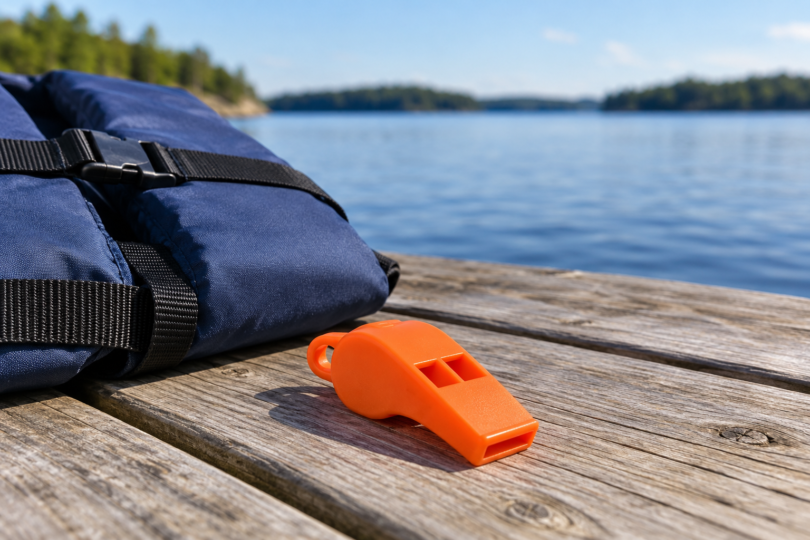

A good whistle for a boat should be easy to reach, usable when wet and clearly identified by its maker. For a straightforward personal whistle, start with the Fox 40 Classic. Consider the ACR WW-3 ResQ when a flat marine-oriented shape matters, or the original Storm All-Weather Safety Whistle when you prefer a larger body to handle. These are practical candidates for personal signaling; choosing one does not automatically satisfy every vessel’s required sound equipment.
Start by deciding whether you are buying a whistle to carry on your life jacket or the sound-signaling appliance required for your boat. Those needs can overlap on a small craft, but a shopping listing that says “marine,” “emergency” or “USCG” is not enough to establish compliance for a larger vessel. Boat length, applicable navigation rules and local requirements all matter.
Compare these three boat-whistle options
| Exact product | Useful design feature | Best reason to choose it | Main buying check |
|---|---|---|---|
| Fox 40 Classic | Three-chamber pealess design; self-clearing chambers | A simple, familiar personal signaling whistle | Selected offer is one black whistle with breakaway lanyard |
| ACR WW-3 ResQ, model 2228 | Flat shape; dual-tone sound | A low-profile option to consider for life-jacket carry | 2228 is the carded version; 2227 is bulk supply |
| Storm All-Weather Safety Whistle | Water-purging sounding chamber | A larger original Storm body | Distinguish Storm from smaller Windstorm and check pack quantity |
Manufacturer decibel figures are not directly comparable unless the measurement distance, airflow and other test conditions match. They also do not prove that a person aboard another boat will hear you at a particular distance. Treat the design and carry arrangement as the useful starting points, then assess the whistle’s role in your complete safety equipment.
1. Fox 40 Classic: our straightforward personal-whistle pick

Fox 40 Classic Whistle with Breakaway Lanyard, Black, One Whistle
As an Amazon Associate we earn from qualifying purchases.
The Fox 40 Classic uses three sound chambers without a moving pea. Fox 40 says the chambers are designed to clear when submerged and lists a 115 dB sound-power figure. This selected listing is the black Classic with a breakaway lanyard, sold as one whistle. The manufacturer also sells other attachment configurations, so check the exact version in your cart.
This is the easiest starting point for someone who wants a dedicated whistle without building the decision around specialty materials or extra accessories. The absence of a moving pea removes that particular moving component from the design. It does not mean the whistle can never be blocked, damaged or misplaced. Check the mouthpiece and chambers along with your other gear before heading out.
The included neck lanyard is an accessory, not an instruction to wear a loose cord around your neck while boating. Work with the attachment arrangement recommended for your life jacket and activity. A whistle clipped somewhere you cannot reach while wearing the jacket has little practical value, even if it was easy to find on the product page.
- Pros: pealess construction; self-clearing chamber design; several attachment versions available.
- Cons: the selected black version is less visually conspicuous than bright alternatives; the included lanyard may not suit your preferred carry method; no universal vessel-compliance assurance.
2. ACR WW-3 ResQ: flat design for a marine gear kit
The ACR WW-3 ResQ is a flat, dual-tone whistle. ACR describes a shape that avoids retaining water and specifies sound up to 100 decibels. Its product numbers distinguish the carded 2228 from the bulk 2227. Choose the carded version when you want an individually packaged item and inspect what attachment comes with the actual package.
The flat shape is the reason to shortlist this model. If a bulky whistle interferes with a jacket pocket or the way your gear sits, compare the ACR’s profile first. The goal is to find an item you will keep accessible, rather than one you eventually move into a storage compartment because it gets in the way.
ACR’s product page uses broad language about meeting USCG requirements. That statement should not be read as approval for every boat, vessel length or sound-signal duty. The specific navigation-rule requirements below still apply. Also avoid deciding that its lower advertised decibel number necessarily means inferior real-world signaling: the manufacturers’ figures are not a controlled comparison.
- Pros: flat body; dual-tone design; clear carded-versus-bulk model numbers.
- Cons: packaging and attachment details need checking; broad compliance language needs vessel-specific interpretation; no guaranteed hearing distance.
Check the ACR WW-3 ResQ 2228 and dealer options.
3. Original Storm: for buyers who prefer a larger whistle

The original Storm All-Weather Safety Whistle uses a sounding chamber that its maker says purges water when blown. The maker’s Storm and Windstorm comparison identifies Windstorm as the smaller version. If you are shopping for the original Storm, check the name and shape rather than assuming every listing from the brand is the same whistle.
A larger body is worth considering if tiny whistles feel awkward to locate and hold. That is a fit preference to check with your own hands and clothing, not a reason to assume louder output or easier use for everybody. Make sure the size works with your intended attachment point and leaves the mouthpiece accessible.
Storm’s marketing emphasizes extreme loudness and underwater operation. Neither claim makes the whistle a replacement for required navigation equipment or an assured way to contact a distant boat. For this shortlist, the relevant features are the original model’s larger format and water-purging design. The selected offer is one orange Storm with a lanyard. Check the quantity carefully: sellers offer different packs and attachment combinations.
- Pros: larger original body; manufacturer-described water-purging chamber; useful alternative to a flat whistle.
- Cons: greater bulk than the smaller Windstorm; pack and lanyard variations; advertised loudness does not establish effective range.
Check the manufacturer’s Storm purchasing options.
When does a whistle meet a boat’s sound-signal requirements?
Under U.S. Inland Rule 33, a vessel under 12 meters that does not carry the prescribed sound appliances must have another means of making an efficient sound signal. At 12 meters and above, a compliant whistle is required; at 20 meters, a bell is also required; at 100 meters, a gong is added. The rule’s “whistle” has a technical meaning tied to Annex III, rather than simply meaning any mouth-blown product.
These are navigation-rule thresholds, not a certification of the three products above. For a vessel 12 meters or longer, select documented compliant equipment appropriate to that vessel. For a kayak, canoe or small recreational boat, confirm that your device and its use meet the rules for your waters. The Coast Guard’s International and U.S. Inland navigation rules provide the wider context; state and local requirements may also apply.
Learn the signals for your actual situation rather than relying on a universal “three blasts means help” shortcut. Maneuvering, warning and restricted-visibility signals have specific meanings. For example, Inland Rule 35 separately addresses restricted visibility and small-vessel alternatives. A product purchase does not replace understanding when the applicable signal must be made.
What to check before choosing and carrying one
Try the intended carry position while actually wearing your life jacket. Can you reach the whistle with your usual layers on, and can you bring it to your mouth without removing the jacket? Follow the jacket manufacturer’s attachment guidance and avoid loose, snag-prone arrangements. NRS specifically warns against attaching a whistle to the jacket’s zipper pull, because pulling it can accidentally unzip the jacket.
Make inspection part of packing: look for a cracked body, obstructed mouthpiece, damaged attachment or a missing whistle. An occasional function check in an appropriate setting is more useful than discovering a problem on the water. Keep loud sound away from people’s ears. Choose a carry arrangement you will use consistently and store a replacement where you can find it before the next trip.
At checkout, compare the exact model, number of whistles, attachment type and total delivered price. Buying a multipack may make sense for equipping several jackets, but only if each person can use and reach the whistle. Do not pay extra for a promised rescue distance or an unsupported “legal for every boat” badge. A clearly identified product and sensible carry setup are more useful buying criteria.
Frequently asked questions
Which whistle is the best starting choice for a boat?
The Fox 40 Classic is our straightforward personal-whistle pick. Choose the ACR WW-3 ResQ if a flat shape fits your kit better, or the original Storm if you prefer a larger body. Confirm the separate sound-equipment requirements for your vessel.
Does any whistle make my boat legally compliant?
No. The applicable rules depend on vessel length and operating waters. A personal mouth whistle is not automatically an Annex III-compliant vessel whistle. Check the appropriate navigation, state and local requirements.
Is a pealess whistle always the best option?
It removes the moving pea from the design, which is one reason to consider the Fox 40 Classic. Still check wet-use design, accessibility, condition and your ability to sound it. “Pealess” does not mean impossible to obstruct or damage.
Can I compare whistles by decibels alone?
No. A useful comparison needs matching test conditions, including distance and airflow. An advertised number does not establish hearing range on your water or certify compliance with vessel sound-appliance specifications.
Where should I attach a boat whistle?
Use an accessible point compatible with your life jacket’s instructions and activity. Avoid its zipper pull and loose cords that can snag. Check reach while wearing the jacket; the whistle should remain usable without taking the jacket off.