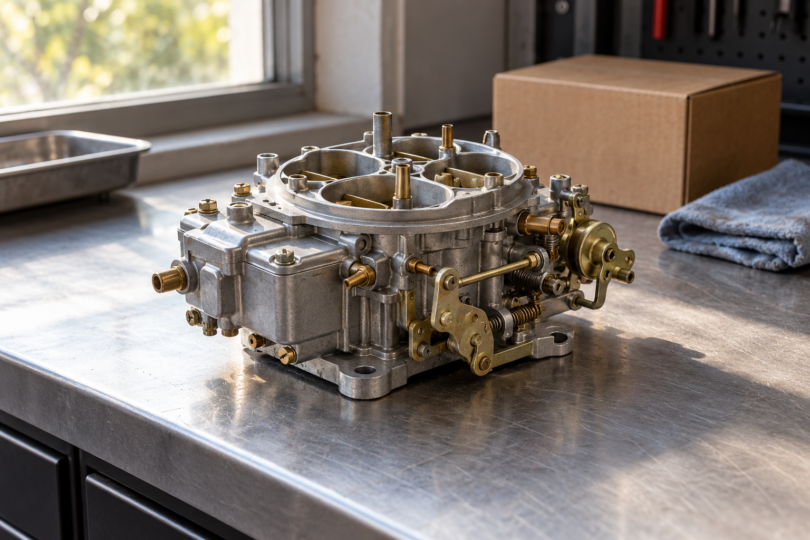

The best carburetor for a 305 Chevy depends on the intake manifold, transmission and emissions equipment already on the vehicle. For a mild, non-computer-controlled engine with a suitable square-bore intake, the Edelbrock AVS2 1901 is our first option to compare: its 500 CFM rating and single-carb calibration suit the small-engine brief. The Edelbrock Performer 1406 offers a conventional 600 CFM alternative, while the Holley Street Warrior 0-80457S is the choice to consider if you prefer vacuum-operated secondaries.
These are conditional automotive recommendations, not universal replacements for every Chevrolet 5.0-liter engine. A factory feedback Quadrajet, two-barrel setup or fuel-injected engine needs a different decision before buying. None of the three carburetors below should be bought for a boat: the automotive 1406 is not Edelbrock’s marine 1409.
Compare the three carburetors
| Carburetor | Key specification | Best reason to choose it | Main limitation |
|---|---|---|---|
| Edelbrock AVS2 1901 | 500 CFM; electric choke; square flange; annular primary boosters | First comparison for a mild small-displacement single-carb setup | Non-EGR; not a computer-controlled replacement |
| Edelbrock Performer 1406 | 600 CFM; electric choke; square flange; air-valve secondaries | Conventional Performer-family option | More rated airflow does not guarantee more usable power |
| Holley Street Warrior 0-80457S | 600 CFM; electric choke; square bore; vacuum secondaries | Holley-style street setup with demand-operated secondaries | Holley discourages adapters to spread-bore manifolds |
Check the existing installation first
Record the vehicle year, exact engine, current carburetor identification, intake casting or part number, transmission and any engine modifications. Photograph the existing linkage, choke arrangement, vacuum connections and emissions label. An engine displacement alone cannot establish mounting compatibility or which original functions the replacement must retain.
- Intake flange: all three choices use a square-bore flange. A factory Quadrajet spread-bore manifold is a different interface. Edelbrock specifies particular adapter arrangements for compatible applications; Holley’s manual discourages converting its square-flange carburetor to a spread-bore manifold with an adapter. Follow the exact carburetor and manifold documentation rather than buying a generic adapter.
- Choke and clearance: these selected models have electric chokes. A divorced or hot-air choke arrangement does not establish the correct electrical supply. Check the specified choke wiring, air-cleaner diameter, fuel-inlet position, hood clearance and any added adapter height with the installer before ordering.
- Throttle and transmission: confirm throttle travel, return springs, cable brackets and automatic-transmission linkage. For Edelbrock/Carter AFB applications using GM 700R4, 2004R or 4L60 transmissions, Edelbrock specifies its 8026 TV-cable adapter. Holley warns that incorrect overdrive TV-cable adjustment can damage the transmission. This is a reason to involve a qualified transmission technician.
- Feedback and emissions: Edelbrock explicitly excludes computer-controlled applications, including some GM feedback Quadrajet systems. Do not assume that removing an electrical connector makes a conventional carburetor compatible. If the vehicle must retain that system, start with a correctly identified original-equipment replacement or specialist rebuild.
1. Edelbrock AVS2 1901: first choice for a mild compatible setup
The AVS2 1901 is a 500 CFM, four-barrel, electric-choke carburetor in satin finish. Edelbrock specifies it for small-block single-carb applications. Its annular primary boosters and adjustable secondary air door distinguish it from the conventional Performer design. Confirm that the seller identifies the current AVS2 version; a listing titled “1901 Q-Jet” leaves the product identity ambiguous.
For an otherwise mild 305, this is the most logical place to begin comparing the three. You are choosing a relatively modest airflow rating and an adjustable air-door design, not paying for a large race-oriented carburetor simply because the engine has eight cylinders. The AVS2’s booster design is its main reason to consider it over the 1406; the manufacturer describes it as improving fuel atomization. That does not establish a measured horsepower or economy gain on your particular engine.
Pros: 500 CFM single-carb calibration, electric choke, annular boosters and documented metering parts. Cons: non-EGR configuration, no computer-feedback compatibility, and possible extra costs for manifold adapters, fuel plumbing and transmission hardware. Choose this only after those requirements are settled.
Compare the AVS2 1901 in Edelbrock’s catalog. Ask the seller to confirm AVS2, 500 CFM, single-carb calibration and electric choke. A listing that merely says “1901 Q-Jet” is not a sufficiently clear match.
2. Edelbrock Performer 1406: conventional 600 CFM alternative
The 1406 is a 600 CFM, electric-choke, square-flange Performer carburetor with a non-EGR specification. Edelbrock describes its calibration as economy-oriented for small-block and small-displacement big-block engines, and recommends it for Performer-level applications. “Economy-oriented” describes the manufacturer’s calibration intent; it is not a promised fuel-consumption improvement.
Consider it when the vehicle already has a compatible Performer-style installation, or when the technician maintaining your car prefers the familiar metering-rod system. Compared with the AVS2 1901, its appeal is a conventional design and established application documentation. The additional rated airflow is not, by itself, a reason to replace a correctly functioning 500 CFM carburetor.
Pros: electric choke, air-valve secondary operation and extensive manufacturer tuning documentation. Cons: it lacks the AVS2’s annular-booster design, still needs application checks, and must not be confused with a marine carburetor. Edelbrock identifies the 1409 and 1410 as marine models; sharing a brand or CFM rating does not transfer that approval to the 1406.
Check the Performer 1406 specification with Edelbrock. Order by the full part number and choke type: the related 1405 has a manual choke and a different calibration.
3. Holley Street Warrior 0-80457S: vacuum-secondary option
The Street Warrior 0-80457S is a 600 CFM Model 4160 carburetor with electric choke, a square-bore flange and vacuum-operated secondaries. Holley positions it for stock to mildly modified V8 street engines. Its secondary system responds to engine demand; it is not a mechanical-secondary double-pumper.
This is the alternative to compare when your intake and supporting hardware suit Holley’s layout and your installer is comfortable servicing that design. The model-specific Holley manual is especially useful because it covers manifold compatibility and GM transmission-linkage requirements. Confirm those before treating it as a straightforward swap.
Pros: demand-operated secondaries, electric choke and model-specific installation and service documentation. Cons: spread-bore adapter restrictions, application-dependent linkage parts and limited emissions applicability. Holley’s narrow historical replacement allowance does not establish that this carburetor is legal on a particular 305-powered vehicle. The manufacturer also lists marine use as “No.”

Holley Street Warrior 0-80457S 600 CFM Electric-Choke Carburetor
As an Amazon Associate we earn from qualifying purchases.
How much airflow does a 305 need?
CFM is an airflow rating, not a horsepower rating or a fitment code. The useful choice depends on the engine’s operating speed, breathing ability and intended use. For this shortlist, the 500 CFM AVS2 earns first consideration because Edelbrock specifies its single-carb small-block application; the 600 CFM options remain alternatives for a matched setup. A heavily modified engine deserves a recommendation from its builder using the actual camshaft, heads, intake and operating range.
Do not reject an original Quadrajet solely because its advertised airflow exceeds these numbers. Its configuration and calibration are a different buying question. Equally, do not choose a 750 CFM replacement merely because a marketplace title mentions Chevrolet. Diagnosing the existing fault and retaining the right original functions can be more valuable than increasing the nominal rating.
Fuel-system safety and the real installed cost
For the Edelbrock models covered by its Performer and AVS2 instructions, fuel pressure must not exceed 6.5 psi; the manual recommends 5.5 psi when an adjustable regulator is used. Excessive pressure can cause flooding. A pump advertised as “5–9 psi” therefore cannot be assumed suitable throughout its range. These figures must not be transferred to the Holley without checking its own instructions.
Fuel-system work can cause fire or explosion. Edelbrock requires ventilation and keeping flames, sparks and other ignition sources away. Have a qualified installer verify fuel delivery, filtration, hose compatibility, leak-free connections and free-returning throttle operation. If fuel leaks or flooding appear, stop operating the vehicle and have the fault corrected. Do not improvise fuel passages or substitute a marketplace installation video for the manufacturer’s instructions.
Compare the complete installed cost: carburetor, required manifold or adapter, appropriate gaskets, filter and fuel fittings, choke wiring, throttle bracket, transmission adapter, air-cleaner clearance and professional setup. Have emissions suitability confirmed for the vehicle and location before purchase. A cheaper carburetor that needs extensive changes can be the more expensive choice; a correct rebuild is also worth pricing before replacing a matched factory system.
Frequently asked questions
Will any four-barrel carburetor fit a Chevy 305?
No. Engine displacement does not identify the manifold flange, choke system, linkage, transmission controls or emissions requirements. A square-bore carburetor is not automatically a direct replacement for a spread-bore Quadrajet, a two-barrel carburetor or fuel injection.
Should I buy a 500 or 600 CFM carburetor?
For a mild compatible single-carb setup, start by comparing the 500 CFM AVS2 1901. The 600 CFM 1406 and 0-80457S are reasonable alternatives when matched to the installation. Let actual engine modifications and intended operating range decide, rather than assuming bigger is better.
Can I replace a computer-controlled Quadrajet with these Edelbrocks?
Edelbrock says its Performer and AVS/AVS2 carburetors are not for computer-controlled applications. Identify the original system and obtain an appropriate replacement or rebuild recommendation before buying. The conventional carburetor’s physical mounting does not establish electronic or emissions compatibility.
Can the Edelbrock 1406 be used on a boat?
No. The 1406 is the automotive Performer model discussed here. Edelbrock separately identifies marine carburetors, including the 1409. A marine engine requires the correct marine-rated components for its exact application; none of this shortlist is a marine recommendation.
Does an electric choke remove the need for tuning?
No. It automates choke operation once correctly installed, but fuel pressure, idle, linkage, transmission controls and application-specific calibration still need verification. Have the installer use the exact manufacturer’s instructions and check operation under the vehicle’s actual conditions.