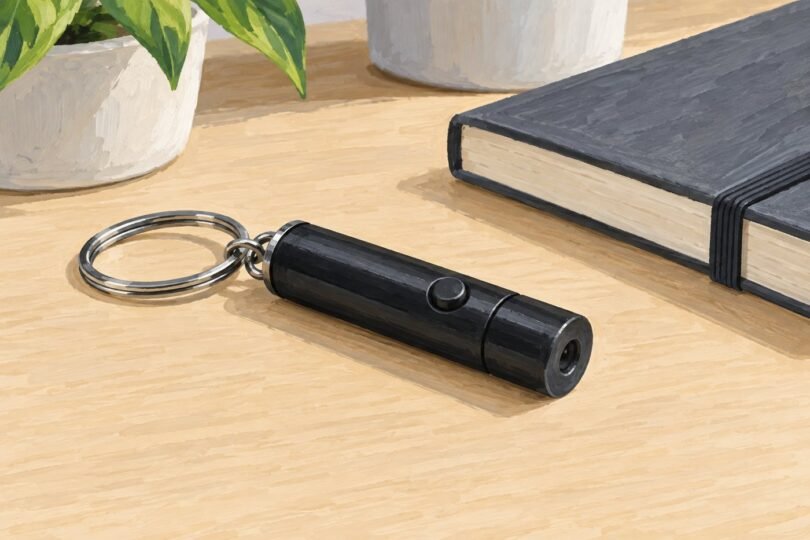

A keychain laser pointer should be easy to identify, difficult to activate accidentally and supplied with clear laser-class and output information. For ordinary close-range pointing, look first at a documented low-power red model. A small housing, USB charging or an impressive distance claim does not establish that a pointer is suitable or safe.
Three relevant models with manufacturer documentation are the Hama LP-LC1, ANSMANN Laserpointer 2in1 1600-0270 and Quarton INFINITER Micro 200. They have different laser classifications and controls. The comparison below explains those differences and the checks to make before purchase; it does not claim hands-on beam testing or certify individual units.
What to check first
- Exact model: match the product, instructions and warning label, rather than relying on a photograph of a similar metal tube.
- Laser specification: look for the class, output in milliwatts and wavelength. A flashlight’s lumen rating tells you nothing about its laser.
- Controls: consider whether a button can be pressed by other keys in a pocket or bag.
- Power source: identify the correct batteries or charging requirements and how securely the compartment closes.
- Intended use: check whether the manufacturer permits the environment and application you have in mind.
A laser pointer produces a small directed spot. An ordinary keychain LED flashlight illuminates a nearby area, while a laser distance meter measures distance. These are different tools, even when retail search results mix them together.
Hama LP-LC1: the lowest published output here
The Hama LP-LC1, model 00003502, is a red keychain pointer with a snap hook. Hama specifies Class 1, maximum output of 0.35 mW, 640 nm wavelength and three LR44 batteries. The current manufacturer’s page identifies a 69 mm body length.
Why consider it: it has the lowest documented output of these three examples. It is worth comparing for nearby pointing when that meets your needs. Do not interpret the classification as permission to aim at eyes or treat the device as a toy.
Check first: Hama specifies private, non-commercial household use. This is European manufacturer documentation; confirm the exact model, supplied instructions and required market labeling with the seller. It is a basic pointer rather than a wireless slide controller.
ANSMANN Laserpointer 2in1: laser and LED in one
The ANSMANN 1600-0270 product page describes a compact black keychain unit with a red laser and a separate white LED. It includes three LR41 alkaline button cells, a keychain and a snap hook.
Its model-specific manual specifies a 650 nm red laser, Class 2, with output below 1 mW. The laser and LED work while their respective switch is held. That momentary control avoids a deliberately latched-on mode, although pressure from other objects can still hold a button down.
Why consider it: it has model-specific documentation and combines two distinct light functions. If you want a red pointer for occasional indoor use, this is a useful specification reference.
Important limits: the manual restricts it to indoor, private household use and says to keep it dry. It is not described as waterproof or as a commercial-duty tool. The European Class 2 documentation is not, by itself, proof that every imported retail unit has the labeling required in your country. Request the actual supplied label before buying an import.
Quarton INFINITER Micro 200: a compact presentation pointer
Quarton INFINITER Micro 200, Red 650 nm Keychain Laser Pointer, Chrome Silver, 1 Pointer
As an Amazon Associate we earn from qualifying purchases.
The Quarton Micro 200 specification identifies a red 650 nm keychain pointer with a momentary switch, solid-brass housing and chrome-silver finish. It uses three LR44 batteries. The manufacturer’s store identifies the model as Micro 200 and gives UPC 705702105120.
Why consider it: the compact teardrop shape and latch-on keychain suit someone who wants a dedicated pointer rather than a combined flashlight. Its momentary switch requires continued pressure to operate.
Important limits: Quarton’s technical table classifies it as Class IIIa with output below 5 mW; accompanying text says its control circuit keeps power below 3 mW. That is a higher published output than the Hama or ANSMANN examples. Do not turn the manufacturer’s reassuring marketing language into a promise that direct eye exposure is harmless.
The manufacturers’ pages differ on weight, dimensions and continuous runtime, so those numbers are not used to rank this model. Check the supplied label and instructions, and confirm that you are ordering one Micro 200, not the larger INFINITER 100 or another family model.
Why a higher power rating is not a better specification
The FDA explains that US products promoted for pointing and demonstration are limited to Class IIIa/IEC 3R, including a 5 mW limit in the visible range it describes. That is a regulatory ceiling, not a recommended target for every purchase or a guarantee against eye injury.
For a nearby chart or physical object, first consider whether a lower-power, properly labeled pointer will do the job. Brightness also depends on color, ambient light, distance and the surface. A retailer’s “high power” or “military grade” phrase provides no useful assurance about quality.
Do not buy a device advertised for burning, balloon popping or similar demonstrations as an everyday pointer. Avoid products with no output marking or inconsistent class and power information. Do not modify a pointer to increase output, remove protective parts or defeat its controls.
Read the label, not just the listing
The FDA’s consumer guidance recommends checking for a compliance statement, the manufacturer or distributor, manufacture date, radiation warning and class designation. Its laser-pointer safety notice also emphasizes output and hazard labeling.
Ask the seller for a legible image if the listing hides the label. A familiar housing can be sold with different internals, and a product family name does not verify an individual unit. If the delivered label conflicts with the order or instructions, stop and resolve the discrepancy before use.
A rechargeable design can reduce the need to handle loose batteries, but charging convenience does not validate the laser itself. Check class and output independently. Likewise, a “cat toy” heading does not establish eye safety or make a device appropriate for children.
Safe handling matters even at low power
Plan where the spot will land before pressing the button. Use a nearby matte surface with no people or animals in the beam path, and avoid mirrors and reflective surfaces. Keep the pointer off while turning toward an audience or putting it away. Never look into the aperture or use magnifying optics to inspect an operating beam.
The FDA says never to aim a laser at a person, animal, vehicle or aircraft and not to buy laser pointers for children or let them use pointers as toys. If an eye injury is suspected, seek medical attention promptly.
The FAA warns that aiming lasers at aircraft is dangerous and violates federal law. Do not test a keychain pointer’s advertised range by shining it into the sky or toward traffic. A compact pointer remains capable of distracting someone who is driving or operating equipment.
Battery storage and everyday carry
Store the device where a child cannot reach it, including when attached to car or house keys. Keep new and used button cells secured, and stop using a pointer whose battery compartment is damaged or will not close properly.
The CPSC warns that swallowed button batteries can cause severe internal injury. Suspected swallowing requires immediate medical attention. Never hold these cells in your mouth while replacing them.
Use only the specified battery type and orientation. Do not try to recharge disposable LR41 or LR44 cells. If you need a device every day for work, compare control ergonomics, secure storage and the employer’s rules before choosing the smallest possible keyring model.
The practical buying decision
Compare Hama for its lower documented output, ANSMANN for separate laser and LED functions, and the Micro 200 for its compact presentation-pointer design, subject to the supplied label and local requirements. Prioritize traceable specifications and suitable controls over range. If the seller cannot establish what laser you are getting, choose a better-documented listing or postpone the purchase.
Image note: AI-generated generic editorial illustration; not a photograph of a named or tested product.