Good ham radio headphones should make received speech or CW comfortable to follow without complicating your station. Start by deciding whether you need listening-only headphones or a headset with a microphone. The three models below are wired, listening-only headphones; they suit operators who already use a hand, desk, or boom microphone, or who mainly listen and operate CW.
The Heil Pro Set 3 is worth considering for its detachable cables and phase-reversal switch. The Sony MDR-7506 offers a familiar closed-back studio design with a coiled cable, while the Audio-Technica ATH-M20x is a straightforward alternative with a long straight cable. Check your radio’s headphone-output specifications before choosing among them.
Choose the connection before choosing the headphones
- For receiving audio: find the radio’s headphone jack and check its plug size, stereo or mono wiring, and recommended headphone impedance.
- For transmitting speech: you also need a compatible microphone, its wiring, and a push-to-talk or supported VOX arrangement.
- For a handheld radio: identify the exact accessory connector. A two-pin headset for one radio family is not automatically compatible with another.
- For computer-based operation: connect to the audio output used by your software. A USB headset is a different interface from a conventional analog radio headphone socket.
A 3.5mm-to-6.35mm adapter changes the plug size. It does not correct microphone wiring, supply required microphone bias, or turn headphones into a transmit headset. Avoid ordering a bundle of adapters before checking the manual for your actual transceiver.
Heil Pro Set 3: for a station-focused listening setup
The Heil Pro Set 3, model PS3, is a closed-back dynamic headphone with 40mm drivers and a specified impedance of 32 ohms. Heil lists a weight of 198g and a 3.5mm plug with a 6.35mm adapter. Its original specification sheet includes amateur radio among its intended applications.
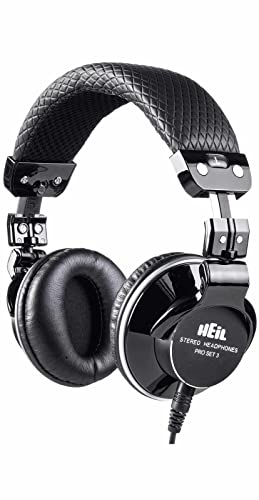
Heil Sound PS3 Pro Set 3 Wired Headphones, Black, 1 Pair
As an Amazon Associate we earn from qualifying purchases.
Why consider it: the phase-reversal switch changes the relative phase between the two earcups, offering a different spatial presentation. Treat that as a listening preference to try, rather than a guaranteed improvement in copying weak signals. It does not replace the transceiver’s filtering or remove radio-frequency interference.
Heil also documents three detachable, twist-lock cables, including straight and coiled choices. That gives more flexibility in arranging the operating desk and replacing a cable than a permanently attached lead. Confirm the accessories included by the seller, especially for used or open-box stock.
Limitation: the Pro Set 3 has no boom microphone. Despite the similar family names, it is a different product from Heil’s transmit headsets. Choose it when you want receive audio and already have a microphone solution, or when transmitting speech is not part of your intended use.
Sony MDR-7506: for a wired radio and studio crossover
The black Sony MDR-7506 is a closed dynamic headphone with 40mm drivers and 63-ohm impedance. Sony specifies a 9.8-foot cord, approximately 8.1-ounce weight, and a stereo plug arrangement that supports both 3.5mm and 6.35mm connections. A protective pouch is included.

Why consider it: it is a useful candidate if the same headphones will serve at the radio, an audio interface, and a computer. The folding design and coiled lead can be convenient for a desk with equipment spread across more than one position.
Tradeoff: the cable is fixed, so cable damage is less straightforward to address than with a detachable design. A coiled lead also pulls back as it extends; check that it will reach your operating position comfortably. Its 63-ohm specification is higher than the other two choices here, so verify the radio’s recommended load and available output rather than assuming all three will reach the same volume.
This is another receive-only choice. The MDR-7506 does not include a microphone, radio interface cable, or push-to-talk switch. Select the standard headphone package rather than a similarly named bundle unless you actually need its extra items.
Audio-Technica ATH-M20x: for a simple straight-cable setup
The black wired Audio-Technica ATH-M20x uses a closed-back dynamic design with 40mm drivers. Audio-Technica specifies 47-ohm impedance, 190g weight without cable and connector, and a 3-meter straight cable exiting the left earcup. The package includes a 6.3mm snap-on adapter.

Why consider it: a straight cable can route neatly behind equipment without the spring tension of a coiled lead. It is a reasonable model to compare when you want conventional analog headphones and do not need detachable cables or the Heil’s phase switch.
Tradeoff: the long fixed cable needs management around a small station or portable setup. Leave enough slack for turning your head, but keep the excess away from chair wheels and controls. Buy the wired ATH-M20x discussed here; similarly named wireless models are different products.
Audio-Technica describes tuning aimed at enhanced low-frequency performance. That is a studio design choice, not proof of superior speech intelligibility on a radio. Your receiver’s audio settings, background noise, and the physical fit will affect what is comfortable to follow.
Comfort, isolation, and receiver settings
Closed-back earcups can reduce surrounding room noise, but none of these recommendations should be treated as certified hearing protection. They also cannot remove static or interference already present in the received signal. Try the radio’s appropriate filtering and audio controls before turning up the volume to overcome an unpleasant sound.
Comfort depends on more than the published weight. Check whether the cushions fit around your ears, whether your glasses disturb the seal, and whether headband pressure remains comfortable during an ordinary operating session. A seller’s return terms are useful when you cannot try the headphones first.
Start with the radio volume low before plugging in, then raise it only as much as needed. Lower it again before changing sources or equipment. For dual-receiver operation, confirm that the radio can route the desired channels to the headphone output; stereo headphones alone do not create separate receiver feeds.
If you need a microphone as well
Choose the transmit headset against your exact radio model. Heil’s BM-17 documentation, for example, distinguishes dynamic and iC electret versions and explains separate microphone, headphone, and PTT connections. The iC element requires bias power and the appropriate adapter. That illustrates why a headset’s connector shape or brand name is insufficient to establish compatibility.
Before buying, confirm the microphone element type, connector pinout, required adapter, and how you will key the transmitter. A gaming headset with a combined four-pole plug or a Bluetooth earpiece may need additional supported hardware. Do not assume a consumer wireless headset can pair directly with a transceiver simply because both devices handle audio.
The practical shortlist
Compare the Heil Pro Set 3 when detachable leads and its phase switch matter. Compare the Sony MDR-7506 when you prefer a folding design and coiled cable for mixed radio and audio work. Compare the ATH-M20x when a basic wired, straight-cable setup fits your desk. The best match is the one that meets the radio’s connection requirements and stays comfortable at a sensible listening level.
Image note: AI-generated generic editorial illustration; not a photograph of a named or tested product.