
The right 90-degree inverted flare fitting is the one that matches both connections and the system it serves. Start with the tube outside diameter, thread specification, sealing seat and required application rating. A brass elbow that turns the line through the right angle can still be completely wrong for the port.
For a documented 3/16-inch brake hardline connection to a female 1/8-inch NPT port, Allstar Performance ALL50125 is a clearly specified option to investigate. It is not a universal brake adapter, and it is not interchangeable with an AN elbow, a bubble-flare fitting or a hose barb. This guide compares connection requirements rather than claiming hands-on pressure testing.
A specific option: Allstar Performance ALL50125
Allstar identifies ALL50125 as a brass, 90-degree adapter supplied in a four-pack. One end is male 1/8-inch NPT; the other is female 3/8-24 inverted flare for 3/16-inch hardline. Its product information places it in the manufacturer’s brake-fitting range.
The Amazon listing below matches that exact part number, connection pair and four-piece quantity. Consider it only when your component documentation calls for those connections. The 3/16-inch figure describes the tubing, while 3/8-24 describes the flare-end thread. They are different measurements of different features, not conflicting sizes.

Allstar Performance Fitting, Adapter, 90 Degree, 3/8-24 in Inverted Flare Female to 1/8 in NPT Male, Brass, Natural, 3/16 in Hardline, Set of 4
As an Amazon Associate we earn from qualifying purchases.
Important limit: the reviewed product page does not provide a numeric working-pressure rating. Do not invent one, infer a fuel-injection rating, or treat this listing as approval for every vehicle. Obtain any application-specific pressure, fluid, temperature and installation requirements from the component manufacturer before purchase.
Decode the specification before comparing prices
| Specification | What it describes | What to confirm |
|---|---|---|
| 90 degrees | The direction change through the elbow | Installed clearance and line routing |
| 3/16-inch tube | Hardline outside diameter | The line itself, not its fitting hex |
| 3/8-24 | Nominal thread diameter and threads per inch | Thread size plus the required sealing seat |
| 1/8-inch NPT | A nominal tapered pipe-thread size | A matching NPT port, not a metric or straight-thread port |
| Inverted flare | The tube-end connection and internal sealing arrangement | The specified flare form and mating seat |
Write the full connection description for each end on your shopping list. “Small brass brake elbow” loses the information that matters. A supplier should be able to identify the part from its manufacturer’s number and drawing without guessing from a thumbnail photograph.
NPT and inverted flare seal differently
An inverted-flare connection seals at its mating metal surfaces inside the fitting. The threads draw those surfaces together. Parker describes this internal metal-to-metal seal in its brass connector catalog. Thread sealant cannot correct a damaged flare or a mismatched seat.
NPT uses tapered threads. Its sealing and assembly instructions therefore differ from the flare end of the same adapter. Follow the exact fitting and component instructions for approved sealant and tightening; do not apply one generic procedure to both ends. Keep sealant and debris out of the fluid passage.
A fixed elbow also has to finish at an appropriate angle without improper tightening. If the required orientation cannot be achieved according to the component instructions, stop and have the connection arrangement reviewed. Do not loosen a completed connection simply to point it in a more convenient direction.
Similar-looking fittings that are not substitutes
- AN/JIC flare adapters: a common AN connection uses a 37-degree seat. Wilwood’s fitting instructions distinguish this from pipe-thread and other sealing arrangements. An AN elbow is not an inverted-flare elbow just because its thread diameter seems familiar.
- Bubble-flare parts: these need their own matching seat. SUR&R’s brake-line catalog separately identifies inverted-flare and bubble-flare nuts and adapters, including different M10 × 1.0 parts.
- Hose-barb elbows: a listing mentioning inverted flare on one side and hose size on the other describes a different connection. Do not use an ordinary barbed-hose fitting as a hydraulic brake-line substitute.
- Pipe-only elbows: an NPT-to-NPT elbow has no inverted-flare seat. Adding the word “brass” or “automotive” to a listing does not change that.
- Metric and inch fittings: near-matching diameters do not establish compatibility. Never force a nut into a port to see whether it will work.
Brake, fuel and other systems need separate checks
“Inverted flare” describes a connection family, not a blanket fluid or pressure approval. A product intended for one circuit may not be suitable for another. For fuel service, ask about the specific fuel, pressure, temperature and any seals in the assembly. For brakes, use parts expressly suitable for the vehicle’s hydraulic braking system and its service requirements.
The elbow is only one component. Tubing material, flare quality, port condition and how the line is supported also matter. A correct adapter cannot repair corroded tubing or compensate for a stressed routing layout. Brake or fuel leaks warrant stopping use and obtaining qualified inspection rather than experimenting with extra sealant.
A practical ordering checklist
- Identify the vehicle or equipment and the exact component receiving the adapter.
- Read the service information for the port type and permitted connection.
- Record the tube outside diameter, nut thread and flare form separately.
- Compare the manufacturer’s drawing with available clearance for the fitting, line and service tools.
- Confirm application suitability and any missing ratings directly with the manufacturer.
- Check the exact part number and pack quantity when the order arrives, before installing anything.
Bottom line
ALL50125 is a useful, precisely identified candidate for a 3/16-inch inverted-flare hardline to 1/8-inch NPT connection. Choose it only when those specifications match the application. For any other combination, find the correct documented fitting rather than stacking look-alike adapters. Have safety-critical installation and testing performed or checked by a qualified technician.
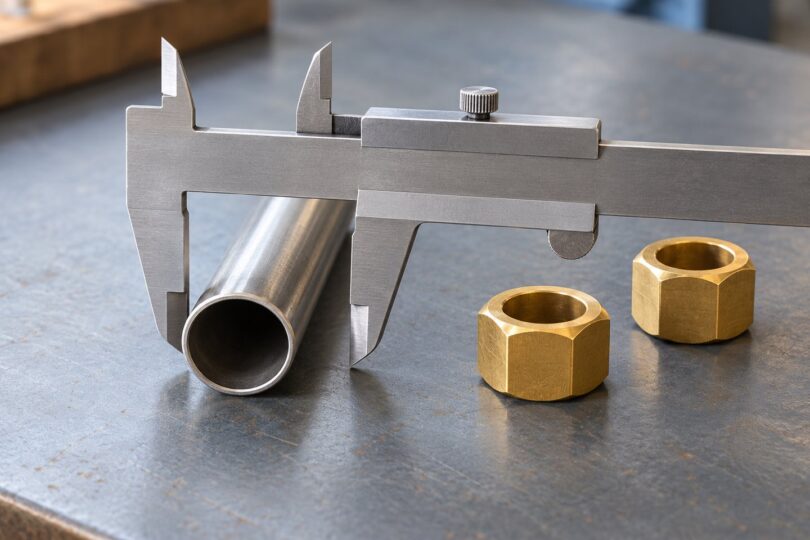
Image note: AI-generated workshop measurement concept; the generic hardware does not depict a particular 90-degree inverted-flare fitting, flare seat, or verified compatible part.