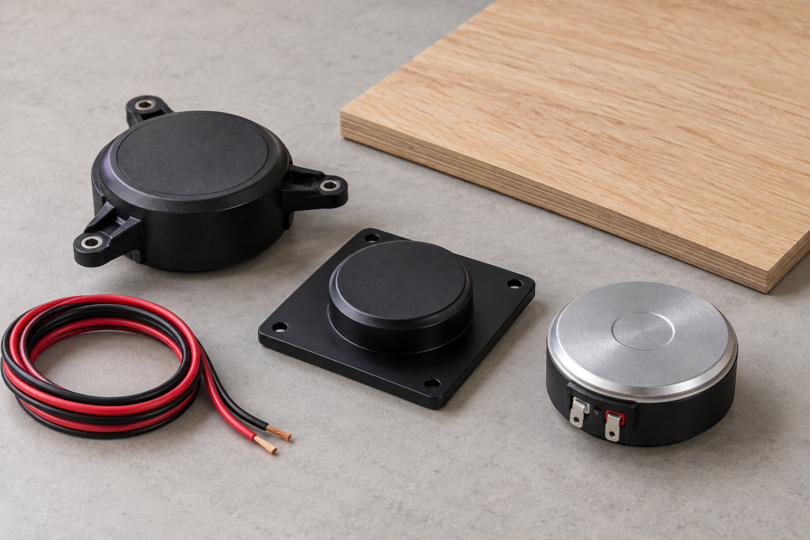

For a DIY surface speaker, the best audio exciter is the one that fits your amplifier and mounting plan. Dayton Audio DAEX25 is our pick when you want a pair of the same model, DAEX58FP offers a mounting plate in a low-profile design, and DAEX32EP-4 Thruster is the option here with a 4-ohm impedance and 40 W RMS power-handling rating.
This guide covers physical surface exciters: transducers that vibrate a panel so it radiates sound. The shopping scope is the exciter component for a DIY speaker project. Recommendations below compare documented specifications and mounting features; we have not performed listening, loudness, endurance or panel-material tests.
Best audio exciters at a glance
| Selected product and quantity | Nominal impedance | RMS power handling | Mounting feature | Best fit in this comparison |
|---|---|---|---|---|
| Dayton Audio DAEX25, pair of two | 8 ohms per exciter | 5 W per exciter | 3M adhesive pads | Buying two of the same exciter for a small project |
| Dayton Audio DAEX58FP, one exciter | 8 ohms | 25 W | Low-profile design with mounting plate | Planning around a plate mount |
| Dayton Audio DAEX32EP-4, one exciter | 4 ohms | 40 W | Pre-applied 3M VHB adhesive | A build designed for a 4-ohm load |
The watt figures are the manufacturer’s RMS power-handling ratings. They are not measured sound output, a loudness ranking or instructions to run an amplifier at full power. Choose the amplifier and operating level for the complete project; this comparison does not certify a particular amplifier pairing.
Dayton Audio DAEX25: best when you want a pair
The DAEX25 makes the most sense here when your shopping list calls for two identical exciters. Dayton’s DAEX25 specification sheet gives an 8-ohm impedance, 25 mm voice coil and 5 W RMS power handling for the transducer, with 3M adhesive pads for attachment.
The selected Amazon listing is titled “Dayton Audio DAEX25 Pair of Sound Exciters (Black)” and specifies a pair. Buy this as a two-unit package, while checking that the selected offer still names DAEX25. The package quantity does not mean the two devices must share one amplifier channel; your amplifier and connection plan determine the load it sees.
Our recommendation is based on quantity and documented specifications. It does not establish that the DAEX25 will make your panel sound better than the other models. Its own datasheet says frequency response depends on the attached material, so leave room to evaluate the finished assembly.

Dayton Audio DAEX25 Sound Exciters, Pair
As an Amazon Associate we earn from qualifying purchases.
Dayton Audio DAEX58FP: best for a mounting-plate layout
The DAEX58FP is the choice to investigate when a mounting plate suits your layout. The manufacturer datasheet identifies a low-profile design, included mounting plate, 8-ohm impedance and 25 W RMS power handling. Check clearance around the body and terminals before buying.
The linked listing is one DAEX58FP exciter. Use the exact model and the manufacturer’s RMS rating when comparing it with another offer; the listing’s separate maximum-output field does not replace that rating.
A plate mount still needs a suitable surface and attachment plan. Dayton’s technical note describes screw-tab or adhesive mounting for Flat Pack exciters. Check the selected unit’s mounting instructions and your panel before committing to holes or permanent adhesive. This guide does not specify fasteners, adhesive compatibility or a universal mounting method.
Dayton Audio DAEX32EP-4: best for a planned 4-ohm build
Choose the DAEX32EP-4 when you have planned for its 4-ohm nominal impedance and want the 40 W RMS power-handling specification. Dayton’s Thruster datasheet also documents a 32 mm voice coil attached to a steel spider and pre-applied 3M VHB adhesive. Those are the documented reasons to consider it, without assuming it will be the loudest or bassiest option on your surface.
The selected offer contains one exciter. Its title identifies DAEX32EP-4, while the listing’s model-number field adds the suffix “-S.” Confirm the model on the selected item and label. This comparison covers DAEX32EP-4; it does not transfer these specifications to a similarly named replacement or interchangeable-mount model.
An amplifier that permits an 8-ohm speaker load is not automatically suitable for this 4-ohm choice. Check its permitted load for the intended operating mode, especially if the build uses more than one exciter. The manufacturer’s wiring guidance warns against presenting an impedance below the amplifier’s minimum rating.
What to check before buying
- Start with the amplifier. Confirm the permitted speaker load and the connection plan before choosing 4 or 8 ohms. Adding exciters can change the total load; do not assume that buying a pair makes every connection suitable.
- Treat the panel as part of the speaker. Dayton’s technical note on exciters explains that material, placement and edge support affect the result. A thin, lightweight panel is a starting point to investigate, not a guarantee of a particular sound.
- Plan the attachment before making it permanent. Check clearance, the exact mounting design and surface preparation. Dayton recommends a clean, dry surface for adhesive mounting and listening tests before settling on a permanent location. Follow the instructions for the selected exciter and adhesive.
- Read response graphs in context. These datasheets describe measurements on a particular foam-core panel and warn that the actual result depends on the application. Their curves do not establish how a desk, wall, glass sheet or different panel will sound.
- Compare the whole purchase. Check whether the offer is a pair or a single unit and verify any amplifier, wire or mounting supplies separately. This shortlist does not promise an included amplifier or wiring kit, and it makes no current price, stock or lowest-cost claim.
Frequently asked questions
Which audio exciter should I start with?
For two matching units, begin by checking the DAEX25 pair. If a low-profile mounting plate suits the project, compare the DAEX58FP. For a system specifically designed for a 4-ohm load, consider the DAEX32EP-4. These are feature-based choices, not a universal sound-quality ranking.
Is a 40 W exciter necessarily louder than a 25 W model?
The ratings alone do not answer that. Here, 40 W and 25 W describe RMS power handling; they do not provide a listening result for your finished panel. The mounted material and installation affect the sound, and we have not measured these models against each other.
Can I choose any amplifier with the same watt number?
A matching number is not enough. Check the amplifier’s instructions for the permitted speaker load and output in your intended mode, alongside the exciter’s power-handling specification. Dayton specifically cautions against a combined load below the amplifier’s minimum rated impedance.
Will the adhesive work on any surface?
This comparison does not establish that. The DAEX25 documents adhesive pads, the DAEX32EP-4 documents 3M VHB, and the DAEX58FP documents a mounting plate. Confirm the exact surface and attachment instructions before buying or bonding; none of these features is a blanket bond-strength or weather-resistance guarantee.