
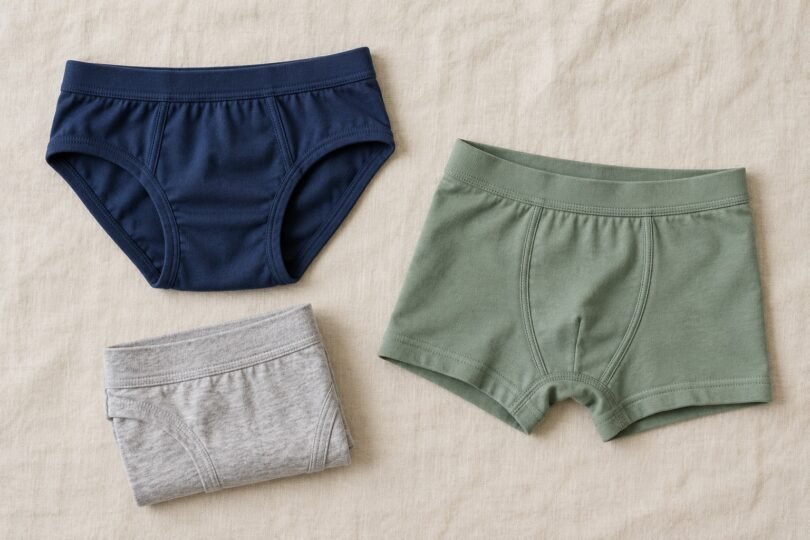

The best boys’ underwear is the pair your child finds comfortable and can manage easily through a normal school day. Start with the current size chart, a familiar fabric and the cut they already like. Waistbands, seams and washing instructions usually matter more than a large multipack or a long list of performance claims.
For a first purchase in an unfamiliar style, buy a small quantity before filling the drawer. A pair that looks similar online can have a different rise, leg length or waistband from the one it replaces.
Two everyday options to compare
Hanes Comfort Flex boys’ boxer briefs, 10-pack
Hanes style B74P10 is a starting point for children who prefer a fitted short-leg style. Hanes lists a tagless interior, a soft-backed waistband and legs designed to stay in place. The page offers assorted colors and sizes S through XL.
Check the composition for the selected pack. Hanes describes cotton or cotton-rich blends depending on color, while its fabric field lists 75% cotton and 25% polyester. Do not assume every color is pure cotton. A design intended to reduce ride-up also does not guarantee a comfortable fit for every child.
Fruit of the Loom boys’ fashion briefs, assorted 10-pack
Fruit of the Loom style 10P46AZ is an alternative for children who prefer briefs without fabric extending down the legs. The manufacturer describes a tag-free construction and soft-touch waistband. It lists different cotton and polyester compositions, including all-cotton solids, so confirm the particular assortment before buying.
Use these as examples of two common cuts. The more useful comparison is whether the size, texture and construction suit your child, rather than which pack has the most pairs.
Choose the size from measurements
Use a flexible measuring tape and follow the instructions attached to the exact product. Keep the tape level and comfortably positioned. Do not rely only on age, the label in school trousers or a size purchased from another brand.
For example, Fruit of the Loom’s boys’ underwear chart places M/10–12 at a 25–26-inch waist and L/14–16 at 27–29 inches. Its guidance says to measure at the usual trouser-waist position, slightly below the natural waist, and choose the next larger listed size when measurements fall between sizes. Those instructions belong to that brand’s chart; they are not a universal conversion for every label.
- Check the product category. Toddler, youth and adult sizes are separate ranges. A similarly named size is not automatically equivalent.
- Check all required measurements. If a chart includes more than waist size, compare the other measurements too.
- Recheck before replacing a pack. Growth and changes to the product can make the old label an unreliable shortcut.
- Avoid excessive growing room. Start with the maker’s recommended size rather than deliberately buying several sizes larger.
Briefs, boxer briefs or boxers?
Briefs have no extended leg section. They can be worth trying when longer underwear bunches under trousers or the child dislikes fabric around the thighs.
Boxer briefs have fitted legs. Compare short and longer cuts, because the extra fabric may be welcome to one child and annoying to another. If the legs repeatedly roll or need adjusting, reconsider both the size and the cut.
Boxers have a looser shape. A child may like that roomier feel, but check how the fabric sits under their usual clothing. Personal preference is a good reason to choose one style over another.
Let your child describe what works in simple terms: too tight, too loose, scratchy, warm or difficult to pull on. Their feedback is more useful than assuming that one design suits every activity.
Look beyond the word “tagless”
A tag-free label addresses one part of the garment. Turn a pair inside out and check the waistband joining seam, leg openings and stitching. Consider whether the elastic feels smooth and whether any raised seam or label edge is likely to bother your child.
If they are particular about clothing texture, compare a new pair with a comfortable pair already in the drawer. Note the waistband width, seam positions, fabric thickness and leg length. Changing one feature at a time makes it easier to work out what they prefer.
Read the fabric label
Compare the actual fiber percentages rather than shopping by a broad term such as “soft,” “performance” or “cotton.” Some children prefer a familiar cotton feel; others like a stretchier blend. There is no need to switch a comfortable everyday fabric just because a different pack advertises extra features.
Check the selected color and pack, not just the first image. An assorted pack may contain more than one fabric blend. Keep the product label or order details if finding the same construction again will matter.
Plan for washing and replacement
Follow the garment’s care label. For the Fruit of the Loom briefs above, the brand specifies cold washing with similar colors, low-temperature tumble drying and no ironing. Hanes recommends cold washing for B74P10. If the packaging differs from an online summary, use the instructions supplied with that pack.
Judge comfort again after the first wash and dry before buying duplicates. Replace pairs when elastic no longer holds its shape, seams fail or the size stops working. Decide how many to buy around your household’s laundry routine, allowing for spare changes rather than chasing the largest bundle.
Before you order
- Confirm the brand, style number, pack count and selected size
- Read the current size chart and composition for that assortment
- Choose a cut and texture your child is willing to try
- Check the seller’s underwear return rules before opening the package
- Keep the first purchase modest until fit and washing results are clear


