
A useful daisy chain for tuna starts with a clear choice: do you want a rig with a hooked trailing lure, or a hookless teaser that draws fish toward another bait? Both can be useful, but they do different jobs. Match the chain’s profile, rigging and handling requirements to the spread you can actually manage.
For a straightforward feather-and-bird rig, the MagBay option below includes a hooked end lure. For a larger squid-and-bird teaser presentation, Squidnation’s original Flippy Floppy Thing is worth comparing. Neither is a guaranteed way to catch tuna, and neither should be selected only because its leader has the biggest breaking-strength number.
Hooked chain or teaser: decide this first
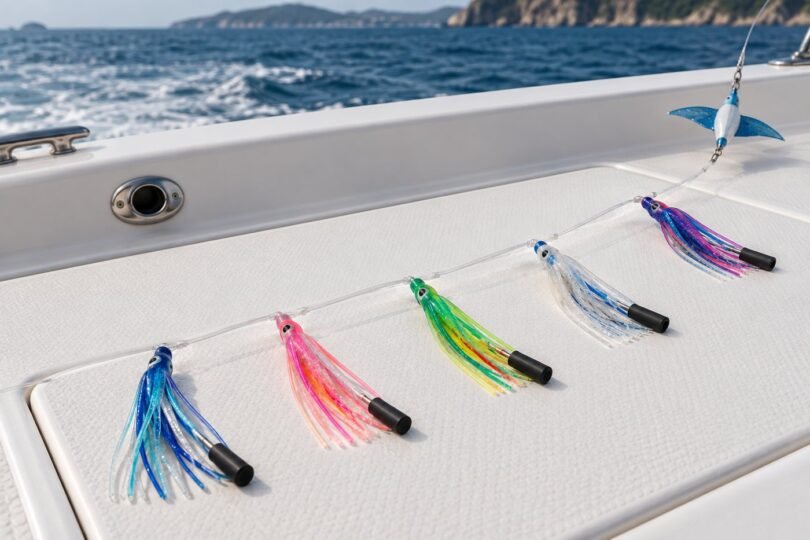
A daisy chain links several attractors along a leader. Squid bodies, feathers, small baitfish shapes and a surface bird can create the impression of several prey items moving together. The terminal rig determines whether the chain itself can hook a fish.
- Hooked daisy chain: The trailing lure carries a hook. It is fished as part of a rod-and-reel setup with tackle appropriate to the species and size being targeted.
- Hookless teaser: The chain provides attraction. A separate hooked bait or a correctly configured trailing lure supplies the catching component.
- Spreader bar: Uses a crossbar to spread multiple lines or lure rows. Its handling and footprint differ from an inline daisy chain, so compare it separately.
Pakula’s guide to hooked chains and teasers explains several configurations and how wind, lure drag and spread position affect them. The key buying lesson is to check the complete rig, including the final connection, rather than assume that every product labeled “tuna teaser” is ready to catch a fish by itself.
Two daisy chains for different roles
MagBay Tuna Feather Teaser Daisy Chain: Purple, one rig
The selected Purple MagBay chain combines a surface bird with feathered attractors and a hooked end lure. MagBay’s linked Tuna Tails product catalog describes four feather teasers, monofilament rigging, a 7/0 hook and a storage bag. The selected Amazon listing specifies a 6-inch bird and one complete rig.

MagBay Lures Tuna Feather Teaser Daisy Chain with Bird, Purple, 1 Rig with Bag
As an Amazon Associate we earn from qualifying purchases.
Why consider it: It gives you a defined hooked-chain option without needing to assemble the main components individually. Its feather-and-bird presentation makes a useful comparison against squid-bodied chains when deciding what profile to add to a spread.
Check before buying: Confirm the current selected color is Purple and that the hook and bag are included. The catalog does not establish a leader breaking strength for this exact variant, so do not assign one from another MagBay chain. Ask for that specification if it is important for your tackle plan.
Trade-off: A pre-rigged hook is convenient, but it still needs inspection. Check point condition, crimps, leader abrasion and how the hook sits within the trailing feathers. A 7/0 label alone does not establish suitability for every tuna size or drag setting.
Squidnation That Flippy Floppy Thing: Dolphin Green, one teaser
The original FF9 Flippy Floppy Thing uses a larger, more elaborate squid-and-bird arrangement. Squidnation specifies 9-inch Rubber Mauler squid bodies, eight 6-inch Fat Daddy squids and a 5-inch bird, rigged on 275-pound-test leader with a 300-pound Marlin Coast Lock swivel. The selected variant here is Dolphin Green.

Why consider it: Choose this when you deliberately want the original squid-and-bird teaser format and have a plan for deploying, watching and retrieving it. The terminal swivel gives it a different role from the MagBay’s hooked feather rig.
Check before buying: Treat this as a teaser; do not assume a hooked trailing lure is included. Confirm whether your intended setup uses a separate hooked bait or a compatible trailing rig, and have an experienced rigger check any changes.
Trade-off: More components create more opportunities for a fouled squid, crossed leader or storage tangle. The leader and swivel ratings describe individual components, not the safe working load of the complete fishing system or a promised fish size.
How to choose the right chain for your boat
Start with the prey profile
Decide whether you need a small feathered profile, a row of squid bodies or a more active surface teaser. Use what you can observe about local forage and what has been working in your fishing area to form a starting point. Color is one variable, but it cannot compensate for a fouled hook or a chain that will not track properly.
It is more useful to know why you are adding a particular rig than to buy several nearly identical colors without a plan. Keep notes on profile, position, water conditions and action so that a future change has a clear purpose.
Match the whole tackle system
Check leader material and length, hook type, swivels, snaps, chafe protection and every crimp. Match those components to the intended fishery and the rod, reel, main line and drag you will use. Avoid treating a heavy leader as permission to increase drag beyond the limits of other components.
If the exact listing leaves out leader strength, total chain length or hook details, ask the seller before buying. “Heavy duty” and a broad list of target species do not supply those missing specifications.
Consider storage and crew workload
Before choosing a larger teaser, decide where it will be stored, who will watch it and who will retrieve it during a strike. A chain that fits neatly into your existing routine is more useful than one that repeatedly fouls other lines or has no safe place on deck.
For a small crew, begin with a manageable spread. Add complexity only after everyone knows which lines to clear and where the hooked rig will go. Keep loose loops and exposed hooks out of walkways.
Setting a chain in the spread
- Inspect it on deck. Lay it out far enough to see the connections and trailing rig. Correct crossed sections before putting it overboard.
- Deploy it under control. Watch the chain as it enters the water and keep hooks and line clear of people and propulsion gear.
- Judge action at your actual trolling speed. Look for a consistent presentation without persistent spinning, tangling or uncontrolled skipping. Change speed or position if the action is poor.
- Test turns. Watch both sides of the spread through gentle turns, when rigs can change speed and position. Retrieve and adjust anything that repeatedly crosses another line.
- Recheck after contact or debris. Weed, a missed strike or a tangled skirt can change the presentation even though the rod still appears to be fishing normally.
There is no single trolling speed or distance behind the boat that is right for every daisy chain. Lure design, sea state, current, boat wake and the rest of the spread matter. Start with the rig maker’s instructions and evaluate its action in the water; avoid adopting an unrelated lure’s speed rating.
Care, repairs and buying checks
After use, rinse salt and debris away with fresh water, let the rig and bag dry, and check for damaged leader, corrosion and worn connections before storage. Replace questionable components rather than relying on the chain’s original rating. If you rebuild it, use sleeves and crimping tools matched to the leader material and diameter; an uncertain crimp deserves professional re-rigging.
Keep hooks covered and separate from loose tackle. Never wrap a loaded leader around your hand or body. Have a plan for clearing gear and handling a fish before adding another rig to the spread.
Check the rules for the place and species you intend to fish, including permits, retention limits and tournament requirements. U.S. Atlantic tuna anglers can start with NOAA’s Atlantic Highly Migratory Species information; current local requirements still need to be checked for the actual trip.
Which should you choose?
Choose the MagBay Purple feather chain if you want the specific pre-rigged hooked format and its confirmed package contents fit your plan. Choose the Dolphin Green Squidnation FF9 if you want the original multi-squid teaser and are prepared to integrate the catching bait separately. In either case, the useful purchase is the rig you can deploy cleanly, monitor and maintain with the tackle and crew you have.
Image note: AI-generated editorial illustration; not a photograph of a named product or an installation/compatibility diagram.