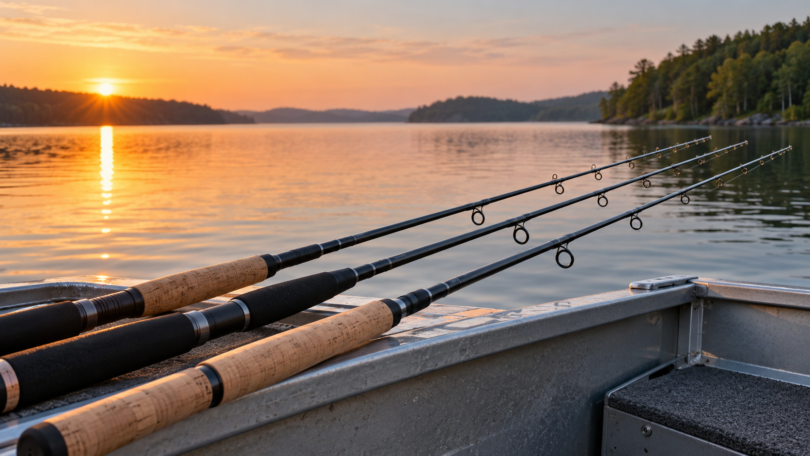

The best downrigger rod depends on the line and tackle you fish, plus how much rod your boat can comfortably accommodate. Start with the Okuma Classic Pro GLT CP-DR-762ML for a shorter general downrigger option, the CP-DR-862M for more length and a higher listed line range, the Lamiglas CG70DR for light trout and kokanee trolling, or the Lamiglas XCC934GH for a heavier salmon setup.
These are feature-based picks drawn from manufacturer specifications and technique guidance. We have not compared catches, measured blank strength or conducted long-term breakage tests. The choices below are fishing rods; a downrigger, reel, rod holder and release clip are separate parts of the setup.
Four downrigger rods to compare
| Exact rod | Length / pieces | Power / action or taper | Line rating | Best reason to compare |
|---|---|---|---|---|
| Okuma Classic Pro GLT CP-DR-762ML | 7 ft 6 in / 2 | Medium Light / S taper | 8–20 lb | A shorter fiberglass downrigger model |
| Okuma Classic Pro GLT CP-DR-862M | 8 ft 6 in / 2 | Medium / S taper | 10–25 lb | More rod length and a higher listed line range than the 762ML |
| Lamiglas Classic Glass CG70DR | 7 ft / 2 | Ultra Light / Moderate | 4–10 lb | Light trout and kokanee trolling, including downrigger use |
| Lamiglas XCC934GH | 9 ft 3 in / 2 | Heavy / Moderate | 15–30 lb | Graphite/fiberglass composite for a heavier salmon downrigger outfit |
The table preserves Okuma’s published S taper code and Lamiglas’s Moderate action label. Power describes resistance to bending; action or taper describes where the rod flexes. Treat each maker’s ratings as selection guidance, rather than assuming that the same power label produces identical behavior across different rod families.
1. Okuma CP-DR-762ML: the shorter general-purpose choice
The Classic Pro GLT CP-DR-762ML is a 7-foot-6-inch, two-piece casting rod with Medium Light power, S taper and an 8–20 lb line rating. Okuma’s catalog places it specifically in the Downrigger Rods group. That exact CP-DR model matters: Classic Pro GLT also includes rods intended for diving disks, planer boards and other trolling arrangements.
The GLT range uses fiberglass blanks, EVA grips and double-foot stainless-steel guides. The 762ML lists a 5½-inch foregrip, an 11-inch rear grip and nine guides plus the tip. Those measurements give you something concrete to check against the reel and holder you already use.
Choose it over the 862M when one foot less assembled rod is useful around the boat or in storage and its 8–20 lb line range matches your outfit. The tradeoff is the lower published power and line range. This is a size-and-specification comparison, not evidence that one model lands more fish.
2. Okuma CP-DR-862M: more length and a wider upper line range
The CP-DR-862M moves to 8 feet 6 inches, two pieces, Medium power, S taper and a 10–25 lb line rating. It remains an actual GLT downrigger model. It is the more relevant of the two Okumas when your planned line falls above the 762ML’s 20 lb upper rating.
Its grip layout also changes: Okuma lists a 6¾-inch foregrip and an 11¾-inch rear grip, with eleven guides plus the tip. Do not assume it will sit or clear surrounding equipment exactly like the shorter rod. Check the assembled length, grip and reel position in your own boat before buying several matching rods.
Choose the 862M for its longer layout and stated line range. Choose the 762ML if the shorter, lighter-power specification is the better fit. Both split into two sections for transport, but two pieces alone does not tell you the exact packed length or prove that either will fit a particular vehicle or locker.
3. Lamiglas CG70DR: the light trout and kokanee option
The Lamiglas Classic Glass CG70DR is a seven-foot, two-piece conventional rod rated Ultra Light, with Moderate action and a 4–10 lb line range. The listed lure range is ⅛–¼ oz. Its much lighter line specification makes it a different purchase from the heavier salmon-oriented XCC934GH.
Lamiglas includes the CG70DR in its trout and kokanee trolling range and specifically discusses using it with a dodger on a downrigger in its kokanee guidance. That guidance describes a fiberglass blank and cork handle. The relevant attraction is the light-tackle application, not a promise that the rod will prevent lost fish.
Compare this one first if your trout or kokanee outfit falls within its published ratings. Do not select it merely because it is short: the seven-foot length comes with Ultra Light power and a 4–10 lb line range. A 15–30 lb salmon setup belongs in a different comparison. Lamiglas’s page listed the CG70DR as sold out when checked on October 11, 2026; check dealer availability for that exact model before ordering.
4. Lamiglas XCC934GH: the heavier salmon-trolling choice
The XCC934GH is a 9-foot-3-inch, two-piece conventional rod with Heavy power, Moderate action and a 15–30 lb line rating. Lamiglas lists a ¾–3 oz lure range and a separate 2–16 oz troll-weight range. Those are rod/tackle specifications, not a downrigger-cannonball rating.
The XCC family uses a graphite/fiberglass composite blank. Lamiglas’s salmon technique chart names XCC934GH specifically for downrigger use, so its inclusion does not depend on assuming that any long casting rod will work.
Choose it when the 15–30 lb line range and heavier salmon application match your fishing. Compared with the CP-DR-862M, it adds nine inches of assembled length and raises the listed upper line rating from 25 to 30 lb. The extra length can be inconvenient on a compact boat; confirm handling and storage space rather than treating a longer rod as an automatic upgrade.
How to choose for your existing setup
- Start with the intended line and tackle: the CG70DR’s 4–10 lb range, the Okumas’ 8–20 or 10–25 lb ranges and the XCC934GH’s 15–30 lb range are distinct starting points. Match your outfit to the exact model instead of comparing only the word “trolling.”
- Measure the usable space: consider the assembled rod around the cockpit and confirm its actual packed length with the seller. All four rods here are two-piece models, but their overall lengths differ. Do not calculate guaranteed packed dimensions by simply halving the advertised length.
- Check the full code at checkout: CP-DR-762ML and CP-DR-862M are not interchangeable with similarly named GLT models. Likewise, select CG70DR or XCC934GH specifically on Lamiglas’s family pages. A series name alone does not establish length, action, line rating or piece count.
- Keep the downrigger system separate: Scotty’s setup overview shows the weight attached to the downrigger line and the fishing line attached through a release clip. Choose and operate the rod, reel, holder and release as a compatible setup. Follow your downrigger and release instructions; do not use a rod’s line rating as the weight capacity of the downrigger.
- Ask what the higher-priced rod changes: compare its exact blank construction, length, grip layout and ratings. This guide does not establish a catch-rate or durability advantage for graphite/fiberglass composite over fiberglass. Decide whether the documented configuration suits your fishing before paying for a different rod.
Frequently asked questions
Which rod is the most sensible first comparison?
For a general downrigger outfit using 8–20 lb line, start by checking the CP-DR-762ML and its 7-foot-6-inch layout. Compare the CP-DR-862M when you want 8-foot-6-inch length or need its listed 10–25 lb line range. Light kokanee tackle and heavier salmon tackle call for the separate Lamiglas options described above.
Is the CG70DR suitable for heavy salmon gear?
Its published specification is Ultra Light power and 4–10 lb line, with a ⅛–¼ oz lure range. Treat it as the light trout/kokanee option here. The Heavy-power XCC934GH has a separate 15–30 lb line range and a manufacturer-supported salmon downrigger application.
Does a 20 lb line rating mean I can hang a 20 lb downrigger weight from the rod?
No. In the downrigger arrangement described by Scotty, the weight is carried on the downrigger line and the rod’s fishing line connects through a release clip. A fishing-line range on the rod does not specify the downrigger’s weight capacity.
Are these complete rod-and-reel combos?
The choices here are the named rods. Budget for a compatible reel and the rest of the downrigger setup separately, unless the retailer explicitly offers and identifies a combo. Also distinguish a two-piece rod from a pack containing two rods.
Can I choose by power alone?
No. Check action or taper, line range, length and the intended technique as well. Okuma explains that a power label can behave differently across rod families. Use the exact model specifications and, when possible, compare how the rod handles your intended outfit before buying.