


The best DC amp clamp meter for your work needs a documented DC-current range through its jaws. Two useful choices are the Fluke 325, with a 400 A ceiling and a smaller body, and the Klein Tools CL800, with a 600 A ceiling and a larger jaw. Both measure AC and DC current through the clamp. Choose between them by the current you need to measure, cable fit, resolution and the required measurement category.
This is a specification-based buying comparison of two documented models. We have not performed hands-on accuracy, durability or live-circuit tests. Recommendations reflect the manufacturers’ manuals and product specifications; they are not a laboratory ranking. Prices, sellers and package contents can change, so check the exact model and included accessories before ordering.
Best DC clamp meters at a glance
| Meter | Best fit | DC clamp ranges and resolution | Jaw and body | Meter category rating | Main limitation |
|---|---|---|---|---|---|
| Fluke 325 | Compact kit for work within 400 A | 40.00 A / 400.0 A; 0.01 A / 0.1 A | 30 mm maximum wire diameter; 207 × 75 × 34 mm | CAT III 600 V; CAT IV 300 V | Lower current ceiling and smaller jaw than the CL800 |
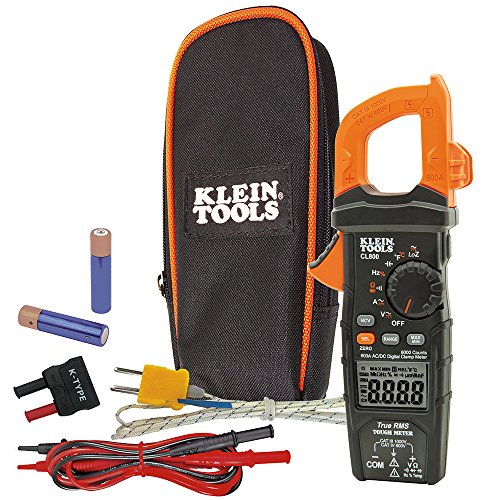
| Klein Tools CL800 | Higher current capacity and a larger jaw | 60.00 A / 600.0 A; 0.01 A / 0.1 A | 35 mm jaw; approximately 231 × 97 × 39 mm | CAT III 1000 V; CAT IV 600 V | Larger body; the 0.01 A display step does not establish milliamp-level accuracy |
The ratings above describe the meters, not permission to work on every circuit below those voltages. The complete measuring setup must suit the circuit, environment and task. Fluke’s manual says a combination of meter, probes and accessories is limited by its lowest-rated component. Read the exact manual supplied with the instrument before use.
Fluke 325: best for a compact 400 A kit
Choose the Fluke 325 when the circuit’s current and measurement category fit its limits and a smaller instrument matters. Its published body dimensions are narrower and shorter than the CL800’s, and its 30 mm maximum conductor diameter is useful to check before purchase. That makes compactness a defensible reason to choose it; it does not prove that it will fit a particular crowded enclosure.
The Fluke 325 specifications list AC/DC voltage to 600 V, resistance to 40 kΩ, continuity, capacitance, contact temperature and frequency. The backlight, hold and Min/Max functions add practical options for recording a reading. Be precise about the model: the shared 323/324/325 manual assigns DC jaw current to the 325. A 323 or 324 is not an equivalent substitute for this particular purchase.
Limitations: the 325 stops at 400 A and has the smaller of these two jaws. Its manual lists DC accuracy as ±(2% of reading + 5 digits), so a 0.01 A display increment should not be mistaken for accuracy to 0.01 A. The standard 325 and the separately listed 325 CAL package are different purchasing options; do not assume the ordinary listing includes a traceable calibration certificate.

Fluke 325 True-RMS AC/DC Clamp Meter
As an Amazon Associate we earn from qualifying purchases.
Klein Tools CL800: best for a 600 A range and larger jaw
Choose the CL800 if your application calls for more current capacity or a larger jaw than the 325 offers, provided the entire setup and working conditions meet the manual’s limits. Its 35 mm jaw and 600 A DC range are the meaningful differences here. The larger case takes more room in a kit, so compare its dimensions with the space available to you instead of treating a higher range as an automatic upgrade.
The CL800 product page documents AC/DC voltage, resistance, continuity, frequency, capacitance and diode testing through the test leads, plus temperature through a thermocouple. Its low-impedance voltage mode is another reason to consider it if that function is relevant to your work. The manufacturer lists a carrying case, test leads, thermocouple with adapter and batteries; check the actual seller’s package before buying.
Limitations: the CL800’s low DC range has 10 mA resolution and ±(2% of reading + 8 digits) accuracy; the 600 A range has 100 mA resolution and ±(2% + 5 digits). Those are range-dependent specifications. The normal voltage function’s 1000 V limit must not be transferred to every other setting: the manual limits LoZ to 600 V. Its non-contact voltage function detects AC voltage, so it is not a general DC-voltage detector.
What matters when buying a DC amp clamp meter
Confirm that the jaws measure DC current
“AC/DC” on a retailer page may refer to voltage measured with probes. Look for a separate DC-current specification explicitly assigned to the clamp or jaw. Fluke’s 323/324/325 manual is a useful example: all three models measure AC and DC voltage, but only the 325 has DC jaw-current capability. A conventional multimeter, outlet tester or non-contact voltage pen serves a different purpose.
Match the range to the measurement
Choose a range that covers the expected current and gives useful resolution for the decision you need to make. These two meters are candidates for amp-scale DC measurements; neither is selected here as a specialist leakage-current instrument. If a very small standby drain is your main concern, compare the complete error specification at that current before purchasing. Counting decimal places alone can lead to the wrong choice.
For example, at a hypothetical 1.00 A reading on the low DC range, the stated formula gives a Fluke 325 allowance of ±0.07 A: 2% of 1 A plus five 0.01 A digits. The CL800 formula gives ±0.10 A: 2% plus eight 0.01 A digits. These are arithmetic illustrations of the published specifications under their applicable conditions, not measurements we obtained or a guarantee of every reading.
Check the jaw opening and the exact package
Measure the relevant cable’s outside diameter before selecting a jaw size, and consider access and safe working clearance as well. A product photograph cannot confirm fit around your conductor. For either model, inspect the seller’s model number, included leads, accessories and condition. A look-alike image or a shared retail listing is not enough to establish that a different variant has the same current function.
Understand the category and probe limits
CAT III and CAT IV describe different measurement environments. The manuals associate CAT III with the distribution part of a building’s low-voltage mains installation and CAT IV with its source. Always read the category together with its voltage. A CAT IV 300 V marking does not become CAT IV 600 V because the same meter is rated CAT III 600 V.
The CL800 manual requires the test-lead shields for CAT III/CAT IV locations and warns that omitting them increases arc-flash risk. Both manufacturers require appropriate leads and warn against using damaged equipment. Their clamp-current instructions also require disconnected test leads. Treat the supplied manual and accessory markings as part of the purchasing decision, not optional paperwork.
Safety boundaries before you use a clamp meter
For covered U.S. workplaces, OSHA’s test-equipment requirements reserve circuit testing for qualified people and require suitable instrument/accessory ratings and inspection for damage. Purchasing a rated meter does not supply the training, protective equipment or work procedures needed around electrical hazards. This buying guide is not a live-work procedure; use a qualified professional when the task is outside your training.
A zero current reading does not prove a circuit is safe to touch. Fluke explicitly warns against using current measurement to establish that. The CL800 manual also prohibits resistance or continuity measurements on a live circuit. Do not let a convenient clamp, a non-contact indicator or a reassuring display replace the required electrical safety process.
Frequently asked questions
Can every AC/DC clamp meter measure DC amps?
No. Check the DC-current-through-jaw specification, not just an AC/DC voltage claim. In Fluke’s 323/324/325 family, the shared manual gives DC clamp current to the 325; the two other models do not provide that function.
Which is the better choice: Fluke 325 or Klein CL800?
The 325 is the smaller option for work within its 400 A range and category limits. The CL800 offers a 600 A range, a larger jaw and LoZ voltage measurement. Choose the features and ratings your application requires; neither wins every job simply because of its brand or maximum current.
Is 0.01 A resolution enough for battery-drain testing?
Resolution alone cannot answer that. Both meters display 0.01 A steps on their low DC ranges, but their accuracy formulas add a percentage and a digit allowance. Decide how small a current you need to distinguish and compare that requirement with the complete specification. This comparison does not qualify either meter for every parasitic-drain test.
Does true RMS mean the clamp reads DC current?
No. True RMS is an AC measurement characteristic; DC-current capability still needs its own specification. The Fluke 325 and CL800 have both documented functions, but the words “true RMS” by themselves are not enough to choose a DC clamp meter.
Can I use the meter’s temperature range with any probe?
No. The probe has its own limit. Fluke’s manual gives the 325 a temperature range to 400°C but rates the included Type-K thermocouple to 260°C. Choose accessories rated for the actual measurement and observe the lowest applicable limit.


