
The Fieldpiece SC440 is our first choice for an HVAC service kit that needs flame-sensor microamps, capacitance and motor-start inrush in one meter. Choose the Klein CL390 if you also need DC current through the clamp, the Klein CL445 for a higher AC-current range and CAT IV 600 V rating, or the Fluke 902 FC if Fluke Connect is useful to your workflow.
These are specification-based recommendations drawn from the manufacturers’ documentation, not hands-on test results. All four measure temperature and DC microamps, but their clamp capabilities, input limits and supplied temperature probes differ substantially.
Best HVAC clamp meters at a glance
| Meter | Best fit | Current through clamp | DC microamps through leads | Capacitance ceiling |
|---|---|---|---|---|
| Fieldpiece SC440 | HVAC service with inrush capture | 400 A AC | 500 µA | 5,000 µF |
| Klein Tools CL390 | AC and DC clamp measurements | 400 A AC/DC | 200 µA | 4,000 µF |
| Klein Tools CL445 | 600 A AC and dedicated inrush | 600 A AC | 600 µA | 6,000 µF |
| Fluke 902 FC | Fluke Connect users | 600 A AC | 200 µA | 1,000 µF |
These are measurement-range ceilings, not permission to use a meter on any circuit below those numbers. Match the measurement category, voltage, frequency, leads, accessories and environmental limits to the actual job. The DC microamp input is a separate function; it does not make an AC-only clamp capable of measuring DC amps.
1. Fieldpiece SC440: best for a dedicated HVAC service kit
The SC440 combines the functions that make an HVAC meter more useful than a basic electrical clamp: DC microamps for flame-rectification checks, capacitance, temperature and a dedicated inrush function. Its dual display, magnetic strap and supplied alligator extensions are practical additions when organizing measurements.
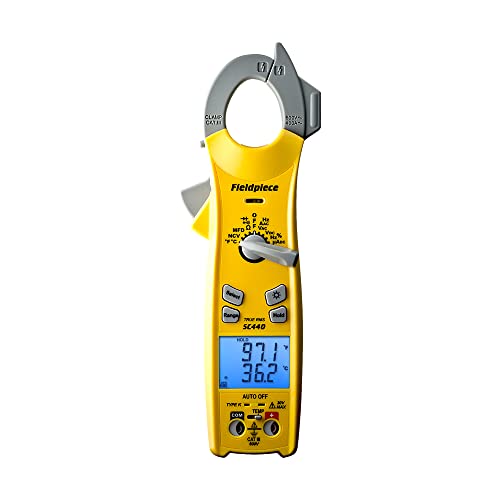
Fieldpiece SC440 True RMS HVAC Clamp Meter
As an Amazon Associate we earn from qualifying purchases.
The clamp has 50 A and 400 A AC ranges. Through the leads, the meter measures AC/DC voltage to 600 V, DC microamps to 500 µA and capacitance to 5 mF, equivalent to 5,000 µF. The inrush mode uses a 100-millisecond measurement period; it is a specified starting-current function rather than an ordinary display-hold button. The meter is rated CAT III 600 V. See the SC420/SC440 operator’s manual.
- Why choose it: a useful combination of inrush, flame-sensor microamps, capacitance and dual-display operation, with a magnetic strap included.
- Main limits: no DC amps through the clamp and no CAT IV rating. Its 400 A ceiling is lower than the CL445 and 902 FC.
- Temperature and kit: the meter input spans −35 to 500°C (−30 to 932°F), but the included ATB1 probe is limited to 204°C (400°F) for continuous use. Fieldpiece lists silicone test leads, short alligator extensions, the ATB1, a strap, 9 V battery and padded case in the standard kit.
Check the manufacturer’s kit contents and the ATB1 probe limits. Choose the SC440 over the CL390 when dedicated inrush capture matters more than DC clamp current.
2. Klein Tools CL390: best when you need AC and DC clamp current
The CL390 is the most versatile pick here for the type of current its jaws measure: both AC and DC, up to 400 A. It also retains a separate 200 µA DC input, so choosing a DC-capable clamp does not mean giving up the small-current function needed for compatible flame-sensor diagnostics.
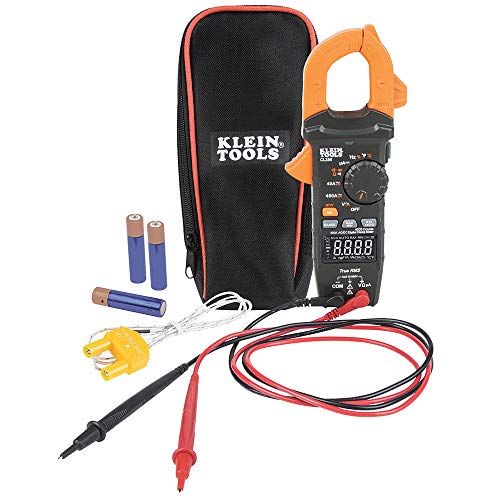
Its other headline limits are 600 V AC/DC, 4,000 µF capacitance and CAT III 600 V. The current manual specifies a minimum measurable clamp current of 0.3 A AC or DC; the 0.01 A display resolution on its lower range does not turn it into a precision leakage-current instrument. Consult the CL390 instructions for accuracy and frequency limits.
- Why choose it: AC/DC clamp capability, a reverse-contrast display, DC microamps and capacitance in one instrument.
- Main limits: no dedicated inrush mode is listed. Max/Min recording is not interchangeable with a specified inrush-capture function. The meter is CAT III 600 V, regardless of higher ratings printed on compatible leads.
- Temperature and kit: the input spans −40 to 1,000°C (−40 to 1,832°F). The current manual limits the supplied thermocouple to temperatures below 230°C (446°F). The standard package includes leads, thermocouple, carrying case and three AAA batteries; the magnetic hanger is optional.
The selected listing is the single CL390 meter package, labeled “Standard Display (Meter).” Klein describes the CL390’s screen as reverse contrast; the retailer’s variation wording does not identify a different measurement model. Confirm CL390 on the order and check the instructions supplied with your unit. Klein’s CL390 product page lists the current accessories.
3. Klein Tools CL445: best for 600 A AC and dedicated inrush
The CL445 is the better Klein option here if you need motor-start inrush and a 600 A AC clamp range. It also offers a simultaneous voltage-and-current display. Its distinct advantage over the CL390 is its HVAC-focused AC feature set and category rating; it does not add DC clamp measurement.

The meter measures up to 750 V AC or 600 V DC through its leads, with ratings of CAT III 750 V and CAT IV 600 V. Its DC microamp range reaches 600 µA, and capacitance reaches 6 mF, or 6,000 µF. Keep the two voltage limits separate: the 750 V specification is for AC, not DC. The CL445 manual supplies the function-specific limits.
- Why choose it: dedicated inrush, a 600 A AC clamp, a worklight and the highest DC-microamp and capacitance ceilings in this shortlist.
- Main limits: the jaws measure AC current only. Its AC-current and inrush specifications cover 50–60 Hz; do not assume that true RMS means unrestricted accuracy on variable-frequency-drive outputs.
- Temperature and kit: the meter input spans −100 to 1,000°C (−148 to 1,832°F), but its supplied thermocouple is suitable only below 180°C (356°F). Klein lists right-angle leads, push-on alligator clips, a K-type thermocouple, pouch and three AAA batteries. The magnetic hanger is sold separately.
The selected CL445 offer is one meter package. Retailer wording about jaw size should not replace the manufacturer’s dimension or the actual clearance needed around a conductor. Review Klein’s product specifications and included accessories before ordering.
4. Fluke 902 FC: best for Fluke Connect users
The 902 FC makes sense when wireless readings through Fluke Connect fit an established service workflow. Its core HVAC functions include a 600 A AC clamp, 200 µA DC through the leads, capacitance to 1,000 µF and resistance to 60 kΩ. Check the current app requirements and regional availability before buying primarily for connectivity.

AC/DC voltage measurement reaches 600 V. The safety ratings are CAT III 600 V and CAT IV 300 V, so “CAT IV” alone is not an adequate comparison with the CL445’s CAT IV 600 V rating. The 902 FC user’s manual also distinguishes its AC clamp from its lead-based DC microamp input.
- Why choose it: Fluke Connect capability with the main HVAC measurement functions, plus Min/Max recording.
- Main limits: no DC amps through the clamp and no dedicated inrush mode listed in the manual. Its 1,000 µF capacitance ceiling and 60 kΩ resistance ceiling are lower than the other three meters’ limits.
- Temperature and kit: the meter’s temperature input reaches 400°C (752°F); that is not the supplied probe’s maximum. Check the actual probe’s documentation before high-temperature work. The listed standard kit includes TL75 leads, an 80BK temperature probe, two AA batteries and a soft case.
Fluke’s product page provides the current kit and connectivity information. Wireless viewing does not make setting up a measurement safe by itself; setup remains a task for a qualified person following the equipment and meter instructions.
How to choose an HVAC clamp meter
Start with the measurements you actually need
For gas-heating service, look for a dedicated DC microamp input with suitable resolution for the equipment’s flame-rectification specification. All four meters here provide 0.1 µA resolution. That is different from their amp-clamp range. There is no universal “good flame signal” number: use the heating equipment manufacturer’s limits and procedure.
For capacitor checks, compare the required value with the meter’s capacitance range and accuracy. A larger range does not automatically mean better accuracy. Dedicated inrush capture is worth prioritizing when starting-current information is part of your work; ordinary Max/Min and Hold modes do not promise the same capture behavior.
Match ratings across the entire measurement setup
Electrical work can expose qualified technicians to shock, arc flash and stored energy. Use only a meter, leads, probe caps and accessories rated for the measurement location and voltage, and follow the lowest applicable rating in the setup. Keep required protective probe caps installed for the relevant category. A high overload-protection number in a specification table is not permission to apply voltage in resistance, capacitance, temperature or microamp mode.
Inspect the meter and leads, verify operation as directed by the manual, and follow applicable isolation, verification and PPE procedures. Resistance, continuity and capacitance testing require de-energized equipment and appropriate discharge of stored energy. A silent non-contact voltage detector does not prove that a circuit is de-energized. This buying guide does not replace electrical training or the equipment’s service instructions.
Read beyond “true RMS” and the temperature headline
True RMS is useful, but accuracy remains subject to the specified frequency range, waveform limits and operating conditions. Variable-frequency drives need particular care: verify the exact test point and meter requirements in the drive manufacturer’s service instructions. None of these recommendations is a blanket endorsement for every inverter output.
A K-type socket is also not a guarantee that the included probe covers the meter’s whole temperature range. The SC440, CL390 and CL445 examples above show how much lower a supplied probe’s limit can be. Budget for a suitable, compatible pipe clamp or high-temperature probe when your work requires one.
Which one should you buy?
Choose the Fieldpiece SC440 for a focused HVAC kit with inrush and useful included accessories. Choose the Klein CL390 when DC clamp current is essential. Choose the Klein CL445 for 600 A AC, inrush and CAT IV 600 V capability within its other limits. Choose the Fluke 902 FC when Fluke Connect is a practical benefit and its lower capacitance and resistance ceilings meet your requirements.
Before paying, verify the exact model, package contents, seller, warranty eligibility and required calibration support. A test-lead bundle, battery tester or ordinary handheld multimeter is not a substitute for the clamp meter you intended to buy.
Frequently asked questions
What makes a clamp meter suitable for HVAC work?
Look for the current and voltage functions your equipment requires, plus capacitance, temperature and a dedicated DC microamp input when flame-sensor testing is needed. Inrush capture can also be useful. The meter, leads and accessories must have suitable category, voltage and environmental ratings for the job.
Do all HVAC clamp meters measure DC current through the jaws?
No. In this shortlist, the Klein CL390 measures AC and DC current through the jaws. The Fieldpiece SC440, Klein CL445 and Fluke 902 FC clamp AC current only. Their separate DC microamp functions use test leads and do not add DC amp-clamp capability.
Can a clamp meter measure a furnace flame-sensor signal?
A meter with an appropriate DC microamp input can support the equipment manufacturer’s specified flame-rectification test. All four models here have that function. This is a lead-based service measurement for a qualified technician; use the heating equipment’s procedure and limits rather than a generic pass/fail number.
Can I use the supplied temperature probe across the meter’s full range?
Not necessarily. The SC440’s included ATB1 is rated to 204°C for continuous use; the current CL390 manual limits its included probe to below 230°C, and the CL445 manual specifies below 180°C. Always follow the actual probe’s rating and the instructions supplied with your unit.
Does a CAT rating or non-contact detector make live electrical work safe?
No. A CAT rating describes an instrument’s suitability for specified measurement environments at stated voltages; it does not replace training, suitable leads, protective equipment or safe work procedures. Non-contact detection can miss voltage, so no indication does not establish that a circuit is de-energized.