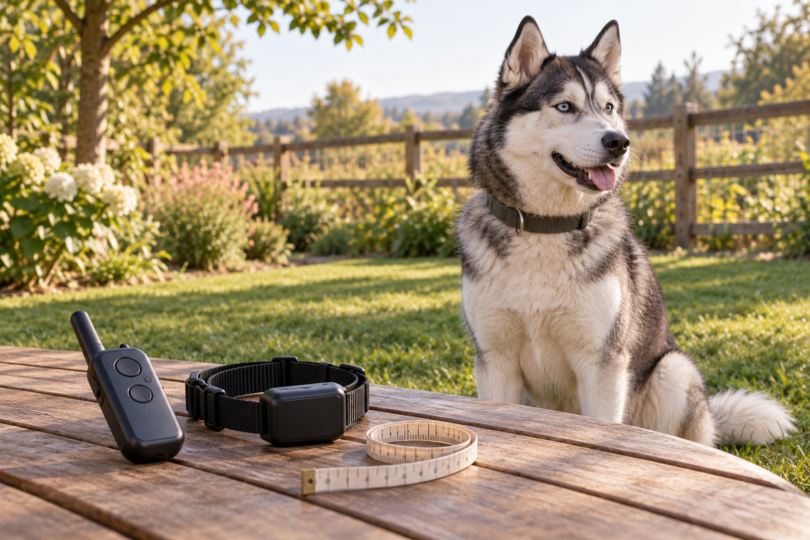

If you are shopping for a shock collar for a Husky, the useful differences are fit, remote controls, available cue modes and the exact receiver included. Our feature shortlist is the SportDOG FieldTrainer 425X, Garmin Sport PRO bundle and Dogtra 1900X one-dog unit. Each has documented hardware advantages and limitations; none earns a breed-specific effectiveness or safety award.
Before buying, consider the welfare evidence. The American Veterinary Society of Animal Behavior recommends reward-based training and opposes aversive methods, including electronic collars; its 2025 statement reaffirms that position. A Husky’s coat, size or reputation for independence does not establish a need for stronger stimulation. This comparison explains products, not how to administer shocks or treat aggression.
Three remote-training collars to compare
We selected these models for traceable manufacturer specifications, accessible model manuals, documented contact options and meaningful differences in controls. This is a comparison of published features, not hands-on testing or a clinical ranking. All three offer electrical stimulation as well as tone and vibration. Their settings are not a common scale for comparing electrical output.
| Exact system | Main reason to compare it | Fit information | Important trade-off |
|---|---|---|---|
| SportDOG FieldTrainer 425X, SD-425X, one-dog system | Published neck range and compact receiver dimensions | Manufacturer: 8 lb or more; 5–22-inch neck; short and long contacts included | Three-dog programming offers tone or vibration, rather than both together in those modes |
| Garmin Sport PRO U.S. bundle, 010-01205-00 | Separate tone and vibration buttons in training mode | 3.5 oz dog device; interchangeable short/long contacts | Automatic BarkLimiter is a separate operating mode; numerical neck limits were not established in the reviewed documents |
| Dogtra 1900X standard one-dog unit | LCD, level lock and receiver light | Current fit panel: 35 lb or more and at least 13-inch neck; 5.6 oz receiver | Large receiver; level lock is not a complete button lock |
These are manufacturer fit criteria, not proof that a particular collar will fit your dog comfortably. Check the actual neck measurement, receiver size and supplied contact options before ordering. The SportDOG and Dogtra cards identify the one-dog versions compared here; Garmin’s link goes to the exact manufacturer bundle. Recheck the selected model and included parts before paying, as offers can change.
SportDOG FieldTrainer 425X: for a smaller receiver and clear sizing
The standard FieldTrainer 425X, model SD-425X, has a receiver measuring 2.60 × 1.30 × 1.23 inches without its strap. SportDOG specifies dogs of at least 8 lb with necks measuring 5–22 inches. Standard and long contact points come in the kit. Those details give you something concrete to check against your Husky’s build and coat.
Advantages: replaceable contact lengths, a compact dial-and-button remote, rechargeable batteries and expansion to three dogs. The matching additional receiver is SDR-AXF. SportDOG specifies a two-hour charge and approximately 50–70 hours between charges, depending on use, plus a 500-yard maximum range. Its stated water rating covers both remote and receiver to 25 feet.
Limits: the X-Series operating guide makes the control trade-off clearer than a feature list. Tone and vibration are preset, not adjustable. Three-dog modes provide either tone or vibration alongside electrical stimulation; do not assume every function stays independently accessible after expansion. Terrain, vegetation, weather and radio interference affect range.
The manual advises against use on aggressive dogs, warns about contact irritation, says to avoid wear beyond 12 hours daily and prohibits attaching a leash to this receiver strap. These are upper restrictions, not a recommended wearing schedule. Compare the standard 425X carefully with the separately named 425XS and 425XCAMO; this pick does not recommend a higher-output version for Huskies.
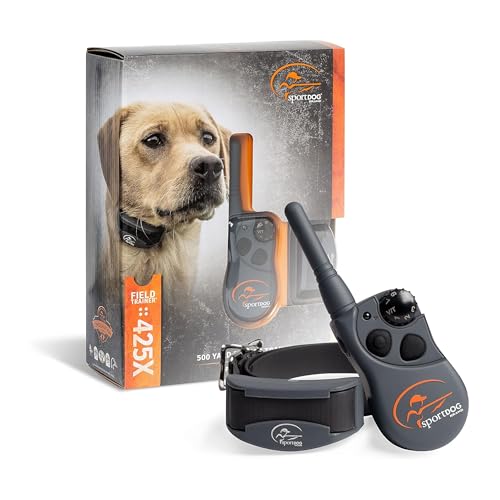
SportDOG FieldTrainer 425X, Gun Metal Grey, 1-Dog System
As an Amazon Associate we earn from qualifying purchases.
Garmin Sport PRO: for separate cue buttons
The Sport PRO bundle, part 010-01205-00, includes the handheld and a dog device. Part 010-01205-50 is the handheld-only version. In normal training mode, dedicated tone and vibration buttons make those functions more directly accessible than the SportDOG’s mode-dependent arrangement. A selector supports up to three paired dog devices, with extra receivers purchased separately.
Advantages: short and long interchangeable contacts, a 3.5 oz receiver and remotely controlled beacon lights. Garmin states up to 3/4-mile range. It rates the handheld IPX7 and the dog device 1 ATM; those are different water-resistance specifications, not an invitation to ignore charging and care precautions.
Limits: the reviewed listing and Sport PRO manual did not establish a numerical neck-size range. Obtain that fit confirmation before buying. The manual describes roughly two-hour charging, a mini-USB handheld connection and a separate receiver charging clip. It lists up to 60 hours for both units, while the current product page lists up to 80 hours for the handheld and 60 for the dog device. Because these figures differ, we do not award Garmin a runtime advantage.
BarkLimiter adds automatic bark-triggered operation. That is distinct from remote cueing, and the manual warns that other collars or tags can cause unwanted activation. Its independent mode also disables remote control. The manual requires at least eight collar-free hours in every 24-hour period to reduce contact irritation; this does not make the remaining hours a target or establish that long wear is harmless.
Dogtra 1900X: for a display and level lock
The standard Dogtra 1900X one-dog unit has an LCD, a lock against unintended level changes, separate tone and vibration controls, and a receiver light. Its documented one-dog setup can prevent the selector switching to another dog’s channel. Additional compatible receivers expand it to three dogs.
Advantages: visible settings, USB-C charging and the control lock distinguish it from the other two. The 1900X manual specifies a two-hour charge and 3/4-mile range for this version. Dogtra lists IPX9K protection for transmitter and receiver. The kit lists 5/8-inch contacts; other lengths are available separately.
Limits: the receiver measures 4 × 1.4 × 1.4 inches and weighs 5.6 oz, heavier than Garmin’s listed dog device. The current fit panel starts at 35 lb and a 13-inch neck, although one product-image description says 33 lb. Use the more restrictive published threshold and ask Dogtra to resolve a borderline fit; coat and neck shape still matter. The 31-inch strap length is not a usable neck-circumference guarantee.
The level lock does not disable every activation button, and vibration strength is not adjustable. Dogtra warns against use on aggressive dogs and instructs removal after eight hours, with skin checks. Its manual describes non-stimulation contacts, but the product listing calls contact covers a limited promotional inclusion: confirm the actual box contents. This comparison covers the standard 1900X, not the 1900S, 1900X PRO, Handsfree bundle or Black Edition, whose specifications and accessories differ.
What the training research can and cannot tell you
Published evidence does not establish a best model for Huskies. In Cooper and colleagues’ 2014 study, the main 63-dog comparison found behavioral welfare concerns without a significant owner-reported efficacy advantage for electronic-collar training. The 2020 analysis by China and colleagues found advantages for reward-focused training on several response measures. These reports share a cohort, so they are not independent replications. Differences in trainers and training conditions limit interpretation; a published critique and the authors’ response should be considered together.
There is contrary efficacy evidence. Johnson and Wynne’s 2024 study found faster suppression of lure chasing with expert-led Garmin Sport PRO training than with two food-reward protocols. Seventeen dogs remained in the analysis after two e-collar-group dogs exceeded the approved stimulation limit and were removed. All six analyzed e-collar dogs passed the first three tests; four passed the novel-setting test, including two that started chasing but stopped on the cue. The dogs yelped in response to stimulation. Limited stress measurements, extra lure exposure in that group, brief reward conditioning and no long-term follow-up constrain the result. The authors caution that expert outcomes cannot be assumed for ordinary owners. This is neither a home-training protocol nor evidence that Garmin is better than the other collars.
How to make the purchase decision
- Resolve fit first. Published weight bands do not replace neck measurements and assessment of receiver bulk. Longer contacts are an available hardware option, not proof of better welfare or a reason to tighten excessively. Ask the manufacturer about compatible contacts instead of mixing parts between brands.
- Compare the controls you actually need. Garmin offers separate cue buttons in training mode. Dogtra adds a display and a level lock. SportDOG has compact hardware but mode-dependent button functions. Tone and vibration can also be startling or aversive; their presence alone does not establish a reward-based training method.
- Count the whole system. These are one-dog kits. Budget for additional compatible receivers if needed, along with any separate contact accessories and replacement charging equipment. Confirm the model number, included parts and return terms at checkout.
- Keep range claims in perspective. The figures are manufacturer maximums under favorable conditions. They do not guarantee recall or make a remote collar a substitute for secure containment and a suitable lead.
Why PetSpy P620 is not in this shortlist: it appeared in the earlier list, but its 2018 manual and current FAQ give different limits. The FAQ specifies supervised sessions up to 15 minutes, no more than four hours’ wear daily and no swimming or underwater use; the old manual gives a 12-hour wear ceiling. We would not use the older, more permissive advice or broad waterproof wording to justify a purchase. The product-page extraction also mixed sold-out and add-to-cart text, so it did not establish an offer we could confidently describe.
Our buying verdict: compare the 425X if its published fit range and smaller receiver are your priorities, the Sport PRO if direct tone/vibration access matters most, and the 1900X if you want a display and level lock and have confirmed fit. These are conditional hardware choices. AVSAB’s reward-based recommendation remains the starting point for deciding whether to buy an electronic collar at all; aggression, fear or a sudden behavior change calls for veterinary assessment rather than a stronger product.
Frequently asked questions
Which shock collar is best for a Husky?
No reviewed evidence establishes a best model specifically for Huskies. The SportDOG 425X, Garmin Sport PRO and Dogtra 1900X differ in fit, buttons and accessories. Compare those features only after considering AVSAB’s recommendation for reward-based training.
Does a thick coat mean a Husky needs stronger stimulation?
No breed-specific evidence reviewed here supports that conclusion. Coat length makes documented contact options and individual fit relevant to the purchase. It does not justify choosing higher electrical output or assuming that a collar will work better.
Can these collars provide tone or vibration without electrical stimulation?
All three document tone and vibration functions. Access depends on the operating mode: SportDOG’s three-dog modes provide tone or vibration, while Garmin and Dogtra have separate cue controls. These functions are not guarantees of stress-free use or a permanently disabled electrical mode.
Is a remote-training collar the same as an automatic bark collar?
No. A remote trainer responds to a person’s transmitter, while an automatic bark collar responds to detected barking. Garmin Sport PRO includes a separate BarkLimiter mode; the reviewed 425X and 1900X are compared here as remote-training systems. Automatic operation is not a solution for diagnosing why a dog barks.
Can a Husky wear one all day or use it as a leash collar?
Do not treat these devices as all-day everyday collars. Their manuals set different wear restrictions, and contact irritation remains a concern. SportDOG and Dogtra explicitly warn against attaching a leash to the electronic-collar strap. Use appropriate separate walking equipment and seek veterinary advice if skin irritation occurs.