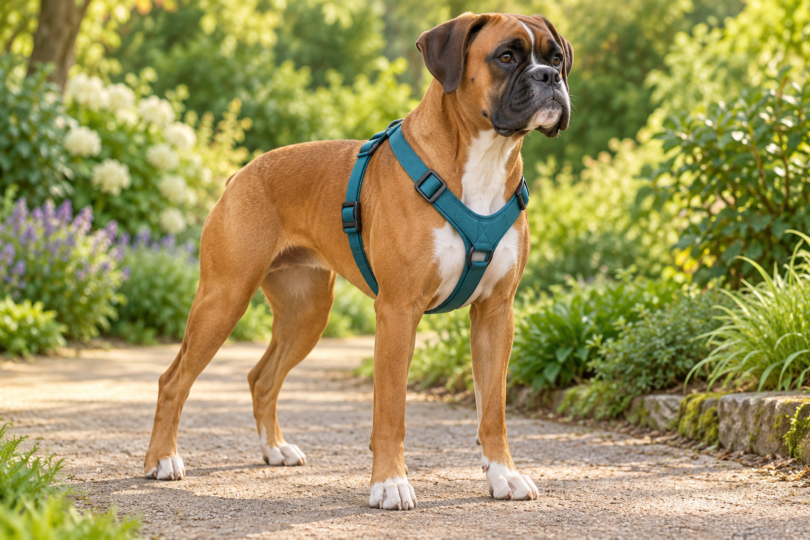

The best harness for your Boxer is one that fits your dog’s measured chest, stays in position during movement and suits the walks you take. Start with the Ruffwear Front Range for a padded everyday design, consider the Blue-9 Balance Harness when adjustable strap placement and a neck buckle matter most, or choose the Ruffwear Flagline when you want a longer body harness with a handle.
These are three documented walking-harness options, not a promise that one size or shape fits every Boxer. This comparison uses manufacturer specifications, sizing charts and fitting instructions; it does not claim hands-on trials, breed-specific testing or numerical performance scores.
Which harness should you start with?
| Exact model | Best reason to consider it | Construction and attachments | Main tradeoff |
|---|---|---|---|
| Ruffwear Front Range, model 30503 | Padded everyday walks | Four adjustments; aluminum back V-ring and reinforced front webbing attachment | Over-the-head design; no lifting handle |
| Blue-9 Balance Harness, standard buckle-neck model | Adjusting strap placement around an individual dog’s proportions | Six adjustments; front and rear leash rings; neck buckle | Unpadded webbing layout takes time to adjust; no handle |
| Ruffwear Flagline, model 30551 | Longer body coverage and a handle for assistance | Six adjustments; three leash attachments; chest/belly panel and handle | More straps to fit and check; extra coverage is not an escape guarantee |
The distinctions above come from the Front Range specifications, standard Balance Harness specifications and Flagline specifications. The recommendations are editorial judgments about those features, not measured rankings.
1. Ruffwear Front Range: the padded everyday starting point
Choose the Front Range if you want chest and belly padding without the longer frame of the Flagline. Its four adjustment points provide a simpler setup than the six-point alternatives here. The back attachment is an aluminum V-ring; the front connection is reinforced webbing, so do not mistake it for a second metal ring.
The current 30503 design has revised girth adjustment, an ID pocket, reflective trim and a loop for Ruffwear’s separately sold light. It goes over the head before the girth buckles close. A dog that dislikes that process may be better served by the Balance’s opening neck loop.
Good fit for: owners who prioritize padding and ordinary leash walks. Watch for: a neck opening that still gaps after adjustment or panels that interfere with your dog’s movement. A chest measurement inside the range cannot settle those questions.
For a concrete configuration, the Basalt Gray Medium is 30503-042M, with a listed 27–32-inch girth range. That is an example to compare against your measurement, not a default Boxer size. Choose a Front Range size at Ruffwear and follow the model’s adjustment sheet: extend the straps first, then tighten the shoulder and girth straps to fit.
2. Blue-9 Balance Harness: the choice for more fitting adjustment
The standard Balance Harness lets you adjust the neck, girth and connecting straps through six adjustment points. Its buckle-neck opening is the clearest reason to choose it over the Front Range if your dog objects to having a harness pulled over its head. Front and rear leash rings support different leash arrangements.
This is a webbing harness rather than a broad padded vest. That keeps the layout open, but it also makes careful strap placement important. The neck loop should sit near the bony chest area, while the girth strap stays on the rib cage and clear of the front-leg crease. Blue-9’s fitting instructions explain how changing the chest and neck straps affects that position.
Good fit for: owners willing to spend time adjusting several straps. Watch for: excessive rotation, rubbing or a front attachment riding too high. Blue-9 notes that some sideways movement can occur with a front leash connection; tightening every strap is not automatically the answer.
The example here is the standard Black Medium/Large, BHB-BLK-ML, with a 24–35.5-inch rib-cage range and 1-inch webbing. It is not the Reflective Balance model or a leash bundle. Compare sizes and colors at Blue-9; the overlap between Medium and Medium/Large makes an individual fitting check especially useful.
3. Ruffwear Flagline: the longer body harness with a handle
The Flagline adds an extra belly strap and a longer chest/belly panel, plus a padded handle that Ruffwear describes for lift assistance. It has six adjustment points and three leash connections: an aluminum back V-ring, a front webbing loop and another webbing loop on the back. Those are separate features; the handle is not an additional leash ring.
Good fit for: owners who want the longer body layout and a handle for brief assistance during ordinary outings. Watch for: whether both body straps and the longer panel can sit comfortably on your particular dog. More straps mean more fitting checks, and this comparison does not certify the harness as escape-proof.
The selected example is Sage Green Medium, 30551-330M, listed for 27–32 inches around the widest part of the rib cage. The manufacturer’s Flagline page includes its size chart and exact-model fitting video. Follow that setup before relying on the handle. A walking-harness handle is not a climbing or suspension system, and a dog needing regular mobility support needs advice tailored to that task.
Measure before choosing a size
Use a flexible tape with your dog standing naturally. Ruffwear measures around the widest part of the rib cage. Blue-9’s chart specifies around the rib cage about 2 inches behind the elbow. Measure at the location shown by the maker rather than copying a collar size or another harness’s letter size.
| Size label | Front Range and Flagline girth | Standard Blue-9 Balance rib cage |
|---|---|---|
| XXS | 13–17 in / 33–43 cm | Not listed |
| XS | 17–22 in / 43–56 cm | 13.5–18 in / 34–45.5 cm |
| S | 22–27 in / 56–69 cm | 17.5–25.5 in / 44.5–64.5 cm |
| M | 27–32 in / 69–81 cm | 21–32 in / 53–81 cm |
| M/L | Not listed | 24–35.5 in / 61–90 cm |
| L or L/XL | L/XL: 32–42 in / 81–107 cm | L: 29–43.5 in / 73.5–110.5 cm |
These are the makers’ published ranges and rounded unit conversions, not interchangeable size labels. Check the current model chart before ordering: Front Range, Flagline and standard Balance. Ruffwear’s current US pages say to choose the larger size between ranges. Blue-9 advises choosing useful adjustment room within its overlapping ranges; ask its fitting team if the neck and chest cannot both fit.
Check the fit on the moving dog
Fit the exact model using its instructions, close every buckle and make sure the webbing lies flat. Watch your dog walk, sit and turn in a controlled space. Check for shifting, pressure near the throat, rubbing behind the front legs or a strap that comes off the rib cage. Stop and adjust or change the model if the fit does not work. Recheck after a short walk and as a growing dog’s measurements change.
A front clip can help you manage leash direction while teaching loose-leash walking. It does not automatically stop pulling or treat behavior problems. Likewise, an extra belly strap does not establish that a dog cannot reverse out. Dogs with a history of slipping equipment need an individual fitting and handling plan rather than an “escape-proof” label.
None of these recommendations establishes vehicle crash protection. Do not use an ordinary walking-harness claim, a metal ring or a lifting handle as evidence that a harness is a tested car restraint.
Buying and care checks
Use the manufacturer links above to compare the exact model, size and color, and check current buying and return options.
Check the seller’s current return terms before fitting, particularly whether worn or dirty products can be returned. Inspect straps, stitching, rings and buckles before each outing; do not keep using damaged equipment. Follow the exact cleaning instructions and allow the harness to dry. The practical first choice is Front Range for padding, Balance for its opening neck loop and strap adjustment, or Flagline for its longer body layout and handle, provided the fit works on your dog.
Frequently asked questions
What is the best harness for a Boxer?
Start with the Ruffwear Front Range for a padded everyday option, the Blue-9 Balance for six-point adjustment and a neck buckle, or the Ruffwear Flagline for a longer body harness with a handle. Your dog’s measurements and movement determine which fits; breed alone does not.
What size harness does a Boxer need?
There is no single Boxer size. Measure where the maker instructs and compare the exact model chart. For example, Ruffwear Medium covers 27–32 inches, while standard Blue-9 Balance Medium/Large covers 24–35.5 inches. Neither range guarantees a comfortable fit at the neck and legs.
Will a no-pull harness stop my Boxer pulling?
Not by itself. A front attachment can help manage leash direction while you train, but it does not replace loose-leash practice or suitable help with difficult behavior. Check that the harness stays comfortably positioned when the leash is attached.
Is the Flagline escape-proof?
This comparison makes no escape-proof claim. The Flagline’s extra belly strap and six adjustments provide a different fitting layout, but an individual dog may still find a way out of poorly fitted equipment. Check fit in a controlled space and seek fitting help if your dog has slipped a harness before.
Can I use one of these walking harnesses as a car restraint?
Do not assume so. This guide does not verify independent crash-test results for these exact harnesses or recommend them as vehicle restraints. Car travel requires a separate assessment of the exact restraint, dog size and installation instructions.