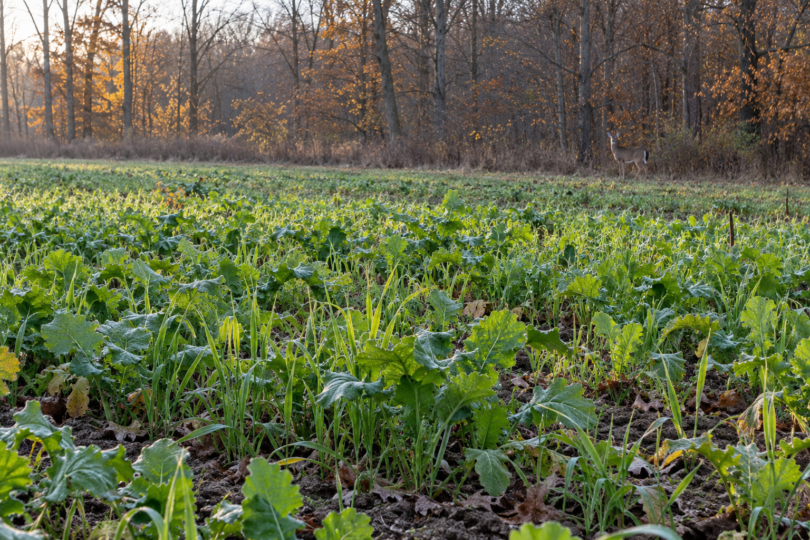

The best winter food plots for deer start with seed that fits your soil, climate and planting window. Our shortlist includes Hancock’s Wrens Abruzzi Grain Rye Seed for a cereal-grain plot in suitable Southern conditions, Whitetail Institute Winter-Greens for an annual brassica planting, and Imperial Whitetail Clover as a perennial component where the site and growing season suit it.
These are actual sowing-seed products, compared using manufacturer planting instructions and university Extension guidance. None guarantees deer visits or green growth through every winter. A plot planted too late, short of moisture or heavily browsed can disappoint regardless of the name on the bag.
Best winter food plot seeds for deer at a glance
| Exact product | Best fit | Main limitation |
|---|---|---|
| Hancock Wrens Abruzzi Grain Rye Seed, 50 lb, SKU WRENS-RAW-50 | A cereal-rye planting where this cultivar is locally adapted, especially in the Southeast | Regional planting advice matters; it is not ryegrass or a complete multi-species blend |
| Whitetail Institute Winter-Greens, 3 lb, WG3 | A dedicated annual brassica plot established within the local planting window | Needs a prepared seedbed; deer use and winter persistence vary |
| Imperial Whitetail Clover, 4 lb, IMP4 | A longer-lived clover component on suitable moisture-holding soil | Not a dependable stand-alone source of green forage through a severe Northern winter |
1. Hancock Wrens Abruzzi Grain Rye: best cereal-grain option for the Southeast
Choose the 50-pound bag of Wrens Abruzzi Grain Rye Seed, SKU WRENS-RAW-50, when you want a named cereal-rye cultivar instead of a proprietary mixture. This is seed sold for planting. Cereal rye is a different crop from annual ryegrass, even though both can appear in discussions of winter forage.
Wrens Abruzzi is among the rye cultivars listed in UF/IFAS guidance for North Florida wildlife food plots. That guidance describes rye as more cold tolerant than oats, while also warning that planting too early in warm fall conditions can expose it to disease. Its recommendation to wait for cooler weather, around mid-November, is specific to that region and should not be copied to a Northern location.
Why choose it: a clearly identified grain-rye cultivar and a straightforward single-crop option. What to weigh: variety adaptation, fertility and planting time still matter, and one crop offers less species variety than a deliberately designed mix. For a colder region, ask local Extension whether Wrens Abruzzi is appropriate before ordering this particular bag.
Hancock specifies 100 pounds per acre for broadcasting or 75 pounds per acre when drilled. At that stated broadcast rate, one 50-pound bag covers half an acre. Those are this supplier’s recommendations, not a universal rate for every rye mixture or planting method. Check the bag’s seed tag and local advice when planning the stand.
Check the 50-pound Wrens Abruzzi Grain Rye Seed bag at Hancock Seed.
2. Whitetail Institute Winter-Greens: best dedicated brassica blend
The 3-pound Winter-Greens bag, WG3, is labeled for half an acre. Whitetail Institute describes it as an annual brassica blend with a small amount of its Tall Tine Turnip. It makes more sense for this purpose than a small kitchen-garden turnip packet or a bag of edible sprouting seeds.
Check Winter-Greens at Whitetail Institute and select the 3-pound, half-acre bag.
Why choose it: a compact bag with a clear plot-size rate and planting instructions for a dedicated brassica stand. What to weigh: it is an annual planting, and a cold-tolerance claim does not ensure active growth all winter. UF/IFAS notes that deer preference for brassicas varies greatly among sites; do not assume every herd will immediately use the plot heavily.
The Winter-Greens instructions call for medium- to well-drained soil, soil-test-based preparation, a smooth and firm seedbed, and about 3 pounds per half acre. They explicitly say not to cover the seed. Follow the specified drag or cultipacker procedure instead of burying these small seeds like a cereal grain.
Use the product’s regional planting map. Its numbered regions are the manufacturer’s own map, not USDA hardiness zones. For example, the Wisconsin/Michigan region is listed for July 1 through September 1, while parts of the Deep South have substantially later fall windows. The word “winter” on the bag describes the intended forage season, not permission to sow at any point during winter.
3. Imperial Whitetail Clover: best perennial complement
The 4-pound Imperial Whitetail Clover bag, IMP4, is labeled for half an acre. The current manufacturer description identifies a blend containing Whitetail ladino clovers, Crusade clover and Alex berseem clover. It is a useful option when the aim includes maintaining a clover plot beyond one annual planting.

Whitetail Institute Imperial Whitetail Clover IMP4 Food Plot Seed, 4 lb for 1/2 Acre
As an Amazon Associate we earn from qualifying purchases.
Why choose it: a purpose-made clover blend with an established planting and maintenance program. What to weigh: it needs suitable soil moisture and ongoing weed and fertility management. The maker’s instructions favor heavier, moisture-holding soil and advise avoiding sandy ground and sites that drain quickly. Broadcast at about 8 pounds per acre and do not cover the seed.
Its winter role depends on climate. University of Georgia guidance describes useful white-clover production in cooler parts of the year in Georgia. Penn State’s white-clover guidance notes that foliage typically dies back in winter, although it may persist in mild winters. These are species-level observations, not a guarantee for this proprietary mixture. In a cold, snowy location, treat clover as part of a broader seasonal plan rather than the sole winter food source.
The Imperial Clover planting map includes different spring and fall windows by region. Follow that map, the current seed label and local advice; do not apply the Winter-Greens schedule to this bag.
How to buy seed for a winter deer food plot
Start with the site and the season
Identify your region, the area you can prepare, soil drainage and available sunlight before choosing a product. A Northern plot may need to establish forage in summer or early fall before hard freezes. Mild Southern conditions can support a later planting window, but warm-weather disease pressure still affects crop choice. Do not replace local planting guidance with a nationwide calendar.
A soil test before planting helps determine pH, lime and nutrient needs. Lime takes time to work, so plan ahead. Avoid applying a generic fertilizer rate to every product: cereal grains, brassicas and clovers have different requirements.
Buy planting seed and read the current label
Look for the actual species or cultivar, bag weight, coverage, purity and germination information on the seed tag. Human-food wheat berries, salad-sprouting alfalfa and prepared deer feed are not equivalent purchases to labeled field seed. A familiar plant name alone does not establish the right variety, sowing rate or growing season.
Do not confuse cereal rye with ryegrass. UF/IFAS specifically discourages ryegrass in North Florida wildlife plots because it can dominate the stand and become a weed problem. That regional advice is another reason to buy by botanical crop and cultivar instead of the word “rye” alone.
Compare cost per planted area
The bags here are not comparable pound for pound. A 3-pound Winter-Greens bag and a 4-pound Imperial Clover bag each carry a half-acre rate; Hancock’s 50-pound rye bag reaches half an acre at its specified broadcast rate. Compare the delivered price for your planned area, then include soil preparation, amendments and future maintenance. Follow the correct seeding rate instead of stretching a bag over more ground.
Plan for establishment and variable browsing
Seed needs appropriate moisture and contact with the soil. Heavy browsing during establishment can reduce the stand, while an unsuitable crop may receive little use. Whitetail Institute suggests a small exclusion cage to compare protected plants with the browsed area. That can help you distinguish growing problems from browsing pressure.
Food plots also have a limited role. University of Arkansas Extension describes them as a supplement within broader habitat management, rather than something that usually sustains a wildlife population by itself. None of these bags guarantees deer attraction, winter-long growth or a complete diet.
Which seed should you choose?
For a suitable Southeastern site, Wrens Abruzzi Grain Rye is the clearest cereal-grain choice here. Pick Winter-Greens for an annual brassica plot you can establish within its local window. Choose Imperial Whitetail Clover for a maintained clover component on suitable soil, with realistic expectations about its winter availability. If the region or planting date does not fit, change the seed choice or timing before buying.
Frequently asked questions
What is the best seed for a winter deer food plot?
There is no single best seed for every climate. This shortlist favors Wrens Abruzzi cereal rye for suitable Southeastern sites, Winter-Greens for an annual brassica plot and Imperial Whitetail Clover as a perennial complement. Match the crop to local adaptation, soil and planting dates.
When should I plant a winter food plot?
Use the exact product’s regional planting window and local Extension advice. Northern plantings often need a summer or early-fall start, while some Southern windows run later. “Winter food plot” does not mean the seed should be planted during winter everywhere.
Are cereal rye and annual ryegrass the same thing?
No. They are different crops with different management considerations. The Hancock pick is Wrens Abruzzi grain rye, not ryegrass. Read the product name and seed tag carefully; UF/IFAS discourages ryegrass in North Florida wildlife plots because it can dominate the planting.
Will clover stay green and feed deer all winter?
Not reliably in every climate. White-clover foliage can persist in mild winters but typically dies back in colder conditions. Imperial Whitetail Clover is a useful seasonal and perennial component where adapted, not a guarantee of accessible green forage throughout a severe winter.
How much seed do I need for half an acre?
For these exact products, the maker’s rates are 3 pounds of Winter-Greens or 4 pounds of Imperial Whitetail Clover per half acre. Hancock’s 100-pound-per-acre broadcast rate for Wrens Abruzzi works out to 50 pounds per half acre. Drilling and mixed plantings can require different rates; follow the current product instructions.