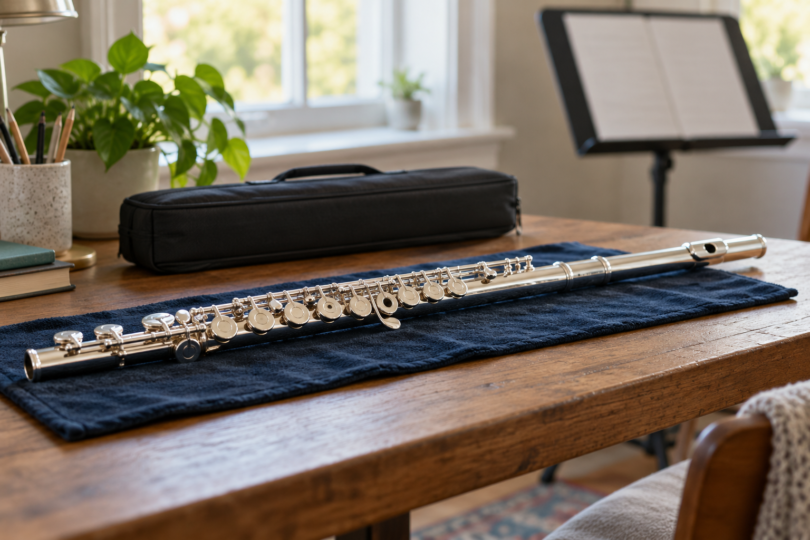

A good beginner flute should fit the player, arrive properly adjusted and have a practical route to repairs. For a first school-band or private-lesson instrument, start with a concert flute in C with covered keys and an offset G. Then compare the actual instrument with a teacher before buying.
Our shortlist is the Yamaha YFL-222 for a straightforward student configuration, the Jupiter JFL700A as an alternative to try alongside it, and the Pearl Quantz 505E-1R if a teacher recommends a split-E mechanism. These choices are based on documented configurations and buying considerations, not a hands-on sound test.
Beginner flutes at a glance
| Exact model | Keys and footjoint | Construction | Reason to consider it |
|---|---|---|---|
| Yamaha YFL-222 | Covered keys, offset G, C footjoint; no split-E mechanism | Silver-plated nickel silver | A simple student specification without open holes to seal |
| Jupiter JFL700A | Plateau keys, offset G, C footjoint | Silver-plated nickel silver; Genesis headjoint | An alternative headjoint and hand fit to compare in person |
| Pearl Quantz 505E-1R | Covered keys, offset G, C footjoint, split-E mechanism | Silver-plated nickel silver; pinless construction and one-piece core bar | A covered-key choice with a documented split-E configuration |
Model suffixes matter. An open-hole, B-foot or curved-headjoint variant is a different purchase even if the listing uses the same series name. The comparison above follows Yamaha’s flute specifications, Jupiter’s JFL700A listing and Pearl’s model table.
1. Yamaha YFL-222: a straightforward starting point
The YFL-222 combines covered keys, offset G and a C footjoint. Yamaha’s brochure identifies its 200-series construction as silver-plated nickel silver and shows no split-E mechanism for this model. It is distinct from the YFL-212, which the same table lists with split E.
Choose it if: you want a conventional student flute to take to lessons and your teacher or local repair shop is comfortable supporting it. Covered keys remove the need to seal small finger holes while learning hand placement. They do not remove the need for the pads and mechanism to be in adjustment.
Check before buying: ask whether setup, an initial adjustment and a case are included in the seller’s offer. For a used example, have a technician assess pad sealing, key alignment and joint fit before agreeing on the total cost.
See the Yamaha YFL-222 and its series details.
2. Jupiter JFL700A: another student model worth trying
Jupiter specifies a Genesis headjoint, plateau keys, offset G, a C footjoint and hidden adjustment screws for the JFL700A. The body and keys are silver-plated nickel silver, and its U.S. specification lists an ABS molded case.
Choose it if: it feels more comfortable to hold or responds more easily for you during a teacher-guided trial. That is a personal comparison to make with the instrument, rather than a claim that one brand has a better tone.
Check before buying: confirm the full JFL700A designation and the supplied case. The regional JFL700 family contains different versions and accessories. Hidden screws are a design feature, not an invitation to adjust the mechanism yourself; arrange service through a woodwind technician.
See the Jupiter JFL700A specifications.
3. Pearl Quantz 505E-1R: covered keys with split E
Pearl’s exact 505E-1R configuration has covered keys, offset G, a C footjoint and an E mechanism. The 505 family uses silver-plated nickel silver, pinless construction and a one-piece core bar. The split-E mechanism assists the third-octave E; it does not replace breath control or instruction.
Choose it if: your teacher wants that mechanism and the flute fits comfortably. It supplies a concrete feature difference from the YFL-222 without requiring open-hole keys.
Check before buying: verify the suffix on the quotation. The 505RE-1R has ring keys, while the 505BE-1RB has a B footjoint. Pearl also lists curved-headjoint versions; do not assume one is included with the 505E-1R. Ask a local technician about servicing this mechanism and obtaining parts.
See Pearl’s Quantz 505 configuration table.
What matters more than an accessory bundle
Hand fit and a comfortable reach
Have the player try the instrument while a teacher checks posture and reach. Offset G describes the position of the left-hand G keys; it is not a sound-quality rating. A small player who struggles with a straight flute may need a curved headjoint or another teacher-approved starting instrument. Buy the configuration that permits a comfortable position rather than expecting the player to grow into an awkward reach.
Covered keys, split E and the footjoint
Covered keys are a practical starting choice because the fingers do not need to close the holes found in ring keys. Open holes are not a prerequisite for being a serious student. A C footjoint reaches low C; a B footjoint adds low B. Ask the teacher whether that extra note or a split-E mechanism is relevant to the intended course before paying for either.
Setup, service and total cost
A recognizable model name does not establish the condition of a particular flute. Ask who checked it, whether it can be returned after a trial, what the warranty covers and who will carry out adjustments. Price a used flute together with any necessary repair work. A low purchase price can be a poor bargain if it needs substantial pad or mechanism work.
Rental is worth comparing when the player is still deciding whether to continue. Read the rental term, maintenance coverage, damage responsibility, purchase credit and return conditions. Yamaha’s rental checklist raises these practical questions; the actual dealer contract determines what is included.
Care that protects a first flute
Follow the supplied care instructions. After playing, remove internal moisture with the appropriate cleaning rod and cloth, and wipe the outside gently without pushing on the keys. Yamaha’s after-playing care guide illustrates the process. Put the instrument in its fitted case when it is dry and finished for the day.
If a joint becomes stiff or keys feel loose, ask the teacher or a woodwind repairer to inspect it. Do not force the joints or experiment with adjustment screws. Yamaha specifically warns against applying cork grease or other grease to a flute’s fitted metal joints in its periodic maintenance guidance.
Beginner flute questions
Is a recorder the same as a beginner concert flute?
No. A recorder is played vertically with a different blowing system and fingering. If a school asks for a flute, confirm that it means a transverse concert flute in C before ordering. A decorative bamboo flute, piccolo or music recording is not an interchangeable substitute.
Does silver plating mean solid silver?
No. These shortlisted student configurations use silver plating over nickel silver. A seller describing an instrument as “silver” should identify the underlying material and which parts it means. Do not infer a solid-silver headjoint or body from a silver-colored finish.
Should a beginner buy used?
A used instrument can be sensible when its condition is checked and the return terms are clear. Ask for an inspection and repair estimate, rather than judging pad condition from a polished exterior or assuming a seller’s “plays well” description proves that it seals correctly.
Which should I choose first?
Try the YFL-222 and JFL700A with the same teacher, then include the 505E-1R if split E is wanted. Choose the instrument that fits, works correctly and has a service plan you can use. Keep room in the budget for lessons and maintenance.