
Compare a Pelican SOLO EVO with Paddle and a Lifetime Wave youth kayak only after checking the child’s fit, readiness and supervision plan. Both are small sit-on-top recreational designs. A properly fitted life jacket, competent adult supervision and suitable water are essential parts of the purchase.
For a first outing, an instructor-led session or rental can be more useful than immediately owning a boat. It lets you assess whether the child can reach the footrests, handle the paddle and follow instructions before committing to a particular size.
Research checked October 4, 2026. We reviewed current manufacturer pages, the linked Lifetime manual, U.S. Coast Guard guidance, CDC advice and the American Academy of Pediatrics’ 2026 drowning-prevention policy. We have not conducted stability, capsize or child-fit tests. These are conditional buying options, not guarantees of safety.
Two small kayaks to compare
| Model | Verified features | Capacity check | Main buying question |
|---|---|---|---|
| Pelican SOLO EVO with Paddle, MJS06P605 | 6 feet long; molded seat and footrests; paddle and visibility flag | Technical table lists 115 pounds and one paddler | Does the actual seating position and paddle suit the child? |
| Lifetime Wave, model 90097 | 6-foot youth design; paddle; multiple footrest positions; swim-up stern | Confirm with Lifetime: current and older indexed descriptions differ | Can the maker confirm the exact boat’s load limit before purchase? |
1. Pelican SOLO EVO: a clearly specified current model
The SOLO EVO MJS06P605 has a listed length of 72 inches, width of 24.5 inches and boat weight of 19.5 pounds. Its technical table gives a maximum capacity of 115 pounds and an occupancy of one paddler. The package includes a paddle and flag.
The molded footrests and seat are worth checking in person: a child should not have to stretch awkwardly to maintain a usable position. The flag may improve visibility, but it does not make a small boat suitable for busy navigation channels or replace an adult’s attention.
Important limit: some marketing text on the same page mentions an additional seat at the stern, but the technical specification says one paddler. This guide recommends it only as a single-person kayak. Do not interpret an open rear deck as permission to carry another child.
This is the SOLO EVO, not every older product called SOLO. Confirm the SKU, included accessories and capacity label instead of applying an older model’s specifications to a newer boat.
2. Lifetime Wave: confirm the exact load rating first
The Lifetime Wave model 90097 page describes a 6-foot youth kayak with a paddle, several footrest positions and a rear deck intended to assist re-entry. It recommends ages five and up with adult supervision. That age is a manufacturer starting point, not an individual readiness assessment.
Specification discrepancy: the direct product-page text reviewed for this update says up to 115 pounds, while an older indexed version of the manufacturer’s page says 130 pounds. Do not choose the higher figure to justify a purchase. Ask Lifetime to confirm the rating for the exact boat and follow its capacity label before use.
We would consider this model only after that clarification and a fit check. Its simple layout may appeal to families comparing compact boats, but the name, bright color or advertised stability does not establish that a child can use it independently.
The safety equipment comes first
The AAP’s 2026 policy recommends a properly fitted U.S. Coast Guard-approved life jacket for children on motorized and nonmotorized watercraft. It also emphasizes an attentive, capable adult whose job is supervision, including recognizing distress and summoning help. Adults should wear life jackets too.
The Coast Guard’s fit guidance says a foam-filled life jacket should fit snugly and should not ride up above the wearer’s chin or ears. Use the label’s weight range, intended activity and fitting instructions. An adult jacket tightened around a child may still be unsuitable, and a larger size bought for future growth can fit poorly now.
Choose an appropriate inherently buoyant child’s life jacket rather than assuming an adult inflatable model is suitable. Fasten every required strap correctly. Have a qualified paddlesports instructor or outfitter help assess the complete setup if you are unsure.
Fit and readiness checks before buying
- Respect the labeled load and occupancy limits. Account for everything carried as instructed by the manufacturer. A maximum capacity is a limit, not a promise of comfortable performance near that limit.
- Check seating and reach. The child needs a usable seated position and appropriate paddle reach. Ask a dealer how to assess fit without damaging a hull resting on dry ground.
- Assess skills, not age alone. An instructor can help judge paddling control, following directions and what to do after an unexpected entry into the water.
- Choose a paddle that fits. An included paddle is convenient but still needs a practical reach and handling check.
- Plan adult access. Supervision from too far away is not an adequate rescue plan. Choose a setting and activity appropriate to the supervising adult’s skills.
Keep the first outings modest
The Wave’s linked owner manual warns against rough, stormy and whitewater conditions, dangerous currents and cold water that could cause hypothermia. It calls for adult supervision, safety training, appropriate equipment and inspection before use. Its swim-up feature should be treated as something to learn with qualified guidance, not a substitute for assistance.
CDC drowning-prevention advice notes that swimming lessons do not remove the need for close supervision. It also warns that natural water can contain hidden hazards and that weather can change quickly. Check local conditions and forecasts, and stop when wind, fatigue or loss of control makes the plan unsuitable.
This shortlist is for supervised recreational use, not surf, whitewater, strong tides or remote crossings. Do not improvise a tether attaching a child to the kayak. Get location-specific instruction rather than turning a short buying guide into a rescue or towing lesson.
Compare the total cost
Budget for the fitted life jacket, instruction, suitable clothing, transport and storage as well as the hull. Confirm what is actually included in the selected package. Check whether an adult can load and secure the boat according to the kayak and vehicle-rack instructions.
For a used kayak, inspect the hull, fittings and capacity label, and obtain the correct manual. If damage or the boat’s identity is uncertain, ask the manufacturer or a competent specialist before putting a child on it. A discount is not a reason to guess.
Frequently asked questions
What age can a child use a kayak alone?
There is no universal age established by this comparison. Manufacturer age guidance does not replace a readiness assessment or active adult supervision. Start with qualified instruction and an appropriate setting.
Can two children share one of these small kayaks?
Do not assume so. The SOLO EVO technical table specifies one paddler. Follow the exact boat’s occupancy and load limits; a rear deck is not automatically another approved seat.
Is a stable kayak enough to keep a child safe?
No. Stability claims do not prevent every capsize or unexpected entry into the water. Life jackets, supervision, skills, conditions and a realistic response plan all matter.
Bottom line: choose by fit and verified limits. The SOLO EVO is a useful current comparison; clarify the Wave’s exact capacity before buying. If readiness or supervision is uncertain, begin with an instructed session instead.
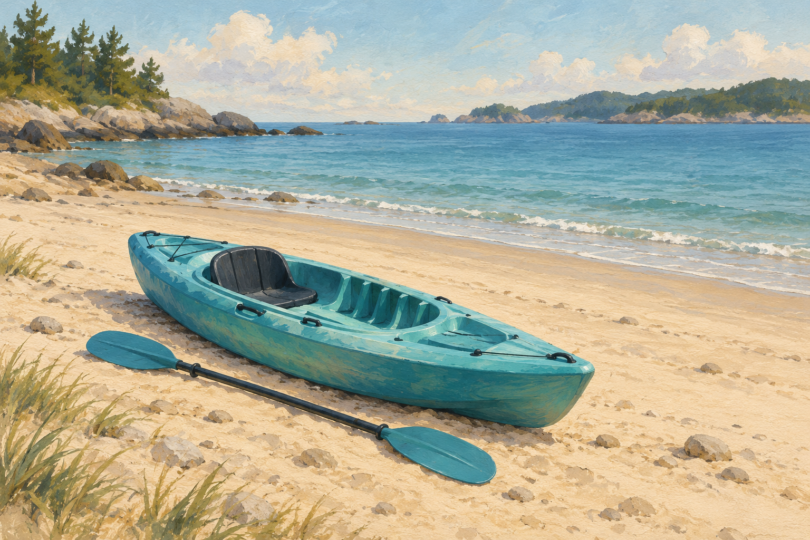
Image note: AI-generated generic youth-kayak illustration; it does not identify a model, certify capacity or demonstrate safe operation.