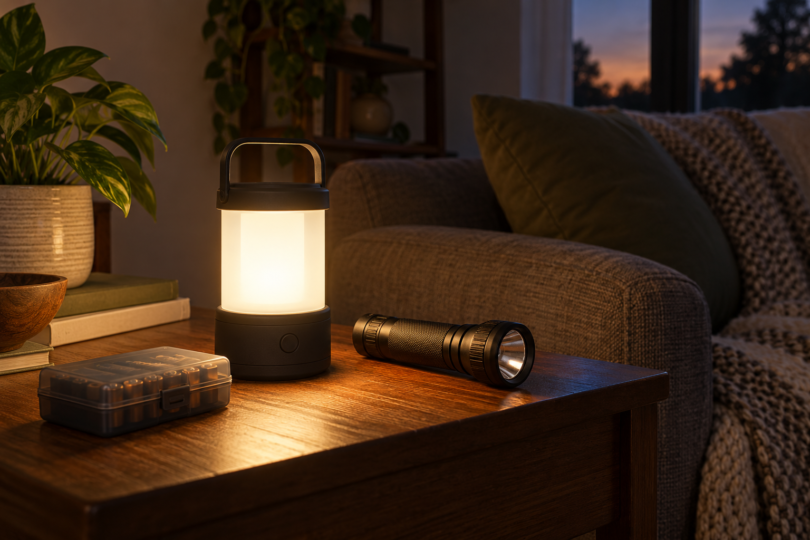

For a home power outage, start with a battery-powered LED lantern for a shared space and a flashlight for moving around. Our shortlist is the Streamlight Siege for adjustable area lighting, the Coleman BatteryGuard 600 for a simpler D-cell lantern, and the Energizer Vision HD Rechargeable Metal flashlight for a directed beam.
These picks compare documented features and power arrangements. We have not measured brightness or runtime, and “best” means a useful fit for the situations below. Keep more than one working light accessible so a flat battery does not leave you without a backup.
Compare the outage lights
| Light | Power source | Manufacturer high-mode rating | Main role |
|---|---|---|---|
| Streamlight Siege 44931 | 3 D alkaline batteries; separate | 540 lumens / 30 hours; cover removed | Shared area with several brightness settings |
| Coleman BatteryGuard 600, 2000032712 | 3 D batteries; separate | Up to 600 lumens / up to 30 hours | Straightforward high/low area light |
| Energizer Vision HD Rechargeable Metal | Built-in rechargeable lithium-ion battery | Up to 1,200 lumens / up to 4 hours | Handheld light when you need to aim the beam |
Treat the figures as manufacturer ratings for the named mode, not a guarantee of steady full brightness until the battery stops. A low-mode endurance figure is not the high-mode runtime. Plan spare batteries or a charged backup instead of sizing your emergency kit around the largest number on a listing.
1. Streamlight Siege: for adjustable area lighting
The full-size Siege is our first choice when several people need a shared light and you want more than two white-light settings. Streamlight lists high, medium and low, plus separate red and SOS modes. A handle and D-rings give you placement options; make sure any hanging point is secure.
It uses three D alkaline batteries, sold separately. The quoted white-output ratings are measured with the cover removed: 540 lumens for 30 hours on high, or 55 lumens for 295 hours on low. The long low-mode figure does not mean it stays at 540 lumens for days.
Streamlight 44931 Siege D-Cell LED Lantern
As an Amazon Associate we earn from qualifying purchases.
2. Coleman BatteryGuard 600: for simple high/low operation
Choose the 600-lumen BatteryGuard model if you prefer a simple high/low lantern and plan to keep D cells available. Coleman lists three D batteries, sold separately, and up to 30 hours on high. Its BatteryGuard mechanism disconnects the batteries from the circuit when the light is switched off.
The selected model is 2000032712. Check that number and the 600-lumen option because the family also contains other sizes. Coleman lists IPX4 water resistance; this is not a reason to submerge it or take it into floodwater. Check the light and batteries before an emergency rather than assuming stored equipment will work.
3. Energizer Vision HD Rechargeable Metal: for a handheld beam
The Energizer Vision HD Rechargeable LED Metal flashlight is the pick for a directed light you can recharge between uses. The official 1,200-lumen version has seven modes and a built-in, non-removable lithium-ion battery; a USB charging cable is included. It needs to be charged before you rely on it.
Energizer rates high mode at up to 1,200 lumens and up to four hours. It also provides a USB output for charging devices, but sharing that stored energy leaves less for lighting. For a long outage, pair it with a separate light and a practical recharge plan rather than assuming a wall outlet will be available.
What to check before buying
Choose a power source you can maintain. Replaceable-cell lanterns let you use fresh spares without mains power; a built-in rechargeable light needs a charged battery and a way to recharge later. Check the exact battery type and package contents, and try the controls in advance.
Think about where the light will be used. A table lantern suits a shared area; a handheld beam is easier to aim while checking a route or finding supplies. Avoid assuming one light will illuminate every room, staircase or outdoor path adequately.
For emergency lighting, the U.S. Fire Administration recommends flashlights and extra batteries and advises against candles. Keep battery lights ready instead of planning to use open flames indoors.
Fuel-burning lanterns, camp stoves and grills can produce carbon monoxide and must not be used indoors. If you also use a portable generator, keep it outdoors at least 20 feet from windows, doors and vents, and use a battery-powered or battery-backup CO detector. Follow the CDC’s outage safety guidance; an open garage door does not make indoor generator use safe.
Frequently asked questions
Is a lantern or a flashlight better for an outage?
They serve different jobs. Choose an area lantern for a shared space and a handheld light for an aimed beam. Keeping both is a useful plan when people may need light in different places.
Are rechargeable lights enough for a long blackout?
Only if you can keep them charged. The Energizer’s battery is built in, while the two lanterns use replaceable D cells. Keep a second working light and suitable spare power rather than relying on one device.
Does a 295-hour rating mean full brightness for 295 hours?
No. Streamlight’s 295-hour figure belongs to its 55-lumen low mode. The documented 540-lumen high mode is rated for 30 hours, with the cover removed for the white-output specification.
Are batteries included with these lanterns?
Streamlight and Coleman both specify that the three D batteries are sold separately for the models compared here. Verify any retailer bundle before ordering and buy the correct cells.
Can I use candles or a camping fuel lantern indoors?
Use battery-powered lights for an outage. The U.S. Fire Administration advises against candles for emergency lighting, and CDC warns against using fuel-burning camping equipment indoors because of carbon monoxide.