A good mindfulness toy gives you something simple to notice: a finger following a path, shapes moving inside a tube, or a brush mark slowly disappearing. The best choice depends on whether you want a guided activity for a child, quiet visual play, or a short creative break for yourself.
Three useful options are the hand2mind Mindful Maze Set for finger tracing, hand2mind Sensory Fidget Tubes for observing movement, and the Original Buddha Board for water painting. They offer different activities rather than a proven hierarchy of health benefits. None should be treated as a treatment for ADHD, autism, or an anxiety disorder.
Choose the activity before the toy
- For a guided routine: Tracing boards provide a visible route and prompts to follow.
- For watching movement: Sealed sensory tubes offer an activity without a puzzle to solve or a picture to finish.
- For creative breaks: A water-painting board suits someone who would rather make marks than follow instructions.
A product that one person finds pleasant may be distracting or irritating to another. Think about noise, texture, lights, scents, hand strength, and cleanup. Start with one suitable activity instead of a large assortment of tiny fidgets that are difficult to supervise or keep together.
hand2mind Mindful Maze Set: for guided finger tracing
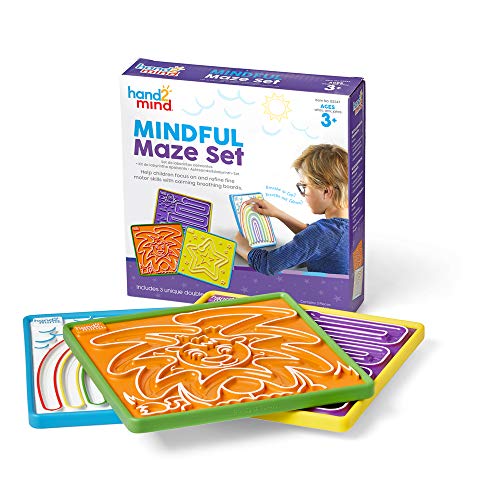
hand2mind Mindful Maze Set 93247, Plastic Boards, 3 Double-Sided Boards
As an Amazon Associate we earn from qualifying purchases.
The original Mindful Maze Set, item 93247, includes three double-sided plastic boards and a getting-started guide. The indented paths contain cues for inhaling, exhaling, and pausing. There are six patterns, including Rainbow, Square, and Star. The selected packaging is marked ages 3 and up.
This is a good starting choice when an adult wants an activity they can demonstrate alongside a child. The route makes the task concrete: put a finger on the path and follow it. Unlike a marble puzzle, there is no loose ball to steer toward a winning position.
How to introduce it: Show one board during an ordinary, relaxed part of the day. Let the child explore the texture before expecting them to coordinate breathing with the symbols. Keep breathing comfortable and unforced; following a path without doing a breathing exercise is also an acceptable way to play.
Watch for: This ASIN is the plastic three-board set, not the separate wooden version or Garden Pack. Do not promise that completing a pattern will change a child’s mood. If the activity feels frustrating, choose a different board or stop.
hand2mind Sensory Fidget Tubes: for quiet visual exploration
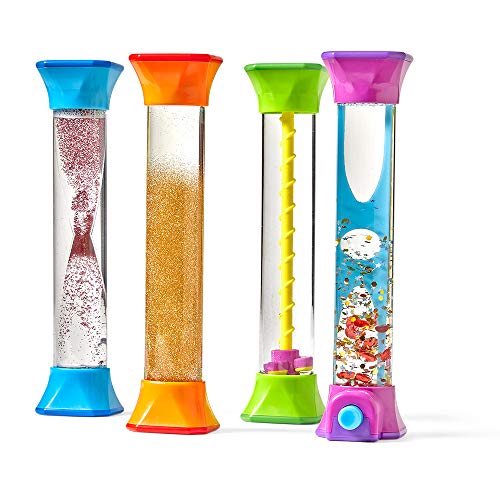
The original four-tube set, item 92419, contains sealed tubes with different moving elements and an activity guide. The manufacturer specifies that no batteries are needed. The tubes offer different motions and settling times, so the attraction is in watching what happens rather than completing an exercise correctly.
This option makes sense for someone who prefers visual movement to verbal instructions. Offer a choice of tubes, then try a neutral prompt such as “What changed when you turned it over?” or “Which part is still moving?” There is no need to turn every play session into a lesson about feelings.
Watch for: The maker labels the set with a small-parts choking warning: not for children under 3 years. Check the tubes for cracks, loose components, or leaks before use, and stop using a damaged one. They are sealed toys, not containers to open or refill. Different settling speeds also mean they should not be relied on as precise one-minute timers.
Original Buddha Board: for water-painting breaks
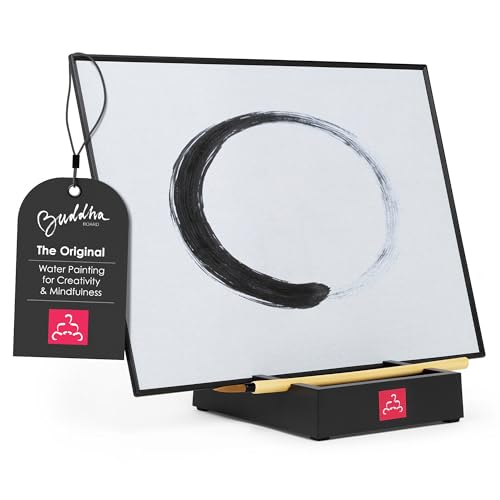
The Original Buddha Board provides a reusable surface, a water-reservoir stand, and a bamboo brush. You paint using water; the marks fade as it evaporates. The full-size Original is a different product from the Mini and Enso versions.
It is an appealing option for an adult’s desk or a supervised creative activity with an older child who enjoys brushwork. Try drawing a few lines and watching their edges change, or make a simple pattern without trying to preserve it. If keeping finished artwork matters to you, choose ordinary drawing materials instead.
Watch for: It needs a stable tabletop and water, so it is less convenient than tracing boards for a car ride or waiting room. The manufacturer says to use clean, room-temperature water and a clean soft brush, avoid finger painting, and avoid soaking or immersing the board. Handle it by its edges and follow the care instructions rather than treating the surface like a washable plastic toy.
What makes a useful mindfulness toy?
A manageable amount of stimulation
Decide where the toy will be used. A clicking mechanism that is enjoyable at home may be unwelcome during a lesson or video call. Moving glitter can be interesting during a break but compete with another task. If the person dislikes strong smells or flashing lights, those features are a reason to choose something simpler.
For classroom use, ask the teacher what is allowed and when the item can be used. A quiet break activity and a fidget used while listening have different requirements. Agree on a storage spot so the toy does not become another item to search for.
Clear age guidance and straightforward upkeep
The CPSC explains that small parts can include pieces that break off, not just loose components in the box. Follow the exact product’s age label and warnings. Do not give a toy marked 3+ to a younger child because an adult plans to supervise, and keep older children’s small toys away from younger siblings.
Also consider the individual user. A person who chews or mouths objects needs an item specifically appropriate for that use; none of these products is recommended here as a chew toy. Inspect items regularly, follow their cleaning instructions, and keep water-painting activities away from electronics and easily damaged surfaces.
An activity someone actually wants to repeat
A mindfulness toy does not need to be complicated. Before buying, try an ordinary pencil-and-paper pattern, observe a familiar object closely, or trace a shape with a finger. Notice which activity the person chooses willingly. That preference is more useful than a long feature list or a claim that one toy works for everyone.
For gifts, ask whether the recipient prefers drawing, movement, or tactile activities. Check that the set contains the expected number of pieces and that the return policy suits the purchase. An attractive product photo does not establish suitability for a particular child’s age or needs.
A simple way to begin
Place one activity somewhere comfortable, explain how it works, and leave room for choice. Start with a brief turn rather than setting a performance target. Ask what the person noticed, or let the activity end without discussion. Avoid using access to the toy as a demand to stop showing feelings.
Choose the Mindful Maze Set when a tracing route is helpful, the Sensory Fidget Tubes when watching motion is the draw, or the Buddha Board when making temporary art sounds enjoyable. The useful outcome is a repeatable activity the person likes, not a guaranteed change in concentration, behavior, or mental health.
Image note: Relevant existing topic illustration retained; not a representation of exact current card contents.