
The best wind-up toy is one the recipient can use safely and enjoy winding again. A bath swimmer, a little walking robot and a tabletop fishing game offer quite different kinds of play. Start with the manufacturer’s age label and the setting where it will be used, then compare the mechanism, pieces and cleanup involved.
Our shortlist below is based on manufacturer information and identifiable product listings. We have not tested these toys, measured their running times or ranked them with invented scores. In particular, a small wind-up toy advertised as a party favor should never be assumed suitable for a baby.
Wind-up toys worth considering
Munchkin Wind Up Swimming Penguin, blue: for supervised bath play, 9 months and older
Munchkin’s swimming penguin is a straightforward choice when you want movement in the bath without introducing a collection of tiny walking animals. You wind its arms and release it in the water. The manufacturer’s Swimming Penguin/Swimming Scuba Buddy page gives an age recommendation of 9 months and older and describes the arm-powered swimming action.
The linked blue product is model 15845, sold as one penguin, not a multi-toy bath set. It makes sense for a caregiver who wants a simple “wind, release, watch” activity. A younger child may need the adult to operate it, and the stated starting age does not imply independent bath play.
The main trade-off is water care: check the supplied cleaning and draining directions, allow the toy to dry after use, and inspect it regularly. Do not assume a mechanical bath toy is dishwasher-safe or can be boiled. Keep hair away from moving parts and discard a damaged toy.
Choose it for: one identifiable bath swimmer. Skip it for: children below the stated age, dry-floor races, or any situation without continuous adult bath supervision.
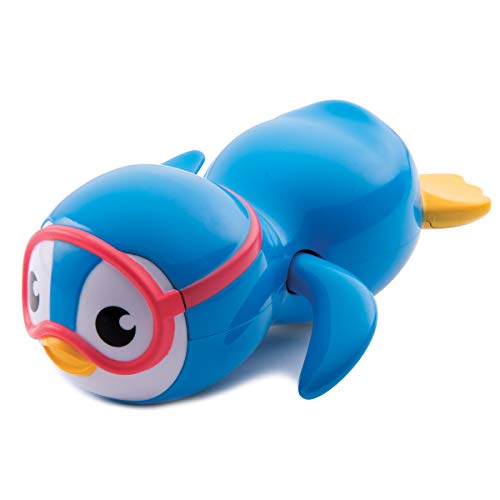
Munchkin® Wind Up Swimming Penguin Baby and Toddler Bath Toy
As an Amazon Associate we earn from qualifying purchases.
Schylling Mini Tin Robots, MTRA: a classic tabletop wind-up for ages 3+
Schylling’s Mini Tin Robots are little mechanical characters with assorted appearances. The manufacturer describes six styles, each sold separately, and lists a height of approximately 2.25 inches. The appeal is the visible connection between winding the toy and watching it move, without an app or electronic controls.
This is a better match for a child who wants a small robot than for someone expecting a full robot collection. The Amazon listing corresponds to SC-MTRA and contains one assorted robot. You should not count on a particular color or facial design unless the seller explicitly offers a selectable variant.
Important age correction: Schylling labels this product 3+ and warns about small parts. Some retailer data fields incorrectly say “3 months”; follow the manufacturer’s 3+ restriction. Keep it away from younger siblings and children who still mouth small objects.
Choose it for: a small, classic wind-up character used on a clear tabletop. Skip it for: babies, water play, or a gift that must have a guaranteed design.

Schylling Gone Fishing Game, GFG: a wind-up game for ages 3+
A wind-up game can provide a different experience from watching a single figure walk. Schylling’s Gone Fishing Game comes with eight fish and three fishing poles. Winding activates the game; players try to catch fish as their mouths open and close. This gives siblings or an adult and child a shared activity with a clear goal.
The practical downside is keeping track of all the pieces. Set it up on a table with enough room to retrieve dropped fish, then count and store the components together. The supplied poles make group play possible, but that does not establish a measured play duration or difficulty level.
Safety matters here: Schylling states 3+ and gives both small-parts and small-magnet warnings. This is unsuitable for children under three or anyone likely to mouth the pieces. Inspect it for loose or missing components. Suspected magnet swallowing or inhalation requires immediate medical attention.
Choose it for: supervised tabletop play with children who can manage small pieces. Skip it for: mixed-age toddler party bags or households where small components cannot be kept away from younger children.

How to choose a wind-up toy
Read the age label before the marketing description
“For kids,” “educational” and “party favor” are broad descriptions, not age approvals. The CPSC explains small-parts restrictions for products intended for children under three. Small parts can include pieces that detach, not just the toy as a whole.
Check the actual packaging and the manufacturer’s page. If an online listing contradicts them, do not resolve the conflict by choosing the younger age. An older sibling’s toy also needs to be stored where a younger child cannot reach it.
Match the winding action to the child
A large arm or handle can feel different from a tiny side key. Look at the product photos for where the toy is wound, how the child would grip it, and whether a separate key must be kept safe. If you cannot tell from the listing, ask the seller before buying.
There is no need to promise developmental results to appreciate the play. An adult can wind a toy while a younger, age-eligible child watches and takes a turn releasing it. A child who enjoys operating the mechanism may prefer a simple, repeatable action over a large variety pack.
Buy for the intended surface
A bath swimmer belongs in water according to its instructions. A walking robot needs an appropriate dry surface. Do not submerge a toy simply because its exterior is plastic, and do not assume a tabletop mechanism will move well on deep carpet.
For races, use comparable toys on the same flat surface and treat any timing as part of the game. Different movement patterns, winding amounts and starting positions make casual races a poor basis for declaring one model faster or better.
Are bulk wind-up party favors a good buy?
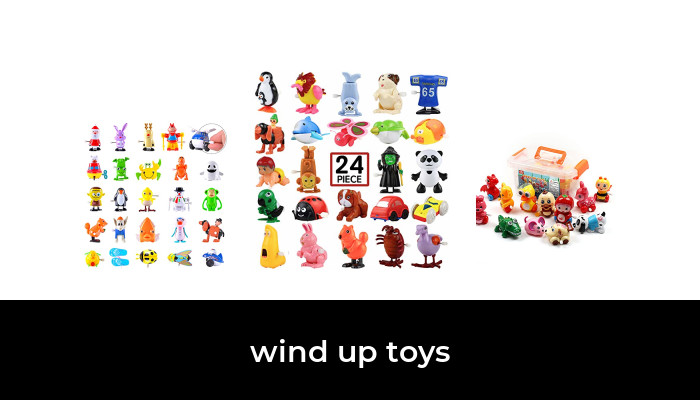
They can be useful for an age-appropriate group, but a low cost per piece tells you little about suitability. Before ordering, check the manufacturer or importer, minimum age, choking warning, exact pack count and whether the pictured assortment is guaranteed. A photograph of 24 different animals may represent assorted stock rather than 24 distinct toys in every box.
Keep labels with the toys when giving them away. Loose favors in unmarked bags can leave another caregiver without the age warning or product identity. If you cannot obtain those details, choose a clearly labeled alternative. Do not use an anonymous miniature assortment as infant sensory toys.
Tin collectibles need separate treatment
Some metal wind-ups are made for adult collectors. Schylling’s Robot Lilliput Large, for example, is designated an adult collectible for decoration and is not a children’s toy. That is a different product category from its 3+ Mini Tin Robots.
A nostalgic appearance does not establish that an item is appropriate for children. For an adult gift, check whether the recipient wants a display collectible, a moving desk novelty or something intended for hands-on play. Follow the stated use even if another seller lists the item in a general toy category.
Care and safe play
- Wind only as directed; do not force a stiff key or keep twisting against resistance.
- Inspect seams, keys, feet and moving pieces before giving the toy to a child.
- Stop using a toy with a loose component, sharp edge or exposed mechanism. Do not hand a damaged toy back after a makeshift repair.
- Follow model-specific cleaning directions and keep dry-only toys out of water.
- Store small toys and separate keys away from younger children.
- For baths, have supplies ready and stay with the child throughout. The AAP’s baby bathing guidance says never to leave a baby alone in the bath, even briefly.
Bottom line
Choose the Munchkin penguin for an age-appropriate, supervised bath activity; the Schylling Mini Tin Robot for a small classic wind-up character; or the Gone Fishing Game for shared tabletop play with careful control of its small magnetic pieces. The most useful comparison is the kind of play and supervision involved, rather than how many toys fit in a pack.
Image note: Examples from the product category; pictured models and variants may differ from the options discussed.