
For carrying minnows alongside a boat’s livewell, start with the Frabill 4825 Aerated Bait Bucket for a small insulated pail, the Engel Original 13 Quart Live Bait Cooler for a rectangular box with a pull-out net, or the Frabill 14071 Magnum Bait Bucket for more bucket capacity. These are portable bait containers. Measure your boat before choosing one as an insert inside an existing livewell.
This shortlist compares documented capacity, aerator arrangement and practical buying limitations. The recommendations are editorial judgments, not results of hands-on survival, leak or battery tests. A bucket’s volume does not establish how many minnows it can safely hold.
Compare the best minnow buckets and portable bait coolers
| Product | Best fit | Capacity and aeration | Main buying check |
|---|---|---|---|
| Frabill 4825 Aerated Bait Bucket | A small pail with the aerator housed in its lid | 1.3 gallons; insulated liner and integrated aeration | Confirm exterior measurements and the supplied pump’s battery requirements |
| Engel Original ENGLBC13-N, white | A portable cooler with removable bait net | 13 quarts; Gen2 two-speed pump using two D batteries or a 12V DC adapter | Choose the Original battery-pump package; the separately sold rechargeable upgrade differs |
| Frabill 14071 Magnum Bait Bucket | A larger insulated pail with a separate clip-on aerator | 4.25 gallons; removable liner and included portable aerator | Verify the overall footprint and included aerator specification before ordering |
Frabill 4825: a small bucket with integrated aeration
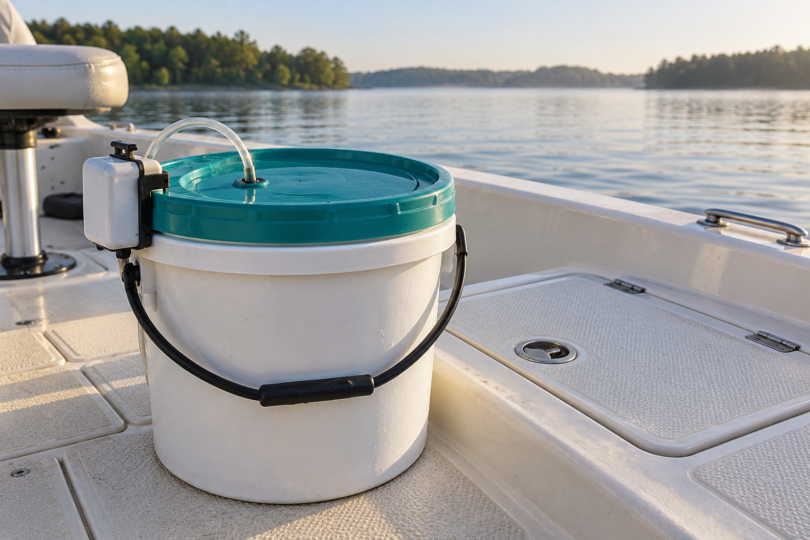
The Frabill 4825 combines a 1.3-gallon bucket, insulated liner and lid-housed aerator. Its lid also has a clip-on bracket and hose hole for a second aerator. The appeal is simple: the included pump occupies the lid rather than another spot on the boat.
Why choose it: This is the smallest nominal capacity in the shortlist, and the integrated aerator is useful when you prefer a self-contained pail. The second-aerator mount gives you an expansion option; a second pump is not part of this recommendation.
What to check: Frabill’s current page does not give exterior dimensions or battery details. Its 2016 product announcement describes two- or four-AA operation, but confirm the instructions supplied with the unit you buy. Do not use Amazon’s implausible 1 × 1 × 1-inch dimension field to decide whether it fits a livewell opening.
The linked Amazon selection is one white-and-yellow model 4825 bucket with an included aerator. Check the model and included parts when ordering; the listing’s broad “Buckets & Accessories” title alone is insufficient identification.

Frabill 4825 Aerated Bait Bucket, 1.3 Gallons
As an Amazon Associate we earn from qualifying purchases.
Engel Original 13 Quart: a cooler with a pull-out net
The Original ENGLBC13-N has a removable net, shoulder strap and an air-tube opening in the lid. Engel lists an exterior envelope of 15 × 10 × 11.25 inches and an interior of 12 × 7 × 8.5 inches. Allow extra room for the pump, hose, handle and open lid; the body dimensions do not establish clearance in a tight compartment.
Its standard Gen2 2X2 pump is not rechargeable. It uses two D-cell batteries, sold separately, or the included 12V DC car adapter. Engel specifies two airflow settings, 0.8 and 1.0 liters per minute. Those pump specifications are not a guarantee of dissolved oxygen or bait survival in your load.
Why choose it: The pull-out net offers a convenient way to reach bait without tipping the box. This is the choice I would investigate first when a rectangular cooler suits the boat’s available space better than a round pail.
What to check: The Original cooler’s standard Gen2 pump differs from Engel’s separately advertised rechargeable upgrade. Keep the air stone inside the net, as Engel instructs, to avoid hose kinking and trapped air beneath it. The pump has water-resistant housing; that is not permission to submerge it.
The linked selection is one white 13-quart Original cooler with a second-generation battery pump. Amazon’s basic dimension field lists the height as 11 inches, while Engel specifies 11.25 inches. Use the manufacturer’s measurement and check actual clearance before buying for a fitted space.

Frabill 14071 Magnum: more room in a bucket format
The Frabill Magnum 14071 provides 4.25 gallons of nominal capacity, a removable insulated liner and an included portable aerator that clips to the lid. The accessory lid has molded slots for equipment such as a bait net.
Why choose it: It offers more nominal volume than the 4825 while retaining a conventional bucket arrangement. Choose it when you want the larger pail and can reserve space for the externally mounted pump.
What to check: The manufacturer page reviewed does not specify exterior dimensions, battery configuration or a rated runtime. Ask for those details for model 14071 before ordering. Do not assume a specification from another Frabill aerator applies to the included unit, or that a nominally larger bucket allows a proportionally larger bait load.
Buying route: Use Frabill’s model 14071 page to check the current package. Match the model number, removable liner and included portable aerator, rather than selecting a similarly named bucket or an aerator-only accessory.
Choose for the livewell you actually have
For an insert, measure the hatch opening, the narrowest internal width, the usable depth and clearance beneath the closed lid. Include handles and pumps in that check. Keep hoses clear of hinges and avoid blocking the livewell’s intake or overflow. For a separate portable container, choose a secure, accessible location where you can inspect the aerator and remove bait without moving other equipment.
A flow-through container serves a different use case. Frabill’s Magnum Flow-Troll 451200 is designed to float in water, with water passing through the bucket. Its operation depends on that water exchange; treat it as an in-water option, not an aerated transport bucket on a dry deck. Confirm its dimensions and suitability for your livewell separately.
Ask your bait supplier about the species, water temperature and realistic holding load for the trip. Keep the container shaded, inspect the hose and bubbling during use, and plan for replacement batteries or another suitable power source. Avoid treating an advertised pump runtime, insulation claim or quart rating as a promise that bait will survive until a particular time.
The U.S. Fish & Wildlife Service recommends cleaning visible plants, animals and mud from equipment, draining water-containing compartments before leaving an access, and drying equipment before reuse. For retained live bait, its guidance is to drain the container and replace the water with spring or dechlorinated tap water. It recommends putting unwanted bait in the trash and never transferring live fish or other organisms between waterbodies. Check the rules for the state and water you fish, including bait species and transport restrictions.
Frequently asked questions
Which bucket is the best starting point for a small bait load?
Consider the Frabill 4825 if its 1.3-gallon capacity and lid-housed aerator suit your trip. Choose based on the bait supplier’s holding advice and actual fit, rather than a fixed number of minnows inferred from bucket volume.
Can any of these go inside my boat’s livewell?
Only after checking dimensions, lid clearance, plumbing and aerator placement. None is presented here as a universal livewell insert. Engel publishes the clearest body dimensions in this shortlist, but you still need room for its external components.
Does the Engel Original 13 Quart include a rechargeable pump?
No. The compared Original package comes with the Gen2 two-speed battery pump. It uses two D batteries or 12V DC power; Engel’s rechargeable pump is a different product or upgrade.
How many minnows can I keep alive overnight?
This comparison cannot establish an overnight survival time or safe fish count. Get guidance for the exact bait species and conditions, keep checking the water and aeration, and avoid buying solely on a runtime or capacity claim.
Can I release leftover minnows when I finish?
Do not release unwanted bait into the lake or move live organisms to another waterbody. Follow the U.S. Fish & Wildlife Service’s disposal guidance and the local fisheries authority’s bait and transport rules.