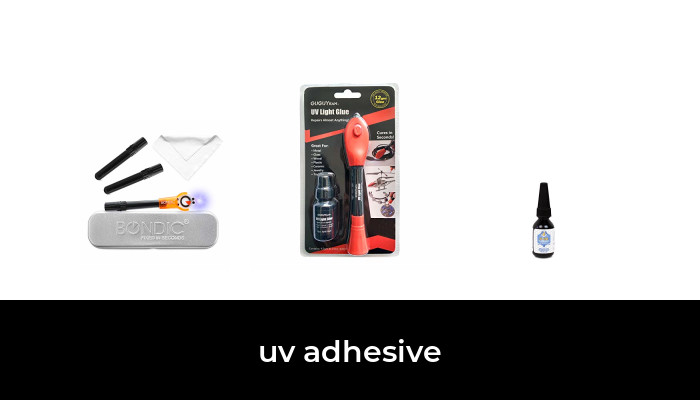
Miracle Glue is a specific cyanoacrylate adhesive brand, and its own instructions rule out some materials. If you are looking for that product, verify the branded 20-gram bottle and read its label. If you simply want a dependable instant adhesive for a small household repair, Gorilla Super Glue Gel and Loctite Super Glue Ultra Gel Control are two clearly identified alternatives worth comparing.
Choose by the materials, joint fit and conditions the repair will face. A fast initial bond is useful for a small ornament; it does not establish that the same glue can repair a food container, a load-bearing chair joint or an object continuously exposed to water.
What the Miracle Glue brand actually specifies
The Miracle Glue USA product page identifies a 20g cyanoacrylate bottle requiring no mixing. It expressly excludes polyethylene and Teflon and does not recommend fabrics or paper. Those restrictions matter more than the site’s broad claim about bonding almost anything.
The brand recommends refrigeration and claims a storage life of up to five years under that condition. Treat the duration as the seller’s claim, not an independently verified guarantee. Follow the instructions on the bottle you receive, keep it clearly labeled and inaccessible to children, and do not transfer the recommendation to other brands.
For the exact Miracle Glue product, use its official product information to establish identity. The alternatives below are different brands and formulas; neither is a relabeled Miracle Glue bottle.
Two instant-glue alternatives at a glance
| Product | Verified package | Useful feature | Important limitation |
|---|---|---|---|
| Gorilla Super Glue Gel | 20g, one bottle | Thicker formula for controlled placement | Indoor use; not a gap filler |
| Loctite Super Glue Ultra Gel Control | 4g, item 1739050 | Side-squeeze bottle and rubber-toughened gel | No continuous water exposure or hot-liquid repairs |
Gorilla Super Glue Gel: a larger bottle for small indoor repairs
Gorilla’s specifications describe a no-run gel that sets in approximately 10–45 seconds. It suits close-fitting repairs where a runny liquid would be difficult to place. The linked 20g single bottle has part number 7700104 and GTIN 00052427770011.
The maker excludes polyethylene and polypropylene, specifies indoor use and says it is not a gap-filling adhesive. It also rules out direct or indirect food contact. Choose another product for a missing chunk, a continuously wet joint or a repair that will touch food.
Gorilla instructs users to apply a small amount to one clean, dry surface. Too much adhesive can delay or spoil the bond. Its storage guidance is a cool, dry location, explicitly not a refrigerator. That is different from Miracle Glue’s instructions.
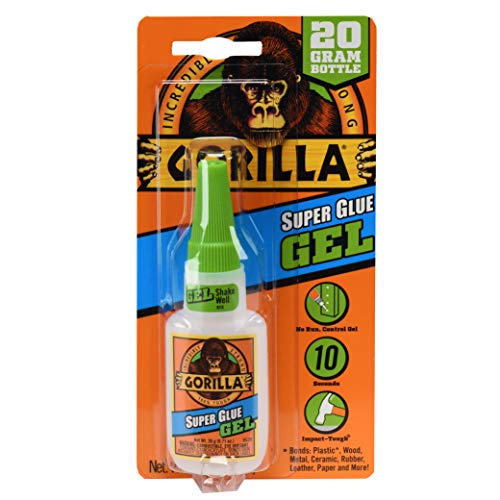
Gorilla Super Glue Gel, Clear, 20 g, All Purpose, Fast Setting | Dries in 10-45 Seconds, Thick No-Run Formula for Vertical Surfaces, Ideal for Projects and Repairs
As an Amazon Associate we earn from qualifying purchases.
Loctite Ultra Gel Control: a small precision bottle
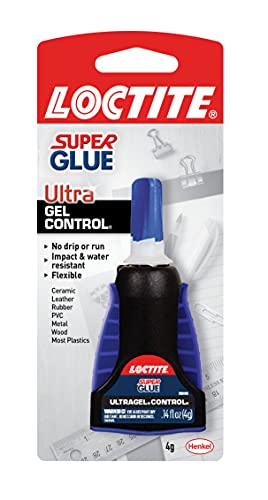
Henkel’s technical data sheet identifies item 1739050 as a 4g bottle of rubber-toughened Ultra Gel Control. The side-squeeze dispenser is useful when control matters more than buying the largest amount. The linked listing matches item 1739050 and UPC 079340646216.
The sheet gives a 15–30-second fixture time and 12–24-hour cure time, depending on conditions. Do not treat the first grip as full strength. It supports several hard plastics, including acrylic, polycarbonate and PVC, but excludes polyethylene, polypropylene, PTFE, silicone rubber, polystyrene foam and glass, among other materials.
It also excludes glazed surfaces, gap filling, dishwashers, ovens, microwaves and assemblies holding hot liquids. Moisture resistance does not mean suitability for continuous water exposure. A retail compatibility field that lists glass does not override these manufacturer restrictions.
Check the repair rather than chasing a strength claim
Before opening the bottle, answer four questions:
- What are both surfaces? “Plastic” is too broad. Look for a resin marking or ask the object’s manufacturer.
- Do the pieces meet cleanly? Dry-fit them. Missing material, a wide gap or a distorted edge may require a different adhesive or replacement part.
- What happens during use? Consider bending, impact, heat, moisture and contact with food. Choose a product explicitly suitable for those conditions.
- What happens if it fails? A decorative item and a safety-critical component deserve different repair decisions.
For a gap-filling job, investigate a suitable epoxy rather than assuming a thicker super glue is a filler. Loctite’s adhesive-selection guide explains the basic distinction: cyanoacrylate is a single-component, rapid-setting adhesive; a two-part epoxy requires resin and hardener and can be formulated for gaps. The exact epoxy still needs to match the materials and exposure conditions.
Do not improvise with glue on brakes, protective equipment, pressurized fittings or other parts whose failure could injure someone. Use the equipment maker’s approved repair procedure or replace the part. For valuable antiques or irreplaceable ceramics, a conservator can advise on a repair that does not make later restoration harder.
A careful application routine
Work in ventilation, protect the surface and read the label before fitting the nozzle. Arrange the pieces and supports first so you are not trying to reposition a fast-setting joint. Remove dirt and grease using a cleaning method safe for the object, and let the surfaces dry. Test an inconspicuous area if discoloration or finish damage would matter.
Use the amount and holding time specified for that formula. Leave the item undisturbed through the recommended cure period before returning it to service. Avoid adding household powders, heat or other chemicals in an attempt to accelerate the repair unless the adhesive manufacturer explicitly prescribes that method.
Keep household adhesive away from skin and eyes
Miracle Glue’s warning calls for ventilation and avoiding skin and eye contact. Household super glue is not a substitute for a medical skin adhesive, nail product, lash adhesive or dental repair product. A broad promotional list of uses does not establish medical suitability.
Poison Control explains that cyanoacrylate can bond tissue and release heat as it cures. Never force stuck fingers or eyelids apart. For eye exposure, rinse with water and seek immediate poison-center or medical guidance; do not put acetone or household debonder in an eye. In the United States, Poison Control is available at 1-800-222-1222.
Keep wet cyanoacrylate away from cotton or wool, including cotton gloves and cotton-swab applicators: the reaction can generate enough heat to burn. Keep bottles separate from medicines and cosmetics, and never open a nozzle with your mouth.
Which should you choose?
Choose the exact Miracle Glue bottle only after its stated exclusions and storage instructions fit your repair. For an ordinary small indoor repair with closely mating surfaces, Gorilla’s 20g gel offers a larger package; Loctite’s 4g Ultra Gel Control offers a compact side-squeeze dispenser. Neither earns a universal “best glue” label. The better purchase is the correctly specified adhesive in an amount you can use and store safely.
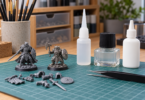
Image note: Original AI-generated editorial illustration; generic objects shown, not branded product photography.