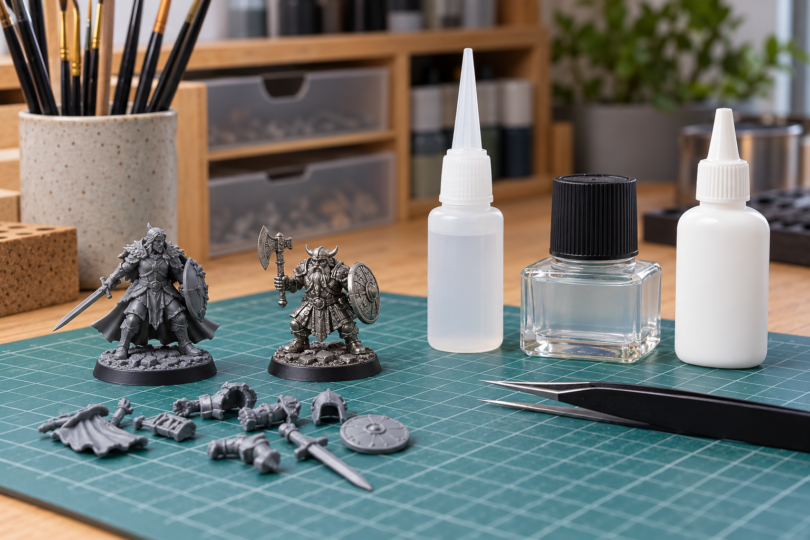

The best glue for miniatures depends first on what the model is made from. Choose Tamiya Extra Thin Cement 87038 for closely fitted polystyrene parts, or The Army Painter Super Glue for resin and metal miniatures. Gorilla Super Glue Gel is another option for small metal joins when you prefer a thicker adhesive. For sand, flock and scenery materials, choose The Army Painter Battlefield Basing Glue.
This shortlist compares manufacturer instructions, material compatibility and safety information. It is not based on hands-on bond testing. The four products serve different jobs, so the first purchase should match your kit rather than a general strength ranking.
Compare four glues for miniature projects
| Product | Choose it for | Main limitation |
|---|---|---|
| Tamiya Extra Thin Cement 87038, 40 ml | Closely fitted polystyrene model parts | Not a general adhesive for resin or metal |
| The Army Painter Super Glue, GL2014P | Resin, metal and mixed-material miniature assembly | Fast bonding leaves little room for mistakes; check the exact material |
| Gorilla Super Glue Gel, 25 g | Small metal joins where gel application is convenient | The maker says it is not gap filling or paintable |
| The Army Painter Battlefield Basing Glue, GL2013P | Sand, grass and scenery materials on bases | Not the choice for assembling a metal miniature |
1. Tamiya Extra Thin Cement: for polystyrene kits
For a kit identified as polystyrene, Tamiya Extra Thin Cement is the most directly matched option here. The manufacturer specifies polystyrene model kits; its thin consistency suits fine seams and small contact points. Tamiya’s global product page describes application between parts that have already been fitted together and confirms the brush in the cap.
Select the standard 87038, 40 ml bottle. Do not transfer its compatibility to an unidentified plastic, cast resin or a metal attachment. Dry-fit first, check the kit instructions, and use a different adhesive when the two parts need a different chemistry. No universal holding or full-hardening time is established by the product pages cited here; follow the bottle instructions before moving on to sanding or painting.

Tamiya 87038 Extra Thin Cement, 40 ml, one bottle
As an Amazon Associate we earn from qualifying purchases.
2. The Army Painter Super Glue: for resin and metal
The Army Painter Super Glue GL2014P is a medium-thickness cyanoacrylate, usually shortened to CA. The manufacturer specifically lists resin, metal and plastic miniatures, including joins between different materials. Its precision nozzle makes it a relevant choice for small components. For an all-polystyrene kit, start with a compatible plastic cement instead.
Dry-fit the joint before opening the glue. The product page describes a fast cure but does not provide a numerical full-cure schedule, so do not borrow one from another brand. Resin is also a broad material category: check the kit or print-resin maker’s instructions rather than assuming every resin formulation behaves alike. The current safety sheet includes skin-sensitization, respiratory-irritation and suspected-carcinogenicity warnings; read the label on your bottle before use.
3. Gorilla Super Glue Gel: for controlled application on small metal joins
Gorilla Super Glue Gel suits small joins on materials the manufacturer lists, including metal, when a thicker adhesive is easier to position. The selected size is 25 g. It is a CA adhesive, distinct from Original Gorilla Glue, the expanding polyurethane product. The maker excludes polyethylene and polypropylene and does not specifically identify miniature resin in its material list, so this is not our resin-specific recommendation.
Use a small amount on a clean, dry, closely fitted joint. Gorilla directs users to press the surfaces together for 10–45 seconds; excess glue and uneven joins can delay bonding. Its specifications say no gap filling and not paintable, so keep adhesive inside the joint. The manufacturer’s full-cure guidance is 24 hours. The short pressing time is not the point at which the bond has finished curing.
4. The Army Painter Battlefield Basing Glue: for scenery and bases
Battlefield Basing Glue GL2013P is a PVA adhesive for attaching sand, rocks, grass and similar basing materials. The maker also lists XPS foam, Styrofoam, wood, paper, cardboard, cork and plaster. It can be thinned with water and changes from white to transparent as it dries.
Choose it for scenery work rather than a metal arm or weapon. The manufacturer says it performs less well on plastics and metals. Its page does not establish a universal drying time, and the safety sheet warns that its preservatives may cause an allergic reaction. Avoid interpreting a craft-glue description as permission for skin contact.
How to choose and prepare the joint
- Identify both materials. Check the kit packaging or instructions. Polystyrene cement is a material-specific choice; a metal accessory on a plastic figure needs an adhesive approved for both surfaces.
- Check the fit without glue. Uneven joins need attention before assembly. For its cast-resin kits, Games Workshop recommends washing away mould-release residue and dry-fitting components. Follow your own kit’s preparation instructions and let cleaned parts dry.
- Consider the part’s weight. Games Workshop’s resin guide describes two-part epoxy for larger, heavier components and pinning with metal rods for added strength. A big part hanging from a tiny contact point deserves more planning than an extra drop of CA.
- Keep the join steady. Arrange support before applying glue, and follow its stated holding or clamping directions. Gorilla’s no-clamp claim still comes with instructions to press the surfaces together. Support a delicate assembly without bending or crushing it.
- Separate setting from full cure. An initial grip does not mean a joint is ready for stress, sanding or painting. Use the exact product’s cure instructions; do not apply Gorilla’s 24-hour guidance to every glue in this list.
Ventilation, eye protection and the CA fabric hazard
Work in a well-ventilated area, avoid breathing vapour, and keep adhesives away from children. Use eye protection and the chemical-resistant gloves specified for the particular product; ordinary fabric gloves are unsuitable for handling wet CA. Tamiya’s safety sheet for 87038 identifies highly flammable liquid and vapour, serious eye irritation, and possible drowsiness or dizziness. Keep it away from heat, sparks and flames, and close the bottle between uses.
Keep wet super glue away from cotton and wool, including cotton swabs and cloths. CA maker Starbond explains that contact with these materials can trigger rapid curing that releases heat. BSI’s CA safety sheet also warns that fabric or paper contact can generate heat, smoke and irritating vapour and cause burns. Follow the adhesive’s spill instructions instead of wiping a puddle with a cloth or paper towel.
CA can bond skin and eyes within seconds. Do not pull bonded skin apart, and do not force a glued eye open. Follow the product’s first-aid instructions and obtain medical advice for eye exposure or burns. Gorilla’s safety sheet covers ventilation, protective equipment and eye-exposure precautions.
Frequently asked questions
Can plastic cement glue resin miniatures?
Do not assume it can. Games Workshop explicitly says plastic-kit glue is ineffective for its resin pieces and recommends super glue instead. Use an adhesive approved for your particular model material; Tamiya 87038 is the polystyrene option in this guide.
Is gel super glue a gap filler?
Not automatically. Gorilla Super Glue Gel is explicitly listed as not gap filling. Improve the fit, and choose an appropriate modelling filler or an adhesive rated for the actual gap rather than relying on the word “gel.”
Can I use PVA for every part of a miniature?
No. Battlefield Basing Glue is useful for scenery and basing materials, but its maker says it works less well on plastics and metals. Match assembly glue to the model material and use basing glue for the job it is designed to do.
Which one should you buy?
For a polystyrene army, start with Tamiya 87038. For resin or metal figures, consider The Army Painter Super Glue. Gorilla Super Glue Gel is an alternative for small metal joins when you want gel application and can keep the bond line hidden. Add Battlefield Basing Glue if you also plan to build scenery or texture the bases.