
Do not choose an oscillating blade for Hardie solely because it says “carbide,” “diamond” or “multi-material.” Dremel documents cement-board cutting for its MM485 carbide blade, but that is not the same as a James Hardie-approved cutting method for every siding or backer-board product.
For new HardieBacker sheets, start with the manufacturer’s scoring or shearing methods. For exterior siding and trim, select the documented cutting system for that exact product, including dust controls. The blade’s ability to make a cut is only one part of the decision.
Research checked October 4, 2026. We reviewed manufacturer cutting guidance and US OSHA resources. We did not test blade life, cut quality, dust generation or exposure. Prices and stock are not verified.
Three practical cutting options to check first
| Option | Documented use | Main limitation |
|---|---|---|
| Carbide-tipped scoring knife | HardieBacker sheets, following the product’s score-and-snap instructions | Not a universal solution for installed siding or thick trim |
| PacTool SS724 Snapper Shear Pro | Drill attachment for 1/4–1/2-inch backer board; straight and curved cuts | Needs a compatible drill; verify board type and thickness |
| HardieBlade in an appropriate dust-collecting saw | Outdoor cutting of the applicable exterior Hardie product | A blade alone does not provide the required dust-control system |
These are different approaches, not three interchangeable oscillating accessories. If you already own a multi-tool, compare the entire job with these options before buying another blade for it.
1. A scoring knife for new HardieBacker sheets
James Hardie’s HardieBacker installation guide recommends a carbide-tipped scoring knife and also permits a utility knife or shears. For a small backer-board job with accessible sheets, this is the first method to evaluate before shopping for a powered cutting accessory.
Why consider it: you may be able to complete the required layout using the board maker’s documented hand-tool method. That avoids forcing a tool you already own into a different task.
Limits: follow the guide for the actual board, including cutouts, support and handling. “Hardie” can mean lap siding, trim or tile backer board; a method documented for one is not automatically appropriate for another. See the installation-instruction library to identify the applicable document.
2. PacTool SS724 for shaped cuts in backer board
The SS724 is a concrete alternative when repeated or curved cuts make a dedicated attachment attractive. PacTool specifies 1/4–1/2-inch HardieBacker, straight and right-angle cuts, curves, and circles down to three inches in diameter. It attaches to a drill, with 18 volts or higher recommended for performance.
Why consider it: the exact product has a documented backer-board use rather than a generic “hard materials” claim. James Hardie’s FAQ also identifies shears as a cutting option for its backer board.
Limits: do not confuse SS724 with a siding shear designed around a different material thickness. It is an attachment, so include the drill and any needed replacement parts in the purchasing decision. A claim of reduced dust is not a promise of zero exposure or automatic compliance on every job.
3. A HardieBlade cutting system for exterior work
For exterior siding and trim, James Hardie’s tool guide recommends the HardieBlade saw blade and explains why the cutting setup matters. Select a blade whose diameter, arbor and speed rating match the saw, then confirm the equipment and method against the product instructions.
Why consider it: the blade family is specifically identified by the material manufacturer for fiber-cement work. This is a more relevant starting point for repeated siding cuts than a bargain pack of wood-and-metal multi-tool blades.
Limits: the guidance calls for power-saw work outdoors. Buying a fiber-cement blade does not turn an ordinary indoor cutting setup into an acceptable one. Budget for the suitable saw, collection system and other required controls together.
What about the Dremel MM485 oscillating blade?
Dremel’s MM485 fact sheet explicitly lists cement board among its applications. Its current MM488B three-blade kit page identifies an MM485 carbide blade alongside separate MM480 wood and MM482 wood-and-metal blades.
That evidence supports treating the MM485 as a cement-board-capable accessory to investigate. It does not prove that every blade in that kit is appropriate, that it fits every modern multi-tool, or that using it on a particular Hardie product satisfies the board manufacturer’s cutting guidance.
Before buying it for this task, obtain confirmation for the exact board and cut from James Hardie, and check the exact tool model against Dremel’s accessory compatibility information. We did not find an explicit oscillating-tool method in the cited US Hardie guidance, so we cannot present MM485 as a verified Hardie-approved solution. No measured dust advantage or blade-life claim is made here.
Silica controls are part of the tool choice
Cutting fiber cement can release respirable crystalline silica. James Hardie provides silica-safety and cutting-station guidance; use it before choosing the work location and equipment. A small cut or a visually small dust cloud should not be used as evidence that exposure is controlled.
The OSHA fiber-cement saw fact sheet describes a specific outdoor setup for handheld circular saws with blades no larger than eight inches. It includes compatible vacuum collection, sufficient airflow and filtration. The construction compliance guide specifies manufacturer-recommended airflow or greater and filter efficiency of at least 99%. Do not transfer that circular-saw provision to an oscillating tool simply because both are handheld.
HardieBacker’s guide prohibits high-speed power-tool cutting indoors and dry sweeping. Follow its cleanup and respiratory-protection instructions, together with applicable workplace requirements. Use wet cleanup methods or an appropriate HEPA vacuum as directed; avoid dispersing collected dust with compressed air. For an unusual installed-board cut, ask a qualified contractor to choose the method and controls.
Before you order
- Identify the board. Record product name, thickness and whether it is loose or already installed.
- Define the cut. A straight cut through a loose sheet, a curve and an opening in an existing wall are different jobs.
- Verify the accessory interface. Match the exact tool and blade. “Universal” in a listing is not sufficient proof of fit.
- Read exclusions. A blade rated for grout, metal or wood has not thereby been verified for fiber cement.
- Include controls and access. Allow for collection equipment, cleanup and the workspace required by the chosen method.
- Protect the assembly. Existing walls can conceal services and weatherproofing. Have the cut assessed before disturbing them.
Frequently asked questions
Is a diamond grout blade the best choice?
Not automatically. A grout-removal application does not establish suitability for through-cutting the board. Look for exact material and task documentation.
Can I cut indoors if I wear a mask?
A mask does not cancel the manufacturer’s indoor cutting restrictions. Choose a permitted method and follow all applicable dust-control and protective-equipment requirements.
Is HardieBacker the same as exterior Hardie siding?
No. Identify the product and use its own instructions rather than treating the brand name as a material specification.
Which oscillating blade lasted longest in your tests?
We have not run those tests. This guide compares documented applications and limitations, not measured durability.
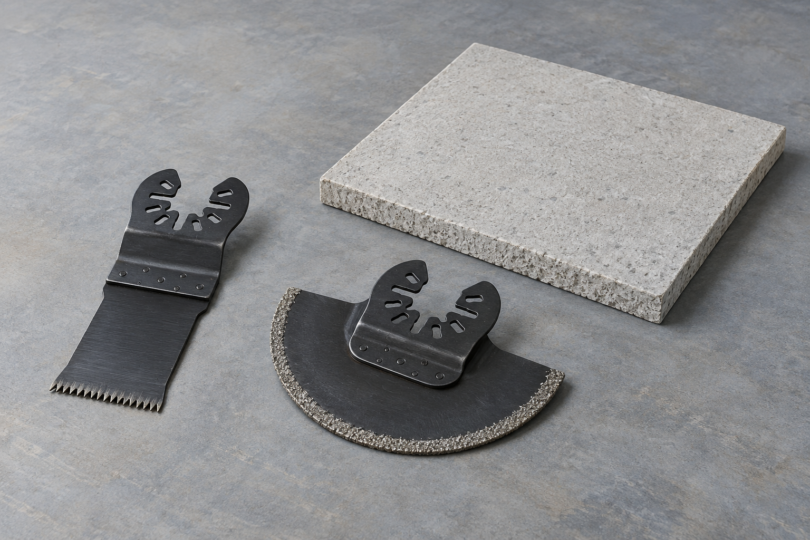
Image note: Generic editorial illustration of tool blades and cement board; verify the specific blade rating and the board manufacturer’s cutting guidance before use.