
For an M8 114 used for ordinary road riding, start by asking a Harley-Davidson dealer whether the SE8-447 Torque package is approved for your exact motorcycle and configuration. The SE8-462 Power package is the alternative to discuss when you prefer higher-rpm performance. Do not choose solely by engine displacement: model year, cooling system, existing parts and emissions certification all matter.
The widely discussed S&S 475C is included below for comparison, but its manufacturer explicitly excludes California and EPA pollution-controlled vehicles. It is not a road-bike recommendation for a typical emissions-certified Milwaukee-Eight 114.
Research checked October 4, 2026. This is a manufacturer-documentation comparison, not a dyno test or installation review. We have not verified current prices, stock or a particular motorcycle’s eligibility.
Three M8 cam options compared
| Option | Identity | Valve lift, intake/exhaust | Buying constraint |
|---|---|---|---|
| Screamin’ Eagle Stage II Torque | Gloss-black kit 92500074A; SE8-447 cam 25400199 | 0.447 / 0.462 in | VIN-specific fitment and compliant package confirmation |
| Screamin’ Eagle Stage II Power | Gloss-black kit 92500075A; SE8-462 cam 25400200 | 0.462 / 0.463 in | Different riding emphasis; listed as unsuitable for Trikes |
| S&S 475C chain-drive kit | Item 330-0641 | 0.475 / 0.475 in | Manufacturer says not legal for California or EPA pollution-controlled vehicles |
Harley’s camshaft specification sheet provides the lift figures above. It lists intake/exhaust duration at 0.050 inch as 197°/217° for SE8-447 and 197°/235° for SE8-462. Those figures help identify the grinds; they do not predict a particular 114’s horsepower or prove mechanical compatibility.
1. SE8-447 Torque: the first dealer discussion for lower-rpm use
Harley positions the Torque kit around low-to-mid-rpm response. That makes it the more natural starting point for a rider whose priority is accessible response rather than spending more time toward the top of the rev range. This is a fit-to-use recommendation based on the maker’s intended application.
The current listing covers certain 2018–2024 Softails, 2017–2025 Touring motorcycles and Trikes, with exclusions including 2023-and-later Center-Cooled Touring models. It also gives CVO and original-equipment 117 exclusions. These broad ranges are not a substitute for the fitment checker and dealer confirmation for your 114.
Main limitation: buying the cam alone does not establish that you have an approved, complete Stage II package. Ask for the correct current kit revision and its required calibration.
2. SE8-462 Power: for a different riding preference
Harley describes the Power kit as emphasizing mid- and upper-rpm acceleration, with added power beginning around 3,000 rpm. Consider that emphasis honestly: a rider who prefers gentle, low-rpm progress may not want the same trade-off as someone comfortable using more of the operating range.
The current page lists certain 2018–2024 Softail and 2017–2025 Touring applications, excludes 2023-and-later Center-Cooled models and says it does not fit Trikes. It requires the specified Screamin’ Eagle Pro Street Tuner calibration.
Main limitation: it is not a universal “better” version of the Torque kit. Ask to see a representative, documented 114 build with the same intake, exhaust and compliant calibration before treating a performance claim as relevant to your motorcycle.
3. S&S 475C: understand the restriction before the specifications
The 475C kit, 330-0641, is a chain-drive product. Do not confuse it with the 475G gear-drive version or a complete cam-chest package. S&S describes the 475C as compatible with stock valvetrain components, but that description does not waive inspection, installation or compliance requirements.
S&S’s application overview places the M8 475 in a 2,200–5,200 rpm range and lists 107–135 cubic-inch applications. Its FAQ contrasts that higher-rpm emphasis with the 465’s lower-rpm touring focus. These are manufacturer characterizations, not our measured results.
Disqualifying limit for ordinary road-bike shopping: the exact 475C product page states that it is not legal for sale or use on California pollution-controlled motor vehicles or any EPA pollution-controlled motor vehicle. We do not recommend installing it on such a bike. A competition label should not be treated as automatic permission to modify a certified street motorcycle.
A current documentation conflict buyers should resolve
At the research date, both Harley Stage II pages displayed a 50-state compliance label alongside generic 49-state/California restriction text. Their fitment details also excluded 2026-and-later California models. We cannot responsibly convert that mixed information into a blanket street-legal recommendation.
Before ordering, ask the dealer to identify the applicable certification or exemption for your model year, VIN and complete parts/calibration combination. Keep the written answer with the quote. If the documents cannot establish eligibility, keep the existing compliant configuration while the question is resolved.
The EPA explains that emissions controls include engine calibrations as well as physical components, and that tampering and defeat devices are prohibited. Its tampering policy is a useful official reference. A seller’s fitment claim is not, by itself, emissions approval.
What to include in a professional installation quote
- Motorcycle identity: model, year, VIN, cooling configuration and confirmation of actual displacement. “M8 114” alone is incomplete.
- Existing build: document intake, exhaust, engine work and calibration so the installer can assess the whole combination.
- Exact purchase: separate the cam-only part number from the complete kit number, finish and revision suffix.
- Required supporting parts: obtain an itemized list using the current instructions. Harley’s Stage II sheet flags additional requirements, including oil-pump assemblies for specified earlier years. Its retention-kit listings are not wholly consistent, so have the dealer verify actual box contents before ordering duplicate hardware.
- Professional labor and calibration: include inspection, manufacturer-required checks, the approved calibration and final verification. A cam swap is engine work, not an accessory installation.
- Warranty and documentation: get the applicable parts and vehicle-warranty terms in writing rather than relying on a general marketing statement.
Frequently asked questions
Which cam makes the most horsepower on a 114?
This comparison cannot establish that. Peak figures from different motorcycles, hardware combinations or measurement conditions are not a controlled comparison. Request the full build details and power curve, including the range you actually use.
Does “bolt-in” mean no calibration is needed?
No. Mechanical installation language does not eliminate the calibration requirements. Both Harley packages explicitly require the specified calibration.
Should I choose the largest lift number?
No. Lift is one specification. Timing, duration, the rest of the engine and the intended operating range must be considered together by the installer.
Can I install a restricted cam and call the bike off-road only?
Do not assume a label removes obligations applying to an emissions-certified motorcycle. Confirm the actual legal status with qualified advice before modifying it; this guide does not provide an emissions-defeat procedure.
How we evaluated the options
We checked current manufacturer listings, exact kit and cam numbers, technical specifications, fitment exclusions and emissions warnings. The useful outcome is a shortlist for a documented professional assessment, not a universal winner or a promised performance gain.
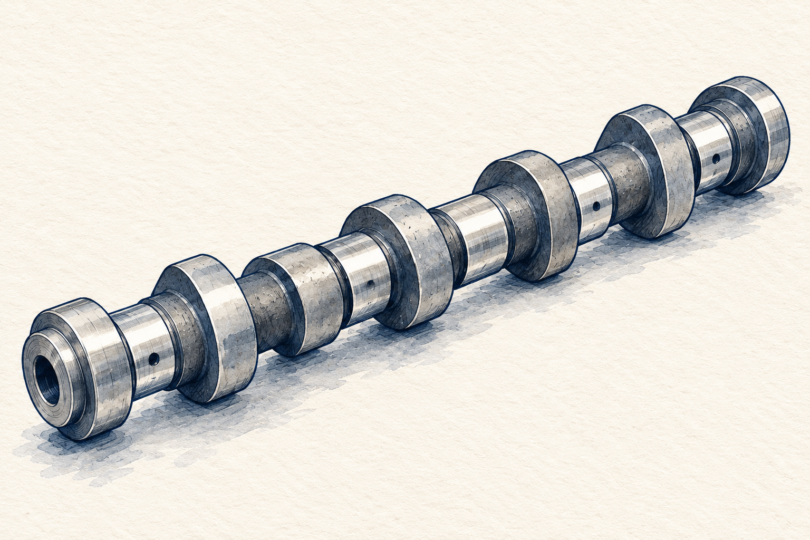
Image note: Generic camshaft illustration for a cam-selection guide; it does not depict a verified Milwaukee-Eight 114 part or establish fitment.