
For a replacement engine for a go-kart, start with the engine specified by the kart manufacturer, including its full type and shaft configuration. A Honda GX160, Honda GX200, or Tillotson TPP-212E-family engine can be a useful candidate in an approved application. None is a universal replacement simply because its displacement looks similar to the original.
This guide focuses on buying a gasoline replacement for an existing kart. The key decision is whether you can restore its documented configuration without creating a new compatibility problem. An unidentified chassis or an undocumented previous engine swap needs assessment before an engine order.
Research disclosure: We reviewed official engine specifications, product pages, and manuals on October 4, 2026. We have not installed, dyno-tested, or road-tested these engines. Recommendations are conditional buying guidance, with no claimed speed, fuel savings, or first-hand reliability results.
Three gasoline replacement options
| Engine | Verified basic specification | When to consider it | Main limitation |
|---|---|---|---|
| Honda GX160 | 163 cc, four-stroke OHV | Your kart specifies a matching GX160 configuration | Model name alone does not identify the shaft variant |
| Honda GX200 | 196 cc, four-stroke OHV | Your kart specifies a matching GX200 configuration | Do not assume interchangeability with a GX160 |
| Tillotson TPP-212E / TPP-212EE | 212 cc horizontal-shaft family; EE has electric start | The kart maker or qualified builder approves the exact configuration | Verify starting-system package, market version, and intended use |
1. Honda GX160: a focused choice for an original-specification replacement
The Honda GX160 specification page lists a 163 cc air-cooled OHV engine. Honda documents several power-takeoff configurations in this family, including straight-shaft and reduction versions. That variety makes the full engine identity important.
Why consider it: If the original kart documentation calls for a GX160, a confirmed like-for-like replacement gives you a clear specification to buy against. It avoids making a power increase the starting point of a repair.
Limits: An engine advertised for a pump or other machine is not automatically the kart version you need. Ask the supplier to confirm the full type code and drawing, rather than accepting “GX160 compatible” as the answer.
2. Honda GX200: for a chassis already approved for this configuration
Honda lists the GX200 at 196 cc with an air-cooled four-stroke OHV design. Like the smaller family member, it comes in configurations that need individual checking.
Why consider it: It belongs on the shortlist when the kart’s original specification or written manufacturer guidance names the exact GX200 type. For a repair, preserving the approved combination is a stronger reason to choose it than a larger displacement number.
Limits: Do not treat it as a guaranteed GX160 upgrade. Even a physically plausible swap still needs approval for the drivetrain, controls, clearances, and chassis. This guide does not establish that approval.
3. Tillotson TPP-212E family: compare the exact package carefully
Tillotson describes the TPP-212E as a general-purpose engine that may be used in karting subject to applicable requirements. Its separate TPP-212EE page identifies that version as electric-start. The family manual lists both at 212 cc.
Why consider it: This family is worth discussing with a kart supplier when you need a documented 212 cc replacement and want a clearly identified starting configuration.
Limits: Tillotson’s 212E page contains inconsistent starting-system wording, so have the seller confirm the supplied engine label and equipment. The European 212CE is separately identified on Tillotson’s site. Do not order a market-specific variant from a similar-looking name or photograph. Racing references do not establish suitability for a recreational chassis.
The fitment checklist that matters more than displacement
Before paying, assemble the kart model and serial number, the old engine’s identification, and the manufacturer’s replacement specification. Give the supplier or qualified kart technician this checklist:
- Engine identity: Exact model, type, revision, and market specification, with a written compatibility answer.
- Output shaft: Orientation, diameter, usable length, keyway, retaining arrangement, and rotation, checked against the intended drivetrain.
- Mounting and space: Mounting pattern, shaft height, and clearance around the seat, frame, fuel tank, intake, exhaust, and guards.
- Drive components: Compatibility with the approved clutch or torque-converter assembly. Matching shaft diameter alone does not confirm the complete system.
- Controls: Compatibility with the kart’s throttle return, stop control, and other safety provisions.
- Starting package: Which parts are included, and whether an electric-start version requires additional approved equipment.
- Support: Correct manual, service parts, warranty terms for the intended use, and a return policy covering a misidentified variant.
If the seller cannot provide the missing specifications, pause the purchase. A low engine-only quote can become poor value once incompatible accessories or an unsuitable configuration are discovered.
Compare the complete repair cost
Request a written estimate covering the verified engine, required compatible replacement parts, professional assessment, and labor. Also ask whether repairing the existing engine is practical. A diagnosis is especially useful when the kart has an unknown history; buying an engine first can leave other unresolved faults untouched.
Keep the replacement at the kart’s approved operating specification. Do not disable governors, bypass stop controls, or remove guards to make a purchase work. The Tillotson manual warns about exposed moving parts, hot components, gasoline, and exhaust. Run gasoline engines outdoors, never in an enclosed garage even with doors open.
Frequently asked questions
Is a 196 cc or 212 cc engine enough for my kart?
Displacement alone cannot answer that. Use the kart manufacturer’s approved engine specification and intended operating conditions. A recommendation based only on rider weight or a desired speed leaves crucial chassis and drivetrain questions unanswered.
Will every engine with the same shaft diameter fit?
No. Length, mounting, rotation, controls, clearances, and the complete drivetrain still need checking. Ask for confirmation against a drawing and the kart’s specification.
Should I buy electric start?
Choose it when the kart supports the complete starting system and you value that convenience. Confirm the supplied package and additional approved components before comparing total cost with a recoil-start replacement.
Where can I find the correct Honda manual?
Use Honda’s manual selector. Match the engine model and serial-number range; a manual for a similar displacement is not enough.
Bottom line: Favor a documented like-for-like replacement. Use the GX160, GX200, and Tillotson 212 family as conditional starting points, then buy only after the exact engine and kart combination has been confirmed.
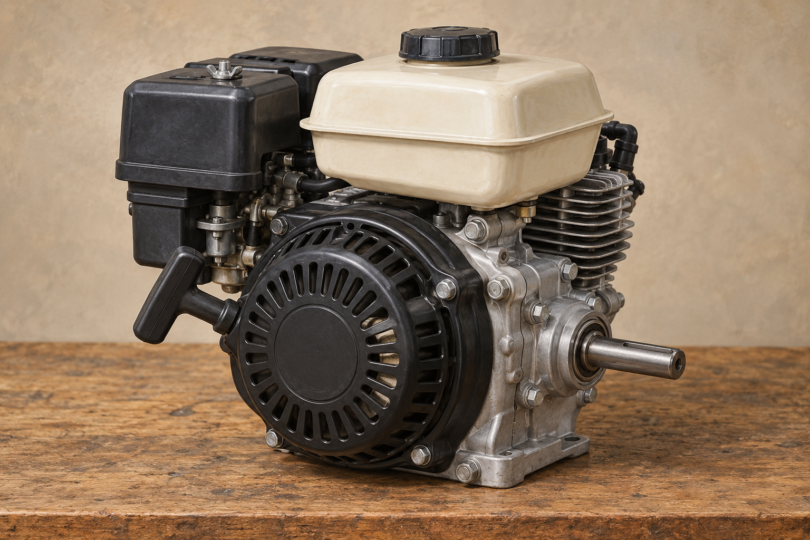
Image note: Generic editorial illustration of a small gasoline engine; no specific model, output, fitment or installation is represented.