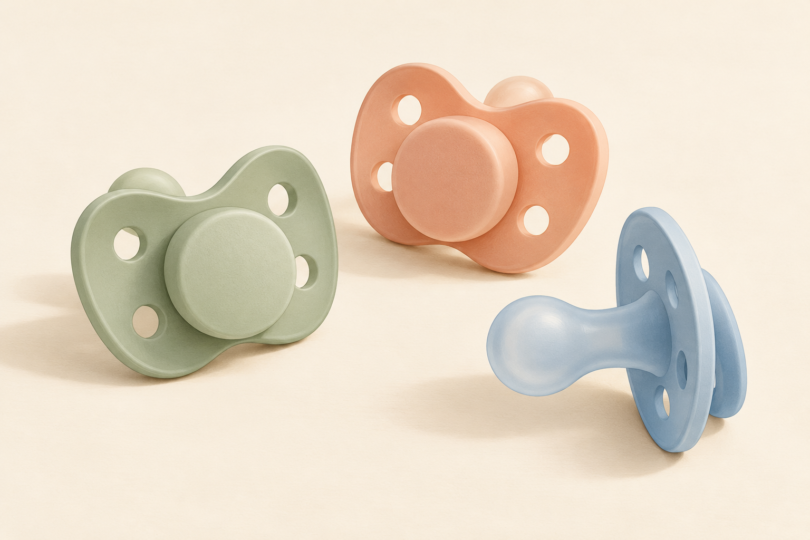

The best pacifier for a breastfed newborn is an age-appropriate model your baby accepts once feeding is going well. The Philips Avent Soothie 0–3m is a sensible first option for its simple silicone construction; Nanobébé Flexy 0–3m offers a curved shield, while NUK Comfy 0–6m provides a different nipple shape. Start with one small pack before buying backups.
Before introducing one, follow the American Academy of Pediatrics guidance: breastfeeding should be established, with a good milk supply, comfortable, consistent feeding, an effective latch and appropriate weight gain. A “0 months” product label describes its intended age range; it does not decide when your breastfed baby is ready.
Best pacifiers for breastfed newborns at a glance
| Pick | Exact version | Why consider it? | Watch for |
|---|---|---|---|
| Philips Avent Soothie | SCF190/41, green, 0–3m, four pacifiers | Simple round shield and one-piece silicone design | This is the 0–3m version, not an older-baby size |
| Nanobébé Flexy | 0–3m, Sage/White, four pacifiers | Curved shield and soft silicone nipple | Flexy Active is a different, older-baby option |
| NUK Timeless Comfy | 0–6m, assorted colors, five pacifiers | Heart-shaped shield and asymmetrical nipple | Check orientation and the age label on the delivered pack |
These picks compare documented construction, age labels and care requirements. There is no hands-on acceptance test or universal winner: a baby may prefer one shape, reject another or want no pacifier at all.
1. Philips Avent Soothie 0–3m: a straightforward first pick

Philips Avent Soothie SCF190/41, 0–3m, Green, 4-Pack
As an Amazon Associate we earn from qualifying purchases.
The SCF190/41 Soothie is a one-piece silicone pacifier with a round shield and an open back. Its simple construction makes it easy to see the nipple and inspect the surface. The selected green pack contains four pacifiers, useful if this is a shape your baby already accepts.
Choose it for a plain, uncomplicated design. The tradeoff is its short labeled age window: this specific version is for 0–3 months. The Soothie name also appears on other sizes and shield shapes, so do not assume every listing is interchangeable.
Philips’ linked Soothie instructions specify boiling for five minutes before first use, cooling fully and removing trapped water. Wash with warm water and mild soap before each use; inspect and pull the nipple in all directions. Replace at the first sign of damage or weakness, and after four weeks of use even if it looks intact. Follow the instructions supplied with your exact pack.
2. Nanobébé Flexy 0–3m: a contoured-shield option

The newborn Flexy combines a curved shield with a soft nipple in a one-piece silicone design. This Sage/White four-pack (FUS4010433) is worth considering if you want a different shield profile from the round Soothie. Fit and acceptance still depend on your baby; a contoured design is not a promise that it will stay in place.
Check that the listing and packaging say 0–3 months. Nanobébé’s Flexy Active is a separate product for older babies, with a firmer nipple and larger side openings. It is not the newborn version recommended here.
The manufacturer’s pacifier FAQ permits hot soapy water or the dishwasher’s top shelf and recommends replacement after four to eight weeks. Replace earlier if damaged, and use only the sterilizing method and cycle approved in your product instructions. Do not transfer cleaning advice for the brand’s bottles to its pacifiers.
3. NUK Timeless Comfy 0–6m: an alternative nipple shape

NUK Comfy has a one-piece silicone body, a heart-shaped shield and an asymmetrical nipple. It offers a different shape to try if a rounded nipple is not your baby’s preference. The selected Amazon listing is the 0–6-month five-pack; its product details identify model 2190570, also documented on NUK’s Comfy page.
The word “orthodontic” describes the design; it is not a guarantee of breastfeeding success or future tooth alignment. Follow the package’s orientation instructions rather than treating the nipple as reversible. This multipack makes more sense once you know your baby accepts the shape.
NUK’s care instructions specify a five-minute boil before first use, then daily washing with hot water and mild detergent followed by rinsing. Top-rack dishwashing is allowed. Let the pacifier cool, remove any retained water, inspect before each use and replace after two months or sooner if damaged.
How to choose without buying a drawer full
Put feeding and fit ahead of marketing
A pacifier is for comfort between feeds. Do not use it to postpone nursing or to quiet hunger cues. If feeding hurts, your baby struggles to latch or weight gain concerns you, ask your pediatrician or lactation professional for help before relying on a pacifier. No nipple shape in this guide is a treatment for a feeding problem.
Buy the correct age range, read the enclosed directions and check the shield and nipple before use. A bottle nipple by itself is not a pacifier. The AAP’s pacifier guide explains why loose bottle nipples and damaged pacifiers are unsuitable. A bigger pack is useful only after the shape works for your baby.
Keep sleep use simple
Offer a pacifier at naps or bedtime once breastfeeding is established, but never force it. If it falls out during sleep, leave it out. Keep strings, neck cords, clips and attached plush toys out of the sleep space. Never tie a pacifier to the baby or crib. Continue placing your baby on their back on a firm, flat sleep surface with no loose bedding; a pacifier does not replace safe-sleep practices.
Check recalls and the delivered pack
Compare the delivered brand, age label and product details with the listing, and check CPSC recalls before use. Product names can conceal important differences: the January 2022 FRIGG recall concerned Classic and Daisy silicone pacifiers. That notice should not be applied indiscriminately to every FRIGG shape or material. Stop using any product that matches a recall and follow its remedy.
Never sweeten a pacifier. The CDC warns against honey and honey pacifiers for infants because of infant botulism. Keep replacements clean and dry, and follow each brand’s replacement interval rather than waiting for a visible tear.
Frequently asked questions
Which pacifier should I try first for a breastfed newborn?
The Philips Avent Soothie SCF190/41, labeled 0–3 months, is a straightforward starting option. Nanobébé Flexy 0–3m and NUK Comfy 0–6m offer different shapes. Buy a small pack and let your baby’s acceptance guide the choice.
When can I introduce a pacifier while breastfeeding?
Wait until breastfeeding is established: feeding is comfortable and consistent, milk supply is adequate, the latch is effective and your baby is gaining weight appropriately. Ask your pediatrician or lactation professional if you are unsure. An age label alone does not establish readiness.
Will a breast-like or orthodontic pacifier prevent feeding problems?
No pacifier design guarantees a successful latch or prevents every feeding difficulty. Choose the correct age range and a shape your baby accepts. Seek feeding support for pain, poor latch or concerns about weight gain.
Can my baby sleep with a pacifier clip or plush attachment?
Keep clips, cords, ribbons and plush attachments out of the sleep space. Offer the pacifier by itself, never tie it to the baby or crib, and do not put it back if it falls out during sleep.
How often should I clean and replace a newborn pacifier?
Clean it according to its own instructions and inspect it before use. Let it cool after heat sanitizing and remove trapped water. Replace immediately for damage or weakness; the documented intervals are four weeks for Soothie, four to eight weeks for Nanobébé Flexy and two months for NUK.